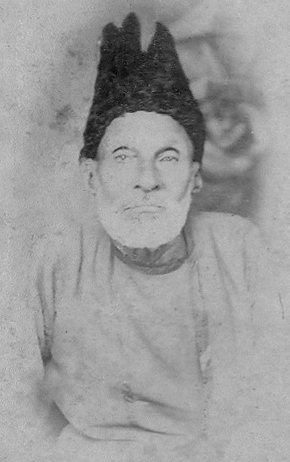
مرزا اسداللہ خان غالب
Perhaps the most quoted poet in Urdu, who wrote in Urdu and Persian and made the ghazal a home for doubt, humour and philosophy.
Life
Ghalib spent most of his life in Delhi, in a house in Ballimaran that is now a small museum. He lived through the decline of the Mughal court and the upheaval of 1857, and his letters describe that world with wit and grief.
Style and legacy
His verse is compact, paradoxical and sly, often turning a single couplet on a sudden thought. He is famous for finding the universal in private feeling, and his prose letters are read as literature in their own right.
Classic writings
Ghalib's Urdu Diwan is the core of his poetic achievement. In it he wrote ghazals on love, loss, pride, doubt and the limits of human understanding, with a sly wit and a sharp mind. His couplets often turn on a paradox: a line seems to say one thing, then reverses itself in the second half. This method allowed him to speak about big questions without losing the playfulness that readers love. The Diwan has been edited and commented on for more than a century.
His Persian verse, much of it in the form of the ghazal and the qasida, is equally important, and he regarded it as his finest work. Ghalib also wrote a famous collection of Urdu and Persian letters, which give a vivid picture of Delhi life, money troubles, friendships and his views on poetry. The letters are written with great charm and a sense of performance, and they are read today as literature in their own right.
Dastanbu is his own short account of the events of 1857, the uprising in Delhi and the siege and capture of the city. It is written with grief and precision, and it records the destruction of the old world he knew. For a reader it is an unusual document: a poet's personal report of catastrophe, with careful attention to individual lives and losses in the city he loved.
Ghalib's influence on Urdu is hard to overstate. Later poets learned from his compression, his irony and his philosophical reach. Hali's biography of him made his life known to a wide public, and his couplets moved from the study into everyday speech. Many lines are now proverbs. Reading Ghalib is a continuing conversation between the poet's wit and the reader's own experience of doubt, desire and humour.
Ghalib's letters deserve special attention. They are addressed to friends, students and patrons, and they range from money problems and illness to comments on poetry and the political events of Delhi. Their style is conversational and witty, full of self-mockery and sudden flashes of insight. The letters show that Ghalib was as much a prose stylist as a poet, and they remain one of the most readable records of the period.
Ghalib's Persian verse, though less read today by general readers, is an important part of his output. It shows a poet working in a high literary language and claiming a place among the great Persian masters of the age. The contrast between his Urdu and Persian work also reveals how carefully he thought about language, audience and the proper place of each tongue in his life.
Ghalib's humour is never far from his grief. A reader will find him joking about his poverty, mocking his own pride and then, a line later, confronting death with calm honesty. This balance is what makes him so hard to exhaust. Each rereading brings out a new layer, and his verse continues to offer company to anyone who has doubted, hoped and laughed at the same time.
Ghalib rewards patience. His Urdu divan is small but dense, and the same couplet can seem playful at first and deep on a later reading. He loved questions, paradox and a little teasing of God, fate and himself, and he often ends a verse with a turn that changes everything before it. His letters, written in a lively, conversational Urdu, are a second classic and are a gentle way into his mind and his humour. Readers new to him do well to start with a short selection with notes, then move to the full divan. His fame today rests on this mixture: difficult ideas, spoken with an easy, human voice, which is why his lines are still quoted in conversation, songs and films.
Read Mirza Asadullah Khan Ghalib (32)
Known works
Researched from published sources; the text is our own. Ghalib's house in Ballimaran is pictured on the sanctuary page.