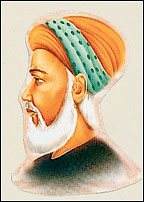
مرزا محمد رفیع سودا
A master of the qasida and of satire, who wrote for patrons across northern India.
Life
Sauda served several noble patrons and moved between cities as courts rose and fell. He wrote in many forms, but his name is linked above all to the qasida, the long poem of praise, and to the sharp satire of the hija.
Style and legacy
His language is rich and formal, with a fondness for wordplay. Critics have praised his control of form, while his satire is among the most vivid in eighteenth century Urdu.
Classic writings
Sauda's reputation rests on the qasida, the long poem of praise addressed to a patron, and on the hija, the satirical verse that attacked enemies and rivals. In the qasidas, he shows a command of rhetoric, a taste for rich description and a wide vocabulary drawn from Persian and Arabic. His poems on the rulers and nobles of his time are rich in court detail, and they are read today as documents of courtly life as well as literary showpieces.
His satires are the most lively part of his work. He could be merciless, and he used wit, insult and clever wordplay to expose the vanity of rivals. Some of his satirical poems were so sharp that they were repeated in the bazaars of Delhi. These pieces show a poet who enjoyed the energy of argument and who understood how verse could travel quickly through a city's conversation.
Sauda also wrote ghazals, and his ghazals show the same love of craft. He experiments with forms, rhymes and images, and he is often praised for a precise, ornate style that delights the ear. Where Mir's ghazals feel close to a sigh, Sauda's can feel like a finely cut jewel. Both styles coexisted in the Delhi of his day, and the contrast helped shape the debates that later poets carried into the nineteenth century.
The lasting value of Sauda's work lies in its variety. He moved between praise, satire and love poetry with apparent ease, and he left a model of technical skill that later writers studied. Students of Urdu often read him to understand how the qasida and the hija developed, and how a poet could balance the demands of patrons with a sharp personal voice. His poems remain a useful guide to eighteenth century Delhi.
Sauda's qasidas show the poet working in a world of patrons, festivals and public speech. He had to please his audience while also displaying learning and skill, and his solution was to fill each poem with dazzling diction, careful metre and rich comparisons. A reader today can see the effort, but also the pleasure he took in showing what the language could do when pushed to its limit.
His satire is also a record of the manners of the time. Through the attacks on rivals, we glimpse the rivalries of poets, the fashions of the city and the small vanities of courtiers. The humour is not always gentle, and the verses can be harsh, yet they give historians and readers a lively picture of the literary quarrels that shaped Delhi's world of letters.
Students often compare Sauda with Mir to see two different strategies in eighteenth-century Urdu. Where Mir reaches for the simple and the felt, Sauda reaches for the ornate and the dazzling. Reading both side by side shows how the language was tested in two directions at once, and why both approaches remained admired for generations.
Sauda is often read for his range. Besides the ghazal he is remembered for the qasida, the formal poem of praise, and for satire, where his wit is sharp and sometimes merciless. His satires show a lively, observant mind that noticed the habits of the people and courts around him. That mix of high rhetoric and quick humour sets him apart from his gentler contemporaries. A newcomer can enjoy him by pairing a few of his ghazals with a short satirical piece and seeing how the same poet changes voice. His strong, confident diction also shows how far Urdu poetry had come in the eighteenth century, when it was becoming a polished literary language in its own right, ready for every mood from praise to mockery.
Read Mirza Muhammad Rafi Sauda (32)
Known works
Researched from published sources; the text is our own.