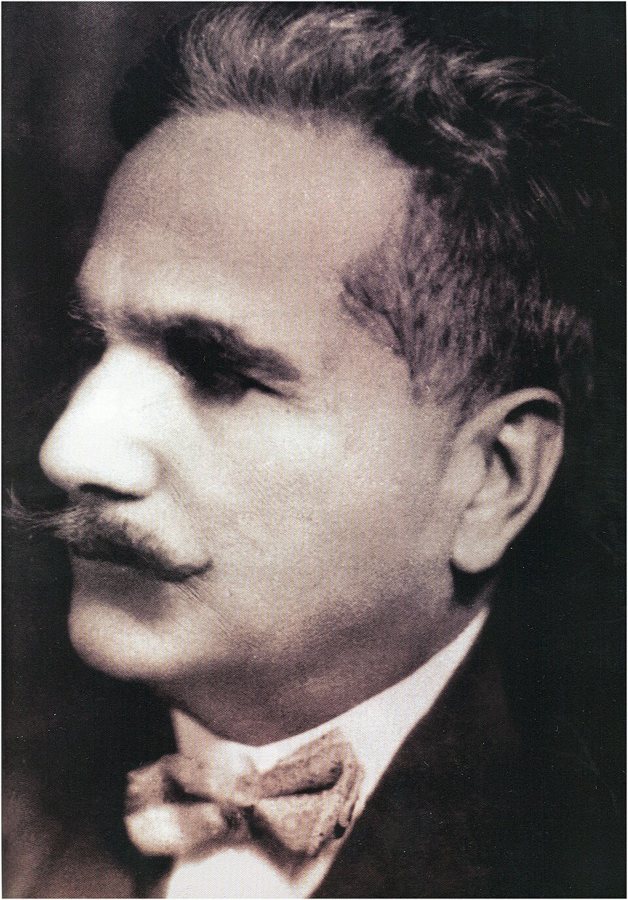
علامہ محمد اقبال
The poet-philosopher who wrote in Urdu and Persian and whose verse shaped the idea of Pakistan.
Life
Iqbal studied in Lahore and in Europe, where he trained in philosophy and law. He returned to Lahore to write, lecture and practise law, and his poetry in Urdu and Persian grew into a major philosophical voice of the twentieth century.
Style and legacy
His Urdu verse mixes philosophy with passionate calls to self-respect, faith and action. Many of his poems were recited at public gatherings, and his name is honoured in Pakistan as the national poet, and across South Asia as a major writer.
Classic writings
Iqbal's Urdu poetry covers a wide range, from early nazms on nature and childhood to later philosophical poems on selfhood, action and faith. His early work is lyrical and patriotic, celebrating India and its rivers and mountains. The later work is more philosophical and more forceful, calling readers to renew their inner strength and to take responsibility for their communities.
Bang-e-Dara, the first major collection, gathers many of his best-known nazms and ghazals from the period before his European years. It shows a poet confident in his craft, moving from simple scenes of nature to larger questions of time, death and national life. Many of its poems have been memorised and recited for generations.
Bal-e-Jibreel and Zarb-e-Kalim, which followed, are sharper and more political. They address the situation of colonised peoples, the failure of the West's materialism and the need for a spiritual awakening. Iqbal's language mixes Urdu and Persian with great skill, and his imagery is dramatic, using eagles, mountains, rivers and the self.
Iqbal's influence is very large. His poems were read as a call to action in the years before Partition, and he is honoured in Pakistan as the national poet, while in India his early nationalist verse remains widely loved. Students of philosophy and of Urdu poetry alike return to him, and his work continues to provoke debate about faith, freedom and selfhood.
Iqbal's Persian verse, which he regarded as his most important poetry, runs alongside the Urdu work and supports the same themes. His long poems use dialogue, dream visions and mystical imagery to explore the relationship between the individual and the community, and between the human self and the divine. Readers who know both languages often see the Urdu poems as a more accessible door into the same world.
Iqbal's language is grand but not empty. He invents striking images, uses a rich vocabulary from Persian and Arabic and builds long, rhythmic lines that carry a sense of urgency. His poems were memorised and recited in schools, public meetings and private gatherings, and they gave a generation a language for self-respect and for hope.
Iqbal's poems can be read as a sequence of responses to the questions of his time: how a people can recover their confidence, what the self is for, and how faith relates to action. Reading the Urdu collections in order shows how his thinking grew from lyric nature poetry to a fierce, prophetic voice, and how his images changed with it.
Iqbal's later poems address the young, asking them to take responsibility for their own future and to reject passivity. The tone is prophetic and urgent, and the poems use symbols such as the eagle, the mountain and the river to express the energy he wished his readers to recover.
Iqbal can be read at three levels. First are his short, stirring poems such as the children's verses and the famous song of the subcontinent, which people learn early and carry for life. Then come his larger Urdu collections, with their themes of selfhood, effort and awakening. Finally there is his work in Persian, where he developed many of his philosophical ideas. He also wrote a well-known set of lectures in English on the reconstruction of religious thought. A new reader should choose a short selection, keep an annotated edition nearby, and remember that his ideas have been argued over by readers of many opinions. What nearly all admire is his command of rhythm and his gift for putting large ideas into memorable lines.
Read Allama Muhammad Iqbal (32)
Known works
Researched from published sources; the text is our own.