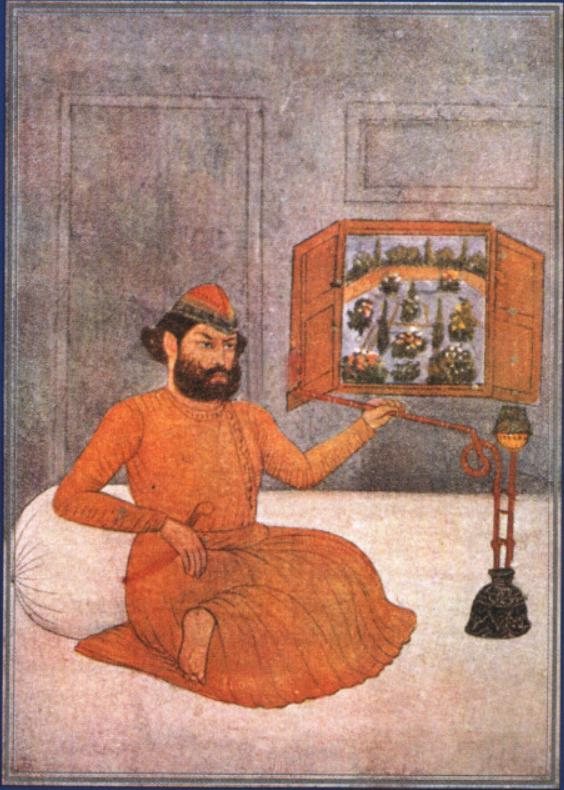
میر تقی میر
The poet many Urdu readers call the first great master of the ghazal, and whose verses still open most anthologies.
Life
Mir was born in Agra and moved to Delhi as a young man, where the city's courts and mushairas shaped his early work. Hard times, a long illness and the decline of Delhi's courts marked his later years, and his self-written autobiography describes that life with striking candour.
Style and legacy
Mir's ghazals are known for plain, grief-touched language and a voice that feels close to the reader. Later poets, including Ghalib, held him in high regard, and his place as a model of feeling in the ghazal has lasted for more than two centuries.
Classic writings
Mir's best-known prose work is his autobiography, usually called Zikr-e-Mir, in which he looks back over his life in Agra and Delhi. It is unusual for its time because it speaks in the first person about grief, poverty, family losses, illness and the slow decline of the city he loved. Where many writers of the period praised patrons, Mir tells the reader what he felt, and the book reads like a conversation with someone who has lost much.
His Kulliyat, the collected verse, is the main body of his work. It contains ghazals, qasidas, masnavis and shorter pieces in Urdu and Persian. The ghazals are the centre of his fame. He writes in plain, almost spoken language, using simple images of gardens, wind, dust, the lamp and the broken heart. The effect is grave and tender, and it made the ghazal feel like a direct human utterance rather than a display of learning.
Mir's themes return again and again to love that brings suffering, to the transience of life, to the cruelty of a beloved who does not answer, and to the dignity of a poor man in a world that has forgotten him. He often writes about his own body and health, and about the small comforts he can still enjoy. This personal frankness is part of why later poets, from Ghalib onward, held him in such high regard.
In the long term, Mir shaped how Urdu poets think about feeling. He showed that a short couplet could hold an entire life, and that a poem did not need elaborate ornament to be moving. Anthologists still begin many collections with him, and readers come back to his autobiography as one of the earliest sustained self-portraits in the language. Reading him slowly, one notices how much craft lies under the apparent simplicity.
Reading Mir alongside his own account of his life gives a particular pleasure. The autobiography shows how a poet's craft and a poet's history are bound together. The small details of lodging, friends, and the passing of seasons turn into a record of a whole culture in decline, and yet the voice never becomes self-pitying for long. Mir keeps a dry humour even in the bleakest pages, and that humour makes the sorrow easier to bear for the reader.
His couplets also teach a lesson in economy. A single line may hold a whole scene: a traveller, a closed door, a wind over the dust of a ruined street. Students of the ghazal are often asked to memorise Mir for exactly this reason, because his compression shows how much a few words can carry when the feeling behind them is honest and the form is handled with care.
A reader who wants to hear Mir's tone can start with the autobiography and then move to the ghazals. The contrast is instructive: the prose is talkative and digressive, while the verse is concentrated and grave. Together they give a fuller picture of a man who wrote about his suffering with a wry, unsentimental dignity that many later poets tried to imitate.
A good way to read Mir is slowly, a few couplets at a time. His six divans are large, and the famous lines are scattered through them like small lamps, so a selection with plain explanations is the kindest place to begin. Notice how often he speaks in the simplest words, a heart, a street, the night, and lets the feeling arrive without ornament. Many readers say his sadness never turns into self-pity; it stays dignified, almost gentle. Later poets, including Ghalib, spoke of Mir with real respect, and that praise has lasted. If you read only one poet to feel what the early Urdu ghazal could do with ordinary speech, Mir is a sound choice, and his couplets repay a second and third reading.
Read Mir Taqi Mir (32)
Known works
Researched from published sources; the text is our own.