Content note Political themes; family conflict.
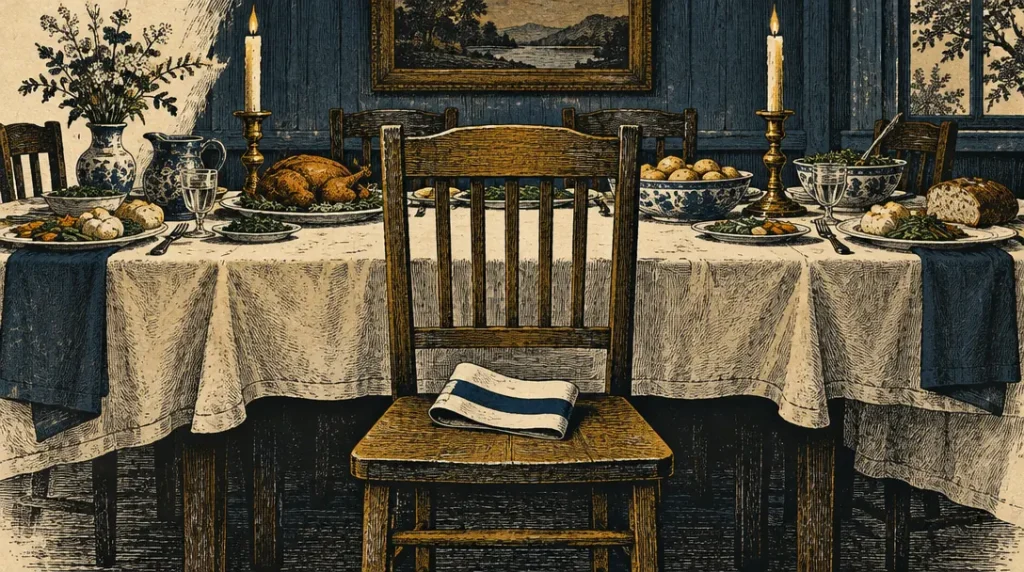
My brother came home on a Sunday wearing an orange armband, and my mother set an extra plate at the table without a word, as if he were a guest.
He was twenty-two. Until that spring, Miguel had been the kind of young man who forgot to pay his phone bill and could fall asleep anywhere, including once, memorably, standing up at a wedding. He had dropped out of his engineering course after the second year. He worked shifts at a call centre and spent his nights playing games online with strangers from four continents. He was funny and lazy and kind to old people and dogs. He was not, as far as any of us knew, interested in anything except sleep.
Then the Volunteers found him.
They were everywhere that year — young people in orange armbands, organising clean-up drives, handing out rice in poor districts, standing outside train stations with clipboards and smiles. The movement had won the last election by a landslide, and the Volunteers were its hands and feet. Officially, they were a youth service organisation. They planted trees and painted schools. Unofficially, everyone knew they also kept lists.
“I have a purpose now,” Miguel said at dinner, helping himself to rice. “For the first time in my life, I’m part of something.”
My father kept eating. He had been a schoolteacher for thirty years, and he had a way of chewing that could communicate an entire paragraph of disapproval.
“That’s good, anak,” said my mother carefully. “What kind of something?”
He told us. The meetings in the community hall every Thursday. The older boys who had taken him under their wing and told him he had talent, that he was a leader, that the country needed young men like him. The trips to the provinces to “listen to the people.” The certificate he’d received for distributing two thousand food packets in a week. He showed us photographs on his phone: Miguel in orange, grinning, arm-in-arm with other young men in orange, in front of a banner with the movement’s slogan in letters three feet high. One Nation. One Heart.
He looked happy. That was the hardest part. I had not seen my brother look that happy since he was nine years old and got a bicycle for Christmas.
“And what do you do,” I asked, “on the trips? When you listen to the people?”
He shrugged. “We talk to them. We see what they need. We write down who’s supportive and who’s not.”
“Why do you write that down?”
“So we know who needs more help,” he said, as if it were obvious. “Some people have been confused by bad information. We help them understand.”
My father put down his fork.
“Your Tito Ramon,” he said quietly. “Would you write him down?”
Tito Ramon was my father’s oldest friend, a retired journalist who still wrote a weekly column for a small newspaper. His columns had become sharper that year, and the newspaper had become smaller. Two months earlier, someone had thrown paint at his front door.
Miguel’s face changed. Just slightly. A flicker.
“Tito Ramon is different,” he said. “He’s family.”
“Everyone on your list is somebody’s family,” my father said.
Nobody spoke for a while. The ceiling fan turned. A dog barked somewhere down the street. My mother got up to fetch more water that no one needed.
“You don’t understand,” Miguel said finally, and his voice was not angry, just tired, the way it had been when he dropped out of school. “Nobody ever asked me to be anything. Not teachers, not bosses, not you. They ask me. They need me. When I walk into the hall on Thursday, people are happy to see me. Do you know what that feels like?”
And I realised, with a terrible sinking feeling, that I did not. That none of us had ever asked. We had loved him the way you love the weather — a fact of the house, a sleeping shape on the sofa. We had never once told him he was needed.
After dinner, I found him on the roof, where we used to sit as kids to watch the planes come in over the bay. He was holding the armband in his lap, turning it over in his fingers.
I sat beside him. For a long time neither of us said anything.
“Do you remember,” I said, “when you were twelve and you fixed Lola’s radio?”
He laughed a little. “With a paperclip and chewing gum.”
“She listened to it every day until she died. She told everyone her grandson was a genius. An engineer.”
He was quiet.
“You don’t need an armband to be needed, Miguel,” I said. “You’re already needed. We just never said it. That’s on us, not you.” I swallowed. “But I need to know you won’t write down Tito Ramon. Or anyone like him. I need my brother more than they need another name on a list.”
The planes came in over the bay, their lights blinking red and white. Miguel watched them for a long time.
He didn’t throw the armband away that night. Things are not so simple, and I won’t pretend they were. He went to the hall the next Thursday, and the Thursday after that. But something had changed. He started coming home earlier. He started asking my father about engineering colleges that took students back after a break. One evening he spent four hours on the roof with Tito Ramon, who had come for dinner, arguing passionately about everything under the sun, and when Tito Ramon left, he hugged my brother at the gate for a long time.
The armband lives in a drawer now. Miguel goes to night classes. He is in his third year again.
Last month, Tito Ramon’s paper ran a column about young people and the hunger to belong. It was gentle and wise and did not name anyone. At the bottom, in small letters, it thanked “a young friend, who reminded me that every movement begins with someone who simply wanted to be asked.”