The letter arrived on a Monday, which Mr. Tunde Bakare later felt was appropriate. It was printed on official paper with a crest at the top, and it informed him, with deep regret, that he had died on the fourteenth of March.
“Your pension has therefore been discontinued,” it went on. “Please accept the condolences of the Office of Retired Persons. Kindly return any pension book in your possession within thirty days.”
Mr. Bakare read it twice, then handed it to his wife, Bisi, who read it three times and then looked at him across the breakfast table, carefully, as if checking.
“You look well,” she said.
“I feel well,” he said. “For a dead man.”
He had taught mathematics for thirty-eight years. He believed in systems. A system had made a mistake, and a system, he reasoned, could correct one. So on Tuesday he put on his good grey suit, took the bus into the city, and joined the queue at the Office of Retired Persons.
The clerk at the window was young and bored and had a small radio playing near her elbow. Mr. Bakare slid the letter under the glass.
“There has been an error,” he said. “I am not dead.”
She looked at the letter. She looked at him. She typed something.
“The system says you are dead, sir.”
“Yes. That is the error.”
“The system does not make errors,” she said, kindly, as though explaining something to a child. “The system is computerised.”
“But I am standing here.”
She considered this. “Anybody can stand here,” she said. “To be alive, you must have a Certificate of Existence.”
The Certificate of Existence was issued by the Office of Civil Records, on the other side of the city. To obtain it, Mr. Bakare needed his birth certificate, two passport photographs, a letter from a local official confirming his residence, and a sworn statement from two living witnesses who had seen him alive within the last six months.
“My wife sees me every day,” he said.
“Is she a relation?”
“She is my wife.”
“Relations cannot witness,” the clerk said. “They are biased.”
So Mr. Bakare went to his neighbours. Mr. Okafor, who sold phone credit from a kiosk at the corner, was happy to swear that he had seen Mr. Bakare alive, and in fact had seen him that very morning, buying bread. Mrs. Adebayo from the third floor was also willing, but asked first whether being a witness would affect her taxes.
The Office of Civil Records accepted the sworn statements, the photographs and the residence letter. They looked for a long time at his birth certificate, which was yellow and soft at the folds.
“This document is very old,” said the officer.
“So am I,” said Mr. Bakare. “That is how pensions work.”
The officer stamped everything and told him to come back in six weeks.
In six weeks he came back, and the Certificate of Existence was not ready, because the officer who signed Certificates of Existence was on leave. In eight weeks it was not ready because there had been an audit. In ten weeks the officer apologised: the system would not issue the certificate, because the system showed that the applicant was deceased.
“But that is why I need the certificate,” said Mr. Bakare. “To prove that I am not.”
“I understand, sir. But the system cannot certify the existence of a dead person. It would be fraud.”
Mr. Bakare went home and sat on the balcony with a pencil and an exercise book, the way he used to sit when a difficult problem kept him awake. He drew boxes and arrows. The Office of Retired Persons needed the Certificate. The Office of Civil Records needed the system. The system needed the Office of Retired Persons to say he was alive. It was a perfect circle. He admired it, in a way. He had once spent a whole term teaching circles to boys who would rather have been playing football.
“You could go to the newspaper,” Bisi said.
“The newspaper prints obituaries,” he said. “I already have one of those.”
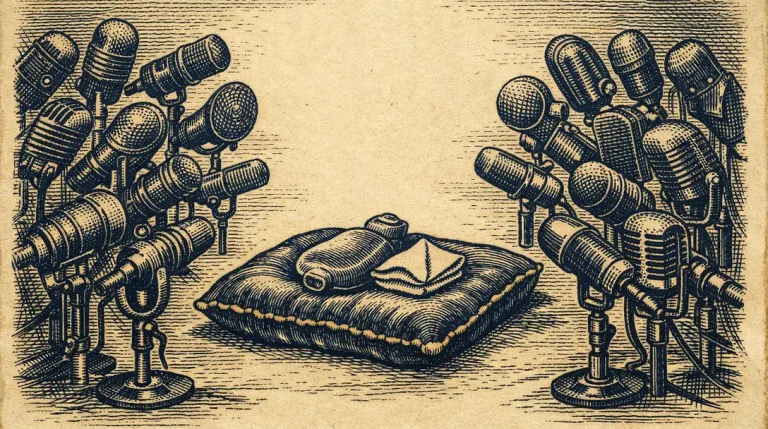
In the end it was his former students who saved him. One of them, Kemi, now worked at a radio station, and she invited him onto her morning programme. “Today we speak with a dead man,” she announced, “who taught me fractions.”
He told the story calmly, the way he’d explain long division. He did not shout. He did not name anyone. He simply described each office and each form and each circle. By the end of the hour the station’s phone lines had collapsed. People called from all over the country. A woman in the east had been dead for two years. A farmer in the north had been dead since the last census, and had married, buried a cousin and raised three goats in the meantime. A young man had been declared dead at nineteen and wanted to know if he could still get a driving licence.
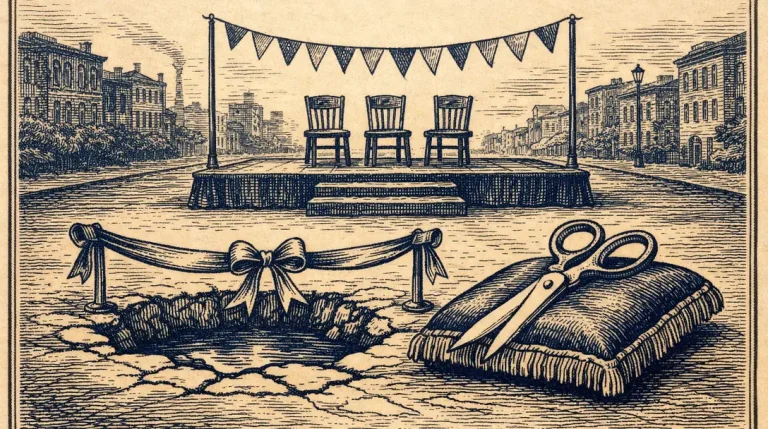
Two weeks later, a car with an official flag arrived outside Mr. Bakare’s building. A deputy director climbed the stairs, sweating, and presented him with a Certificate of Existence in a plastic folder, along with a cheque for his missing pension and a press photographer.
“The system has been updated,” the deputy director said, shaking his hand for the camera. “We are glad you are with us.”
“So am I,” said Mr. Bakare.
That evening he framed the certificate and hung it in the hallway, beside his teaching diploma and a photograph of Bisi at twenty.
“Is it really so important?” she asked.
“It is the only official document,” he said, “that says I am not finished.”
Every morning now, on his way out to buy bread, he touches the frame lightly with one finger, the way some people touch a doorpost for luck. Then he goes down the stairs, alive, in triplicate.