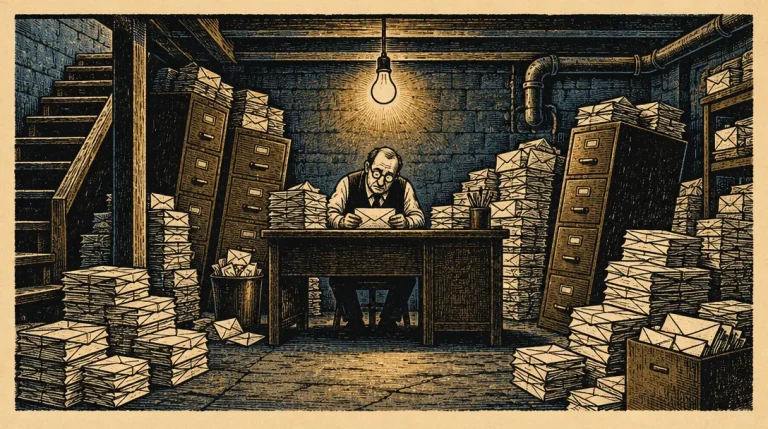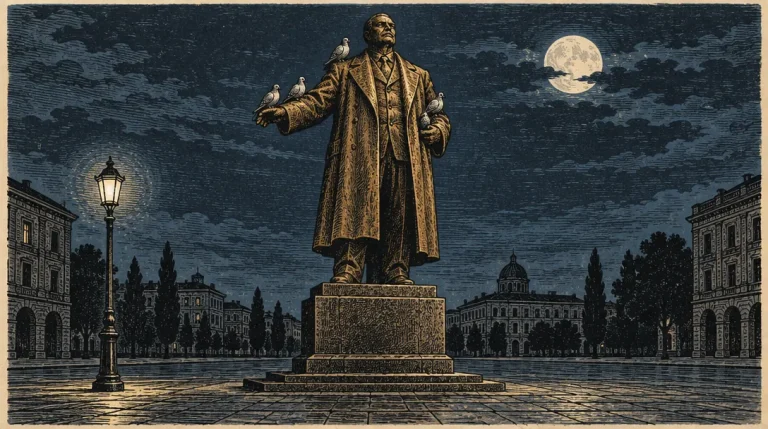
The order came on a Thursday: ten thousand flags by Monday, for the spontaneous celebration.
“Spontaneous,” said Marisol, reading the paper the supervisor had pinned to the wall. “With a delivery date.”
“Don’t,” said Ana at the next machine, without looking up. “Not today.”
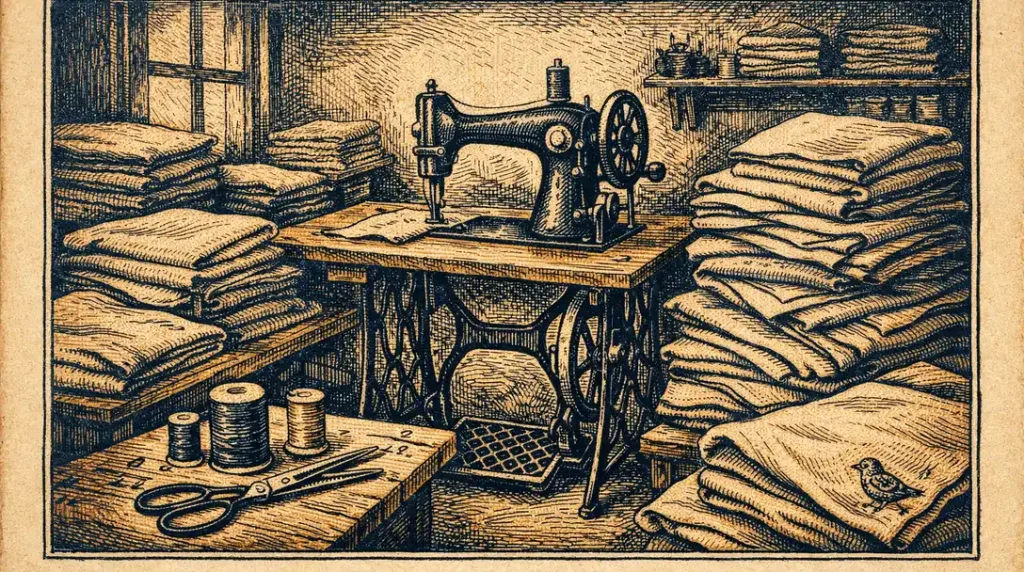
The factory sat at the edge of the city, where the bus routes gave up and the road turned to gravel. It made everything that needed to be waved: flags for parades, flags for elections, flags for the opening of bridges and the closing of bridges. Marisol had worked there for nineteen years. In that time she had sewn the flag of the country in three slightly different designs, as the Leaders changed and the shade of blue was adjusted each time to mean something new.
This time the flags were small, the size of a schoolbook, on thin wooden sticks. Children’s flags. They would be handed out at the stadium on Monday, where crowds would gather to celebrate the Leader’s birthday, his great love for the people, and the people’s great, unscheduled love for him.
The supervisor, Don Ernesto, walked the rows with his clipboard. He was not a cruel man. He was a tired man who had been told numbers by other tired men, and who had a daughter at university and a mother with bad lungs.
“Ten thousand,” he said, stopping at Marisol’s machine. “If we don’t make it, they’ll give the next order to the factory across the river. And the one after that.”
“We’ll make it,” Marisol said.
They worked through Thursday night. The machines hammered like rain on a tin roof. Blue cloth, white cloth, the gold star in the middle, which had to be sewn on separately and perfectly centred, because a crooked star had once cost a man his job. Marisol’s fingers knew the pattern so well she could have done it asleep, and around three in the morning she nearly did.
On Friday afternoon, the radio in the corner played the official song of the celebration. A children’s choir sang about the sunrise in the Leader’s eyes. Ana hummed along without meaning to, then stopped, embarrassed.
“It’s catchy,” she said. “That’s the worst part.”
On Saturday, the electricity went out for four hours, as it did in that district most weekends, and they sat in the dark eating bread and talking about their children. Ana’s son wanted to be an engineer. Marisol’s daughter wanted to leave the country. Neither of them said what they thought about either wish.
When the power came back, Marisol began to sew differently.
It was a very small thing. On the white stripe of each flag, on the back where no one would look, she began to sew a single stitch of red thread. Just one. A dot, hardly bigger than a grain of rice.
Ana noticed on the second hundred.
“What are you doing?”
“Nothing,” said Marisol.
“That’s not nothing. That’s red.”
Marisol kept sewing. “When I was a girl,” she said, “my father took me to a celebration like this. He held me on his shoulders. I waved a flag until my arm hurt. On the way home he told me to throw it in the river. I asked why. He said, ‘So you remember you were the one holding it.'”
Ana was quiet for a long time. The machines kept hammering. Then she reached into the box of thread, took out a spool of red, and threaded her own machine.
By Sunday night, the whole row was doing it. Nobody discussed it. It went down the line the way a yawn goes round a room. Women who had not spoken to each other in years over some old quarrel about overtime passed the red spool between them without a word. Even Don Ernesto, walking the rows at midnight, picked up a finished flag, turned it over, saw the dot, and stood holding it for a long moment.
Marisol watched him. Everyone watched him.
He set the flag down carefully in the box, on top of the others, and wrote 10,000 — complete on his clipboard, and went to his office and closed the door.
On Monday morning, the trucks came. The flags went to the stadium. On television that afternoon, Marisol watched the crowd: thousands of people in the stands, children on shoulders, the great sea of little blue-and-white flags rising and falling as the Leader waved from a balcony and the choir sang about sunrise.
Nobody in the stadium could see the red dots. They were too small, and on the wrong side. That had never been the point.
The point was that ten thousand people were holding something that had been made, in secret, by people who remembered. That every flag waved for the cameras carried, folded into its back, one small stitch of a different opinion.
That evening, Marisol took the bus home with Ana. As they crossed the bridge, Ana opened her bag and took out a flag she had kept — the last one from the box, with its tiny red dot.
She held it up for a moment in the window, against the orange light.
Then she slid the window open and let it go, and they both watched it tumble, blue and white, down toward the brown river, turning over and over, so that for an instant, just once, the red dot faced the sky.