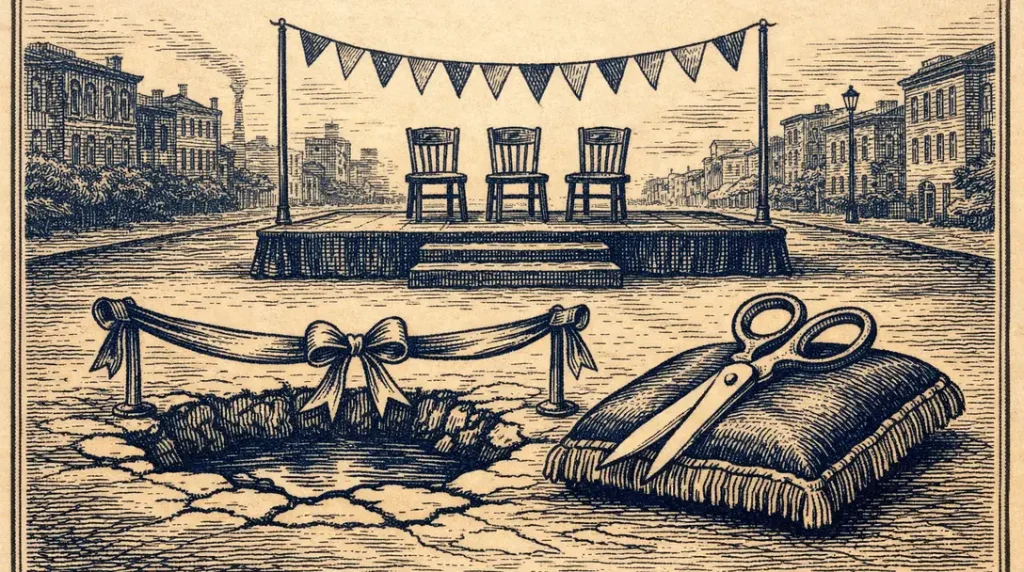
I want to tell you about the pothole, because if I don’t write it down, nobody will believe me, including my future self.
It lived outside our building for four years. It began as a crack, the way most disasters do, and grew a little every monsoon until it was big enough to have a personality. The children called it Uncle. Auto drivers swerved around it with the reverence usually reserved for temples and sleeping cows. Once, a delivery boy’s scooter went in up to the headlight and he climbed out shouting, holding a pizza box above his head like a lifeguard holding a baby.
We complained, of course. My father wrote letters. My neighbour Mrs. Fernandes filed complaints on the municipal website, which replied each time with a cheerful automatic message: Your concern is important to us. Ticket closed. One year, somebody planted a small banana tree in it. It did quite well.
Then, last month, a man in a white shirt came with a measuring tape and a clipboard, and the whole street went quiet, the way a classroom goes quiet when the principal walks in.
“Is it finally being fixed?” I asked him.
“It will be inaugurated,” he said.
I thought I had misheard.
Two days later the posters went up. They covered the walls of our street, our building, and, for some reason, the side of a parked truck that didn’t belong to anyone. They showed the face of the local representative — smiling, enormous — and underneath, in gold letters: ROAD DEVELOPMENT INITIATIVE — PHASE ONE. Below that, in smaller letters, the date and time.
On the morning of the inauguration, a stage appeared beside the pothole. A real stage, with a red carpet, a podium, a row of white plastic chairs, two speakers the size of refrigerators, and a large ribbon stretched across the pothole itself, held up by two bamboo poles. A man was testing the microphone: Hello, hello, check, check, one, two, development.
The whole street came out. Not because anyone was impressed, but because nothing this ridiculous had happened in our neighbourhood since the time the same representative had distributed free calendars with the wrong year printed on them.
At eleven, a convoy arrived: four white cars, a police jeep, a van full of photographers, and a small truck carrying exactly one bag of asphalt. The representative stepped out, waved, and was garlanded by people I had never seen before, who left immediately afterwards in the van.
The speeches lasted an hour and ten minutes. I timed them. The first speaker thanked the representative for his vision. The second speaker thanked the first speaker for his thanks. The representative spoke about the nation’s journey, the dreams of our children, the importance of infrastructure in the modern age, and, briefly, about his own childhood, which he said had also contained potholes, so he understood our pain.
Mrs. Fernandes, standing beside me, muttered, “Then why did he leave it for four years?”
A man in sunglasses turned to look at her. She smiled at him sweetly and fanned herself with a poster.
Then came the big moment. The representative was handed a pair of oversized golden scissors. The photographers crouched. He cut the ribbon. It fell into the pothole. Applause. A drum played. Two workers stepped forward, poured the bag of asphalt into the hole, and patted it down with shovels while the representative held one shovel handle for the photograph, not quite touching the ground.
The pothole was filled. The whole procedure took four minutes. The convoy left. By evening, the stage was gone, the chairs were gone, and the posters were already peeling in the heat.
That night, it rained.
You already know what happened. By morning, Uncle was back — exactly as he had been, as if he’d only gone out to buy cigarettes. The asphalt lay in a sad black puddle at the bottom. The ribbon, which no one had removed, floated on top like a red flag of surrender.
But here is the part I actually want to tell you about.
The next evening, my father came home with a bag of cement he had bought with his own money. Mrs. Fernandes brought sand. The man from the tea stall brought a bucket of water and his nephew. The delivery boy whose scooter had once gone in up to the headlight showed up uninvited, rolled up his sleeves, and refused to explain himself. Even the children helped, mostly by getting in the way and naming each new layer.
We worked until midnight under the streetlight. Nobody gave a speech. Nobody cut a ribbon. Nobody took photographs, except me, on my phone, which is how I know it happened.
It held. It is still holding as I write this, three monsoons later. You can see a small patch on the road, a slightly different colour from the rest. The children scratched their initials into it while it was wet.
Last week, new posters went up on our street. ROAD DEVELOPMENT INITIATIVE — PHASE TWO. The same smiling face. The same gold letters.
My father looked at the poster for a long time, then went inside and checked how much cement was left.