For eleven years, Celine translated the Leader into the second language of the country, and for eleven years she lied a little in every sentence.
It was not her idea. It was simply understood. On her first day at the State Broadcaster, her supervisor had sat her down in the narrow glass booth above the studio and explained the job in a voice so gentle it was almost tender.
“The Leader speaks from the heart,” he said. “Sometimes the heart is impatient. Your job is to translate the meaning, not the impatience.”
So when the Leader said, “Those who complain about the price of bread are enemies of progress,” Celine said, into her microphone, for the hundreds of thousands who listened in the second language: “The Leader understands concerns about the cost of living and is committed to progress.”
When the Leader said, “The journalists who write such things will learn a lesson,” she said, “The Leader values a responsible press.”
When he said, “Let them leave if they don’t like it here,” she said, “The Leader welcomes all citizens.”
She was good at it. Better than good. She had a gift for finding the soft word inside the hard one, the way a cook finds the tender meat under a tough skin. Her supervisor praised her. She was given a small raise and a parking space and, one year, a framed certificate for Excellence in National Communication, which her mother hung in the kitchen next to the calendar.
Her mother listened to every broadcast in the second language. She was proud. She would call afterwards and say, “He sounded so reasonable tonight. You made him sound so kind.”
“That’s my job, Maman,” Celine would say, and hang up, and sit for a while in her car in the dark parking space before driving home.
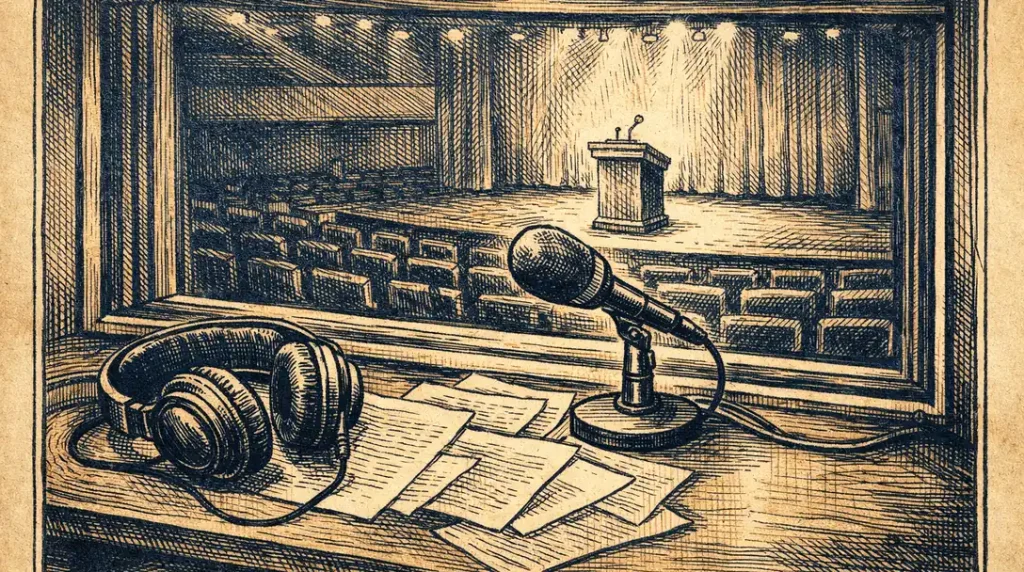
The night it happened was ordinary. A televised address about the economy, the kind the Leader gave every few months, with a flag behind him and a glass of water he never drank. Celine settled into the booth, adjusted her headphones, and opened her notebook, where she kept a list of useful soft phrases. Committed to dialogue. Values the concerns of. Continuing efforts toward.
The Leader began as usual. Growth, stability, the great achievements of the past year. Celine translated smoothly, barely thinking.
Then, twenty minutes in, he put down his notes.
“And to the people of the river districts,” he said, “who have been marching, who have been making noise, who think they can embarrass this government in front of the world —”
Celine’s pen hovered over her notebook. The Leader acknowledges the river districts —
“— let me say this clearly. You will be dealt with. Your water will wait. Your roads will wait. Your schools will wait. Everything you ask for will wait, until you remember how to be grateful.”
The river districts were where her mother lived. Where Celine had grown up. Where the tap water came out brown and the school had lost its roof two winters ago and the marchers had carried nothing more dangerous than buckets.
She looked down at the studio through the glass. The Leader, small from up here, speaking into the bright camera. The technicians at their consoles. Her supervisor in the corner, arms folded, not listening at all, checking something on his phone.
She thought of her mother in her kitchen, listening, leaning toward the radio. He sounded so kind tonight.
Celine took a breath. And for the first time in eleven years, she translated exactly.
“You will be dealt with,” she said into the microphone, in the second language, slowly and clearly. “Your water will wait. Your roads will wait. Your schools will wait. Everything you ask for will wait, until you remember how to be grateful.”
Her voice did not shake. That surprised her. It was the voice she used for everything — calm, warm, practised — and in that voice the words sounded worse than they had in his. They sounded exactly like what they were.
She kept going. Every sentence. She did not add anything. She did not take anything away. She did not make anything soft or hard. She simply let the Leader speak, at last, to the people who had been listening to her version of him for eleven years.
It took her supervisor four minutes to notice. Then he looked up from his phone with the expression of a man who has just felt the floor tilt.
He burst into the booth as the Leader was finishing. “What are you doing?”
Celine took off her headphones and laid them on the desk.
“My job,” she said. “You told me to translate the meaning.”
They escorted her out of the building that night. They took her parking pass and her keycard and, she found out later, removed her certificate from the wall of the staff corridor where a copy had hung. She drove home through streets that looked exactly the same as they had that morning, because it had been an ordinary night for everyone else.
Except it hadn’t.
When she got home, her phone had forty-one missed calls. Old classmates. Neighbours. A cousin she hadn’t spoken to in years. Strangers who had somehow found her number. And at the top, her mother.
She called her back, sitting in the dark car outside her building, the way she always did.
There was a long silence on the line. Then her mother said, quietly, “So that is how he talks.”
“Yes, Maman.”
Another silence. Celine waited for the disappointment, the fear, the question about the certificate.
“Good,” her mother said at last. “Now we know who we are dealing with.”
In the background, Celine could hear voices — neighbours in her mother’s kitchen, talking all at once, in the second language, angry and alive.