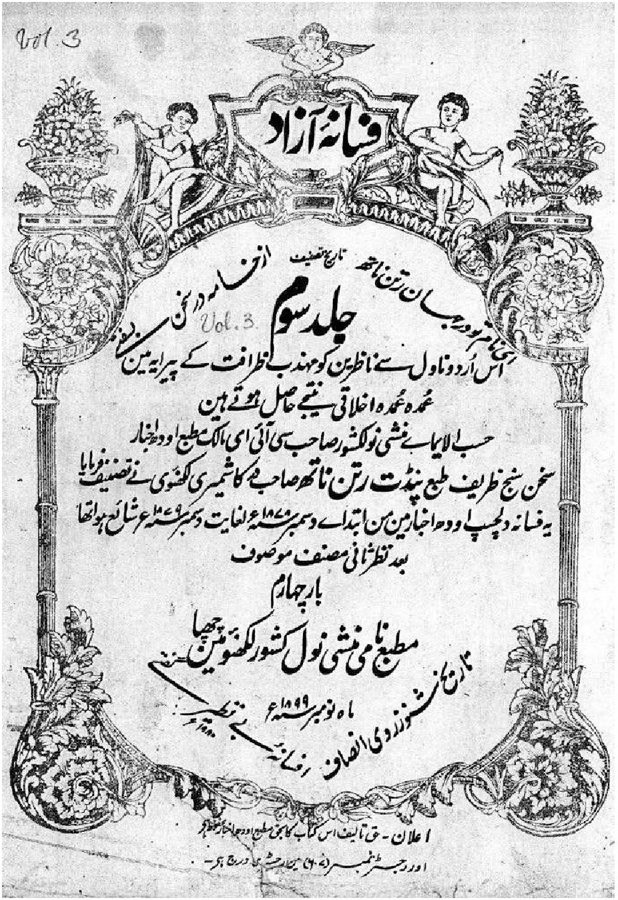
رتن ناتھ سرشار
A Kashmiri Pandit writer whose long novel about a wandering aristocrat is a major work of Lucknow's Urdu prose.
Life
Sarshar worked as a journalist and editor in Lucknow. His novel Fasana-e-Azad followed the adventures of a young nobleman through the Ottoman lands and India.
Style and legacy
The novel is comic, rich in detail and full of the speech of Lucknow's streets and courts, and it remains a key text of the period.
Classic writings
Sarshar's Fasana-e-Azad follows the adventures of a young nobleman, Azad, who travels from Lucknow to the Ottoman lands and back. The novel is comic and expansive, full of episodes, characters and debates. It captures the speech and manners of Lucknow with a lively, teasing humour.
The novel was written in a serial form, and its episodes were published in a newspaper, which gave it a broad readership. Sarshar used the travelling hero to describe many places and people, and his descriptions of war, travel and social life are rich in detail. The book is a rich source for historians of Urdu prose.
Sarshar's style mixes Urdu with a wide range of vocabulary, and he delighted in wordplay and in the varied speech of his characters. The book's humour depends on this linguistic richness, and readers who enjoy language will find much to admire in its comic set pieces.
Sarshar's legacy is a long and lively novel that stands among the key texts of nineteenth century Urdu fiction. It shows the range of prose in Lucknow and gives a strong sense of the city's cultural world in its last great age.
Sarshar also edited a newspaper and wrote on public affairs, and his journalism shows his interest in the social life of his city. He wrote for a readership that enjoyed satire, debate and vivid reporting, and his novel shares that spirit of lively commentary.
The character Azad is both a hero and a figure of fun, and this ambiguity is one of the pleasures of the book. Sarshar uses him to test the values of his society, and the reader is invited to laugh at the hero's excesses while admiring his spirit.
Sarshar's novel is also a travel book in the imagination, moving the reader across landscapes and cities. Its comic episodes, its digressions and its many voices make it a rich example of the expansive Urdu prose of the late nineteenth century, and it still rewards readers who enjoy long, lively storytelling.
Sarshar's humour often works through exaggeration and the comic gap between a hero's ideals and the reality of his travels. The reader laughs, but also sees the absurdities of the society that the hero encounters. This mixture of fun and observation is what keeps the novel fresh for readers who enjoy the period's comic writing.
Ratan Nath Sarshar is best known for Fasana-e-Azad, a long comic novel first published in instalments in a Lucknow newspaper. Its hero, Azad, and his companion, the talkative Khoji, move through the town and country in a flow of incident, argument and joke, and the book gives a vivid, funny portrait of Lucknow society. It is a classic of Urdu humour, and its loose, episodic structure feels like a long conversation. Because it is very long, many readers enjoy it in selections. His name is also a good reminder that writers from many communities, including Kashmiri Pandit families like his, helped to build Urdu prose, which belongs to everyone who has loved and written it.
Known works
Researched from published sources; the text is our own.