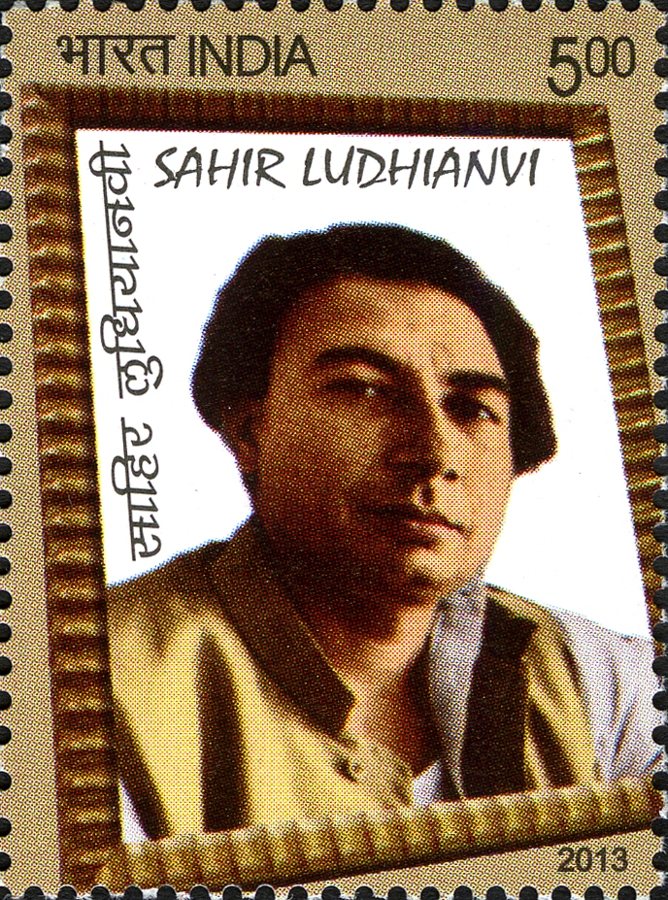
ساحر لدھیانوی
A progressive poet who brought socially committed Urdu verse into Hindi cinema.
Life
Sahir was born in Ludhiana and became a leading progressive poet before moving to Bombay to write for films. His film songs carried social themes into mainstream cinema.
Style and legacy
His nazms are direct and humane, and his film lyrics balance romance with protest. He is one of the most important bridges between Urdu poetry and popular film.
Classic writings
Sahir's nazms are socially committed and direct. He wrote about poverty, war, labour and the injustice of unequal societies, and he did so in a voice that spoke to ordinary readers. His poems carry a sense of anger and hope, and they were part of the progressive movement's effort to make literature serve the public.
Talkhiyan, his early collection, gathered poems that express the bitterness of his generation toward a world of hunger and inequality. The poems are passionate and sometimes rhetorical, but they also contain fine lyric passages that show his feeling for language and rhythm.
Sahir moved to Bombay to write for films, where he brought socially aware lyrics into popular cinema. His songs combine romance with social reflection, and they helped carry the spirit of progressive Urdu poetry into millions of homes. Critics note that his film work is often more restrained than his nazms, and more memorable for it.
Sahir's place in Urdu is that of a poet who connected the progressive movement with the popular stage and screen. His verses remain widely loved, and his name is still linked to the best of Hindi film lyric writing with an Urdu base.
Sahir's film songs often grew out of situations of protest or hope, and this gives them an unusual depth. He wrote for characters who were poor, lonely or wronged, and he gave them dignity through language that was clear, direct and emotional. His work shows how a poet can enter popular culture without giving up his convictions.
Sahir also served as president of the progressive writers' circles and was active in cultural debates of his time. His life reflects the commitment of many writers of his generation to a literature that is both artistic and socially responsible.
Sahir's film songs remain some of the most loved in Hindi cinema. They show that a socially aware lyric can also be intimate and musical, and that a song can carry a political argument without losing its romance. His best work stands as proof that popular forms and serious poetry need not be opposed.
Sahir's poems on war and its cost are among his strongest. He rejects the glorification of conflict and asks his readers to think about the people who suffer, the mothers and children and workers whose lives are disrupted. This humane anger gives his verse a lasting moral weight.
Sahir Ludhianvi lived two lives in verse. In books he is a progressive poet of protest, with collections that speak of love, loss and the poor, and in cinema he is a lyricist whose songs entered the memory of millions. The two sides are joined by the same plain, strong, musical language. Many of his film songs carry real ideas about justice and humanity, which is rare in popular music. A reader can start with a few of his famous lyrics and then see how the same sentiments appear in his poems on the page. He is a perfect bridge between literature and the cinema, which is why he appears in this sanctuary both under poets and under Urdu in Bollywood.
Known works
Researched from published sources; the text is our own.