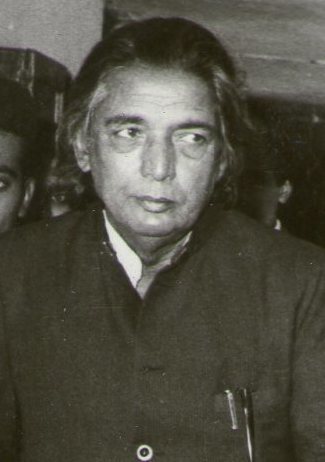
کیفی اعظمی
A progressive poet and lyricist whose verse about labour, women and justice reached film audiences.
Life
Kaifi Azmi was born in Azamgarh and joined the progressive movement as a young man. He moved to Bombay, where he wrote for films and for the progressive theatre.
Style and legacy
His poems speak for workers and women, and his film songs carry the same concern in a lyrical form. He was the father of the actor Shabana Azmi.
Classic writings
Kaifi Azmi's poems speak for workers, peasants and women, and they carry a strong sense of the progressive commitment to social change. His verse is lyrical and humane, and it treats the struggles of ordinary people with dignity and warmth, rather than only with anger.
Aakhir-e-Shab, one of his main collections, contains poems that are both political and intimate. Kaifi wrote about the lives of the poor, the condition of women and the possibility of a fairer society. His poems were recited at meetings and in the progressive writers' gatherings, and they became part of the movement's shared voice.
Kaifi also wrote lyrics for films. His film songs show the same concern for dignity and feeling, and they combine simple language with a fine sense of the emotional moment. Among these is his work for Pakeezah, where his lyrics are part of the film's romantic and social world.
Kaifi's legacy includes the influence of his family, since he was the father of the actor Shabana Azmi, and the example of a poet who kept faith with social justice across a long career. His poems are still read by those who value an Urdu voice that speaks plainly for the people.
Kaifi's poetry includes many poems on the Indian working class and on the struggles of women in a patriarchal society. His language is sometimes slogan-like, but at its best it becomes lyrical and deeply felt. He was a poet who believed that art and politics could strengthen each other.
Kaifi also worked with theatre groups and cultural movements, bringing poetry to people who might never open a book. His performances and his community work are part of his legacy, alongside the printed poems that continue to be read.
Kaifi's poems on the lives of workers and women are still read as a record of a particular struggle, and as a model of how a poet can speak for others without losing his own voice. His tone is patient rather than angry, and this gives his work a quiet authority that many readers find persuasive.
Kaifi's poems on the condition of women reflect the progressive movement's hope for a just society in which women could work, learn and love freely. His voice is gentle but firm, and his poems ask the reader to see the everyday struggles of women as part of the larger struggle for justice.
Kaifi Azmi's poetry grew out of public life. He was active in the progressive movement and wrote with a steady commitment to fairness and dignity, in nazms and ghazals that join clear language with strong feeling. He also wrote songs for films, and several remain well loved. Readers new to him can begin with his short poems about the everyday, then move to his longer political pieces. His village, Mijwan in Uttar Pradesh, stayed important to him and later became the base for work in his name. Kaifi shows how a poet can be both an artist and a citizen, using clear lines to say what he thought was right, and his verse remains a good place to see Urdu used for public conscience.
Known works
Researched from published sources; the text is our own.