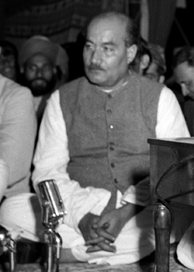
جوش ملیح آبادی
A poet of fire and rebellion, known for his vivid nazms on freedom, love and the body of the Indian subcontinent.
Life
Josh was born near Lucknow and grew up in a family of poets. He worked in Hyderabad and later moved to Pakistan, where he lived until his death.
Style and legacy
His nazms are grand, loud and romantic, filled with a sense of revolt. His reputation as a poet of rebellion grew in India and Pakistan, and his language is full of energy and rhetorical force.
Classic writings
Josh's long nazms are his most distinctive work. They are loud, passionate and dramatic, and they speak of freedom, rebellion and the energy of a changing world. He uses bold imagery and strong rhythms, so that his poems are meant to be declaimed to large audiences, not read quietly.
His love poems have a different tone: sensual, direct and sometimes defiant. Josh did not hide the body or the senses from his verse, and this frankness shocked some readers and delighted others. His poems on the beauty of the Indian landscape show a more tender side, with careful attention to rivers, fields and seasons.
Josh's politics were part of his poetic identity. He wrote in support of independence and social justice, and his poems were read at public meetings. His choice to move to Pakistan in the late 1950s divided opinion among his admirers in India and Pakistan, and it remains a subject of discussion among readers of his work.
Josh's place in Urdu is that of a poet of power and heat. Critics debate whether his bombast sometimes outweighs his subtlety, but his best nazms still have an electric force, and they remind readers of the public voice that Urdu poetry has at its disposal.
Josh was also a prose writer and a keen commentator on the literature of his time. His memoirs and essays show a man who saw himself as part of a long struggle for dignity and freedom, and his prose is as vigorous as his verse. Readers interested in the politics of the early twentieth century often turn to these pages for context.
His reception has been divided. Some critics see in his work a driving force that brought Urdu poetry into the public square; others feel that its rhetoric sometimes overwhelms its craft. Either way, his nazms remain an important record of the feelings of a generation that lived through independence and Partition.
Josh's nazms also show the power of the public recitation. Many of his poems were built to be spoken aloud, with strong beats, repetitions and clear climaxes. Reading them silently gives only part of the effect; hearing them declaimed shows how they once moved large crowds at meetings and celebrations.
Josh Malihabadi was known for the force of his voice. His poems are loud in the best sense, full of strong rhythm, revolutionary feeling and love of nature, and he recited them with a passion that made him a star at gatherings. He is often called the poet of youth and revolt because of the energy and the call for change in much of his work. He also wrote prose, and his memoir is widely read for its candour and its lively portrait of his times. Reading Josh is a good contrast to the soft ghazal tradition: he reminds us that Urdu can thunder as well as whisper. A few of his nazms, read aloud, show his power better than any description. Pair one of his nature poems with one of his poems of protest, and you will hear two sides of the same big voice.
Known works
Researched from published sources; the text is our own.