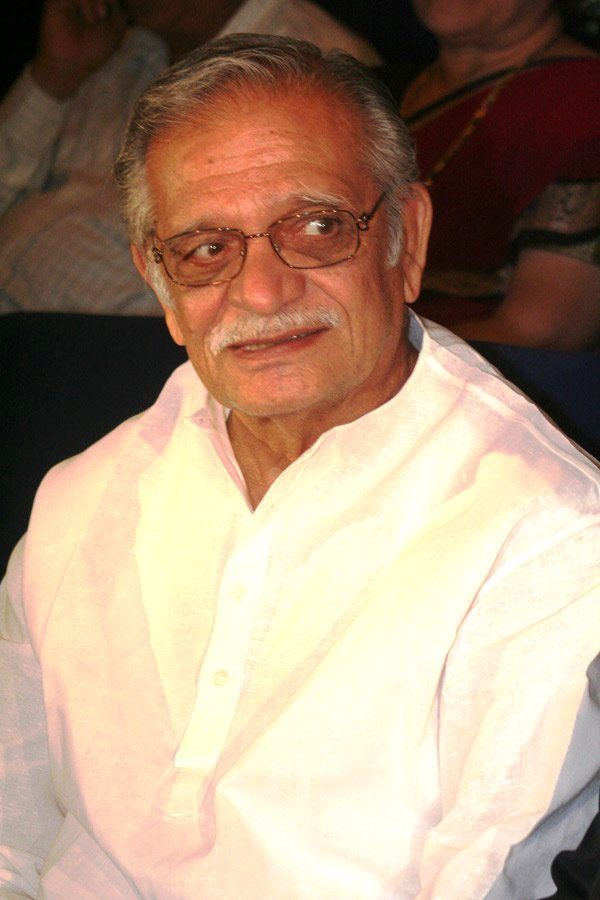
گلزار
A poet, lyricist and filmmaker whose nazms and film songs have shaped Urdu and Hindi for six decades.
Life
Born Sampooran Singh Kalra in Dina, he moved to Bombay after Partition and began writing lyrics and short poems. He later directed films and wrote screenplays.
Style and legacy
His nazms are short, intimate and often reflective, and his film lyrics bring Urdu imagery into everyday Hindi speech. He is one of the most widely read living poets of the language.
Classic writings
Gulzar's nazms are short, intimate and reflective. He writes about small moments, the textures of memory, the moon and the river, and the quiet losses of daily life. His language is simple on the surface but full of unexpected images, and his poems often end with a turn that makes the reader see the familiar differently.
His film lyrics have reached a very large audience. Gulzar brought Urdu imagery into everyday Hindi speech, and his songs combine a poet's care for words with an ear for melody. He has also written screenplays and directed films, and in these he brings the same attention to detail and feeling.
Gulzar's collections of short poems have been widely read, and his work has been praised for its humour, tenderness and surprising wisdom. He often writes with the eye of a filmmaker, framing a scene in a few words and letting the image carry the feeling.
Gulzar's legacy is the bridge he built between Urdu poetry and the wider culture of Hindi cinema and popular song. He shows that the nazm can be both serious and playful, and that a poet can work across many forms without losing the core of a personal voice.
Gulzar's short poems are often built around a single image and a single turn of thought. He can describe a bridge, a kite, a shadow or a crack in a wall and open it into a larger question about time and memory. His restraint makes these poems memorable, and they are often quoted in conversation and in writing.
His work as a director also shapes his poetry. He thinks in scenes and frames, and his nazms often feel cinematic in their precision. This crossover between poetry and film has given him a unique place in the culture of South Asia.
Gulzar's poems about childhood, the moon, rain and the river show a poet who finds wonder in small things. His style is careful and unhurried, and his images often surprise by combining the domestic with the cosmic. For many readers he is the poet who made modern Urdu feel tender and close to everyday life.
Gulzar's love poems are gentle and reflective, often dwelling on absence and memory. He describes the lover's waiting in quiet images, and the emotion is conveyed through what is left unsaid. This restraint, together with his musical sense of rhythm, makes his romantic verse especially memorable.
Gulzar is a living bridge between poetry and everyday song. His writing, in Urdu and Hindi and a plain, tender Hindustani, uses small images, a window, a winter morning, a pair of old shoes, to say large things, and many listeners know his lyrics before they know his name. He has also written short stories, screenplays and film direction, and his short three-line form, which he named triveni, and his free-verse nazms are loved for their softness. Because he is still read and heard in the present, the best way to know him is to listen to a recitation while following the text. He shows how Urdu feeling can live in the language most of India speaks at home.
Known works
Researched from published sources; the text is our own.