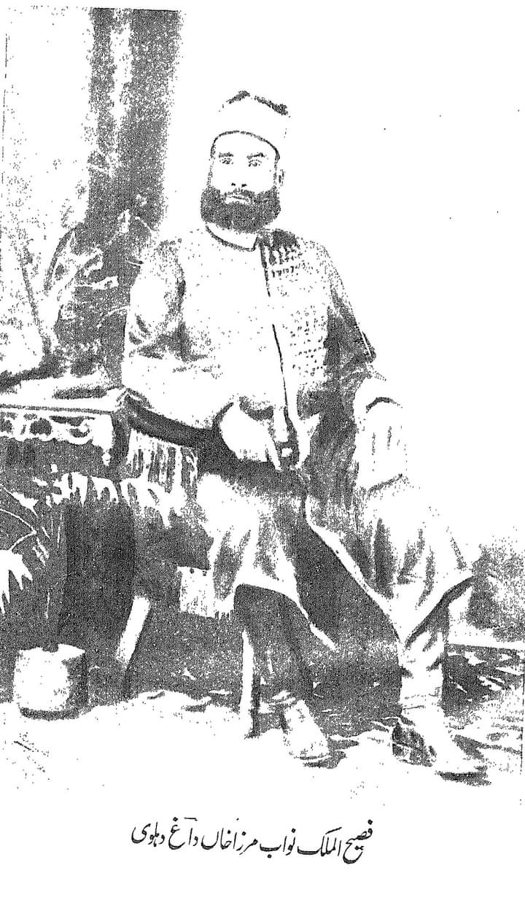
نواب مرزا خاں داغ دہلوی
The ghazal's great master of lightness and charm, who spent his later years as court poet in Hyderabad.
Life
Dagh was born in Delhi and wrote in the city's mushairas before moving to Hyderabad, where he served the Nizam's court. Hyderabad's literary life gave his work a new audience and a sense of prestige.
Style and legacy
Dagh is known for fluent, musical ghazals with a playful tone and a love of the everyday. He taught many poets, and his lighter style became a model for generations of Urdu ghazal writers.
Classic writings
Dagh's ghazals are light, musical and full of charm. He writes about love with a playful confidence, often turning a small quarrel or a glance into a sparkling couplet. His language is fluent and everyday, but it is carefully made, with a sense of rhythm that makes many of his lines easy to remember and sing.
His Diwan is his main collection, and it shows the range of his subjects from teasing lovers to wry reflections on the pleasures and disappointments of life at court. Dagh's verse was famous in his lifetime, and his students spread his manner across India. The easy grace of his style made him one of the most popular poets of his age.
Dagh's years in Hyderabad gave his poetry a new setting. The court life and the cultured audience of the city shaped his tone, and his poems were recited at gatherings where taste and wit were valued. Many of his ghazals reflect that refined sociability, with a lightness that hides real skill.
Dagh's legacy is in the spirit of the lighter ghazal. Later poets who wanted clarity and charm looked to him, and his couplets are still quoted by readers who enjoy Urdu's playful side. He shows that a poem can be delightful without being shallow.
Dagh's ghazal often works through a conversational turn. A lover complains, then laughs at the complaint; a rival is mocked, then forgiven. This movement gives his poems a warmth that listeners remember, and it helps explain why his verses were so often sung and recited at private gatherings and in the mehfil.
For the modern reader, Dagh is a good introduction to the pleasures of the ghazal without the heavy philosophy that some older poets demand. His couplets are a lesson in how a small thing, a shy look or a broken promise, can be made into a complete and graceful poem.
Dagh's easy grace has a practical side too. His couplets were made to be recited in company, and their rhythm, their short sentences and their clever turns made them easy to remember and repeat. That is one reason his manner shaped so many later poets who wanted to sound natural and bright without losing their craft.
If you want to see how the Urdu ghazal learned to smile, read Dagh next to Mir. Where Mir is hushed, Dagh is bright, social and a little mischievous, and his language is the clear, spoken Urdu of Delhi. He is a good guide to the idea of zaban, the purity and ease of speech that poets of his school cared about. His couplets are short, quick and made for the mehfil, so they work well read aloud. A student of poetry can learn a great deal from how he builds a verse around a single teasing situation and closes it with a clean, memorable line. He is proof that lightness, handled with skill, is its own serious art. Try reading three or four of his couplets aloud in a row and notice how each one ends on a neat, surprising turn.
Read Nawab Mirza Khan Dagh Dehlvi (32)
Known works
Researched from published sources; the text is our own.