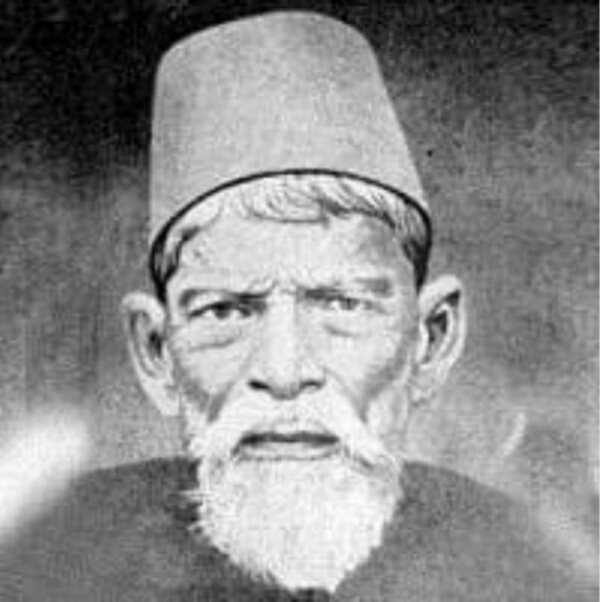
سید اکبر حسین الہ آبادی
The satirist who turned his sharp wit on colonial manners, Western fashions and the changing times.
Life
Akbar worked as a judge and then lived in Allahabad, watching the new schools, newspapers and fashions of British India with a sceptical eye. His poems were printed widely and became popular with readers far beyond literary circles.
Style and legacy
His couplets are short, cutting and humorous, and they carry serious criticism beneath the joke. He showed that Urdu verse could comment on modern life without losing its music.
Classic writings
Akbar's poetry is mostly in the form of short satirical verses, many of them couplets. He used them to comment on the spread of English education, the new fashions of the middle class, the eagerness for titles and offices, and the anxieties of Muslim society in a changing India. The humour is quick and cutting, and the satire often hides a serious criticism of what he saw as shallow imitation.
His critique of modernity is complex rather than simply hostile. Akbar did not reject new learning out of hand; he wanted Indians to keep their dignity and their own culture while engaging with the world. His couplets often mock those who abandoned tradition without understanding what they gained, and they also mock those who clung to old forms without thinking.
As a poet, Akbar kept the classical ghazal and the Persian tradition in view but gave them a new satirical edge. His language is clear and spoken, and his rhymes are often playful. Readers of his time enjoyed the way a single couplet could expose a whole social type, and his verses were printed and passed from hand to hand.
Akbar's legacy is a model of how Urdu could join politics and humour without losing its artistry. Anthologists still include his satirical verse, and his couplets remain a reference point for writers who want to comment on public life with wit. He is one of the clearest voices of the transition from the old literary world to the modern one.
Akbar's tone can shift from amused to angry within a single poem. He was not a detached observer; he took sides, and his verses reveal anxieties about identity, religion and status that many of his readers shared. Reading him today requires some historical context, but the wit of his best couplets still works without footnotes, because the human types he describes have not vanished.
Akbar's style also deserves attention for its economy. He often used a single image, a fashionable object or a familiar phrase, to carry a whole argument. His rhyme and rhythm are tight, and his best lines have the snap of proverbs. For this reason he remains one of the most quoted satirists in Urdu, and his verses are still used in speeches, columns and conversation.
Akbar's satire also works as a diary of changing manners. Through his couplets, we see the arrival of new schools, new clothes, new professions and new anxieties about status. The poems are funny, but they also record a society learning to live with modernity, and they show how much was at stake in that process.
Akbar Allahabadi is best known for humour with a purpose. He wrote witty, sharply observed verse about the changes of his time, the new schools, new manners and new institutions that came with colonial rule, and he did it by smiling rather than shouting. A reader should know that his humour often carries a real argument about tradition and change, and that people of different views have read it in different ways. He also held a legal office in his career, which gave him a close view of the world he teased. A short selection of his satirical couplets gives a clear sense of his charm, and shows how quickly a joke in Urdu can turn into a serious question about who we are becoming.
Read Syed Akbar Hussain Allahabadi (32)
Known works
Researched from published sources; the text is our own.