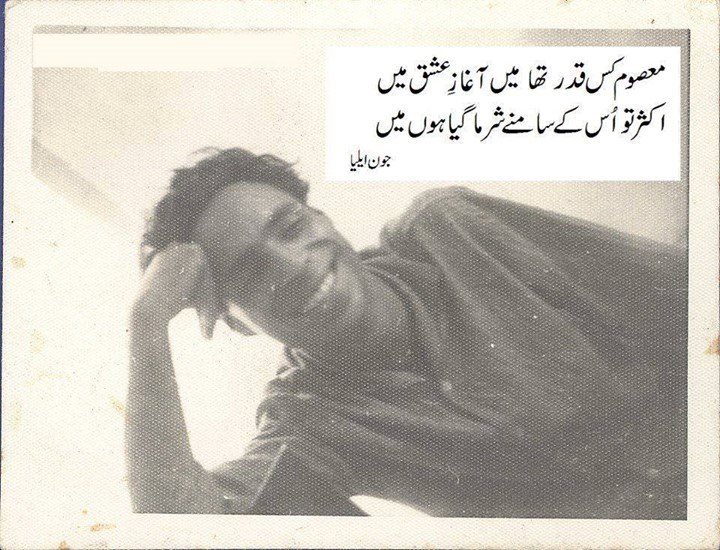
جون ایلیا
A poet of irony and quiet despair, whose free-verse and ghazals are read by a young audience.
Life
Born in Amroha, Jaun Elia moved to Karachi after Partition. He was known for his unconventional life and for performances that brought his poems to a new audience in the 1990s and after.
Style and legacy
His language is conversational and ironic, with a sharp sense of humour about love and loss. His books were published late in his life and became popular with younger readers.
Classic writings
Jaun Elia's poems are ironic, restless and frequently self-mocking. He writes about love, loss and the failure of communication with a conversational directness, and he often turns his own failings into the subject of his verse. This tone made him very popular with younger audiences, who heard in him a voice that refused grand gestures.
His collections were published late in his life, and their success surprised many critics. Shayad and Yani brought together poems that mix free verse and ghazal forms, with a playful rhythm and sharp images. He used repetition, paradox and sudden shifts to create effects that feel spontaneous and unsettled.
Jaun's poetry also reflects the experience of Partition and migration. He moved from Amroha to Karachi, and the sense of displacement runs through his work, along with a wry awareness of the gap between a person and the world they once knew. His wit is never simply comic; it carries a real melancholy.
His legacy is a new kind of intimacy in modern Urdu poetry. Readers who care for irony, honesty and a bare, unpolished style often come to him first, and his lines have become a familiar part of contemporary Urdu speech.
Jaun was also a translator and essayist, and he had a strong interest in philosophy and in the question of how language can express doubt. His prose pieces are as sharp and self-aware as his poems, and they reveal the thinking behind his frequent mockery of easy answers.
His reading style, in live performances, added another layer to his work. The audience heard the pauses, the repetitions and the ironic emphasis, and they took his poems as a kind of confession shared in public. This performative intimacy helped create a devoted following.
Jaun's wit can seem casual, but his poems are carefully built. Repetitions, reversals and abrupt changes of address are used with real skill, and they create the impression of a mind thinking out loud. Readers who come to him for entertainment often stay for the seriousness underneath the jokes.
Jaun's poems on the failure of communication between lovers and friends are among his most recognised. He shows how words can fail, how a sentence can wound without intending it, and how an ordinary conversation can contain a whole history. His frankness about these failures gives his poems their particular honesty.
Jaun Elia speaks to readers today in a way few poets of the last century do. His lines are raw, self-mocking, learned and conversational, and they travel easily on social media and in recitation videos, which has given him a large new audience. Behind that popularity is a poet who read philosophy and history widely and who turned disappointment, memory and argument into a very personal voice. Because many couplets attributed to him online are misquoted or invented, it helps to read from a trusted published collection. He is a good example of how a modern Urdu poet can sound like a person talking, direct and sometimes difficult, and still be rich in learning and in feeling.
Known works
Researched from published sources; the text is our own.