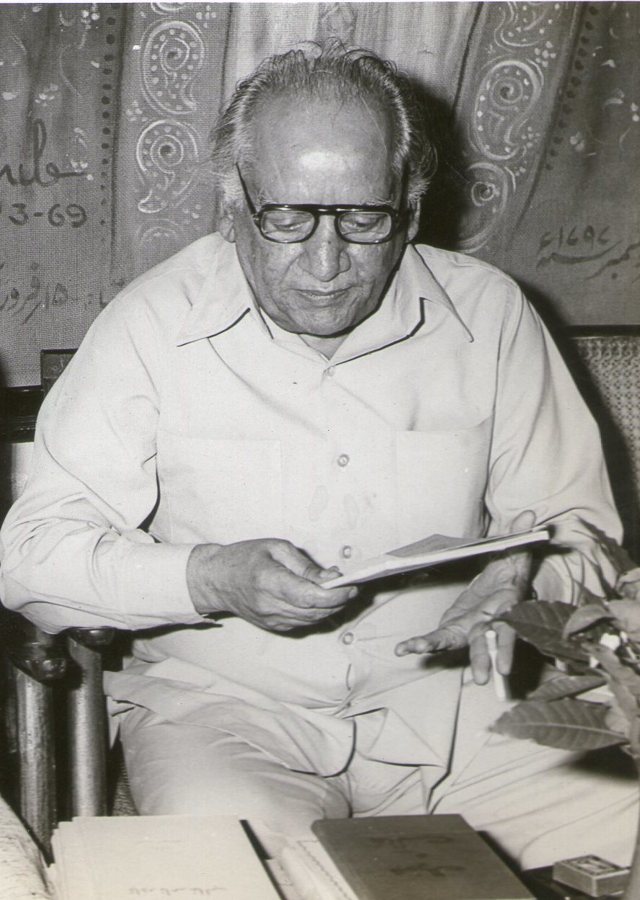
فیض احمد فیض
The most widely loved poet of the progressive movement, whose verse about love, justice and imprisonment crossed borders.
Life
Faiz was born in Sialkot, studied in Lahore and Amritsar, and became a leading figure of the progressive writers' movement. He spent years in prison and in exile in the 1950s, and his poems were written under those conditions.
Style and legacy
His language blends the classical ghazal with modern political themes. He is widely read in India, Pakistan and the diaspora, and his poems are sung and recited at gatherings for peace and freedom.
Classic writings
Faiz's poems about love, justice and imprisonment are among the most widely read in modern Urdu. His language blends the classical ghazal with direct political statement, and he used the traditional symbols of the lover and the beloved to speak about the people and the struggle for freedom. This double meaning allowed his poems to pass through censorship and to reach readers in many countries.
Naqsh-e-Faryadi gathers many of his poems on love, protest and the hope of liberation. The title itself refers to the imprint of lament, and the book carries the sense of a poet who lived through prison, exile and hardship. The poems are measured and dignified, with a restraint that makes their emotion more powerful.
Dast-e-Saba and Zindan-nama, which followed, deepen the same themes. The poems of imprisonment are intimate and concrete, describing the walls, the light and the small rituals of a cell, while keeping an eye on the wider world outside. Faiz showed that the prison could be a place of reflection as well as suffering.
Faiz's legacy is an enormous one. He is read in India, Pakistan and the diaspora, and his poems are recited at protests, memorials and cultural evenings. His combination of craft and conviction gave progressive Urdu poetry its most enduring voice, and his work continues to speak to readers who care about justice.
Faiz also wrote prose, including essays on art, culture and the role of the writer in society. In them he defends the idea that literature should speak to the common life of people and should not be sealed off from the struggles of its time. His essays make clear how his poems were conceived as part of a larger effort.
Many of Faiz's poems were written to be sung. Several were set to music by leading composers, and this has carried his voice into concerts, films and gatherings across South Asia. The musical life of his poetry is one of the reasons it has remained so present in the public memory.
Faiz's romantic poems and his protest poems are often read together, because for him they were part of one vision. The beloved and the people, the night and the dawn, the chain and the freedom are not separate worlds in his work. This unity is why his poems can move a reader who came for love and stay for justice.
Faiz's poems on the dawn, the chain and the prison wall have become symbols of hope in many countries. They are not merely political slogans; they are carefully crafted poems that use the rhythm and imagery of the ghazal to express a shared longing for freedom and dignity.
Faiz Ahmed Faiz is the poet of the tender revolution. His lines join the vocabulary of the classical ghazal, the beloved, the rival, the night, with the hopes and sorrows of working people, so that a love poem can also be a poem of conscience. He spent time in prison for his political commitments, and some of his best-known poems come from those years. His verses have been sung by many great voices, which has carried them far beyond the page. For a first reading, choose a few of his famous nazms and read them in a good bilingual edition. They show how a modern poet can honour a classical tradition and still speak plainly for the people of his own day.
Known works
Researched from published sources; the text is our own.