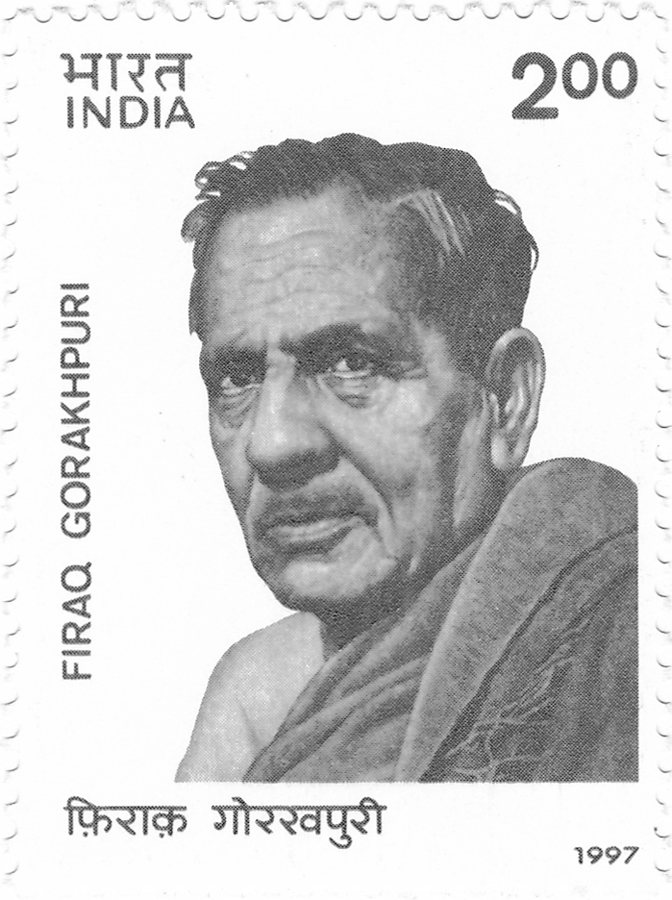
فراق گورکھپوری
A poet of the ghazal who was also a scholar of English literature and a teacher at Allahabad.
Life
Born Raghupati Sahay in Gorakhpur, Firaq took his pen name from his home town. He taught English at Allahabad University and wrote ghazals that were widely admired for their depth and subtlety.
Style and legacy
His ghazals mix personal feeling with a broader sense of loss and longing, and his language has a clear, grave beauty. He received major literary honours in India for his collection Gul-e-Naghma.
Classic writings
Firaq's ghazals are quiet and thoughtful. He writes of separation, of the loneliness of thought and of the passage of time, and his images are often drawn from the seasons, the night and the familiar corners of Indian life. The tone is grave and dignified, and it reflects a poet who had thought carefully about what poetry could say about the human condition.
Gul-e-Naghma, his principal collection, is the book for which he is most admired. It mixes lyric feeling with a philosophical turn, and it shows a poet who could balance personal grief with a broader sense of loss in a changing world. The book earned him high honours in India and secured his place among the major poets of his generation.
As a teacher of English literature, Firaq brought a critical awareness to his Urdu verse. He was alert to the English romantic poets and to the modern critics of his time, and this shaped his sense of form. His ghazals show a careful control of syntax and sound, with an unusual clarity for the classical form.
Firaq's legacy lies in his serious, gentle voice. He reminds readers that the ghazal can address modern questions of meaning and loss without losing its musical identity. His poems remain a fixed point for students who want to see how the classical tradition continued into the twentieth century.
Firaq also wrote essays on language and literature, in which he defended the particular qualities of Urdu. He was a careful reader of English and Indian poetry, and his critical sense helped him to see the ghazal as a form that could hold modern experience. These essays show how seriously he took the question of how poetry should speak to its time.
His ghazals often return to images of the night, the lamp and the solitary walker. These images are familiar, but Firaq gives them a fresh weight, and the reader feels the poet thinking aloud about the nature of loss and the possibility of consolation.
Firaq's reflections on the Indian landscape, the seasons and the lives of ordinary people give his poetry a grounding in place. His ghazals are not abstract; they carry the smell of a particular town and the feeling of a particular evening. This rootedness is part of why his work still feels personal to readers from many backgrounds.
Firaq Gorakhpuri is one of the reasons the Urdu ghazal stayed alive in the twentieth century. He brought a modern, thoughtful sensibility to a very old form, mixing the language of love with ideas drawn from wide reading, and he was also a respected teacher of English literature. His roots in Gorakhpur and Allahabad are a living example of how Urdu belongs to every community of North India, since he came from a Hindu family and became one of the great voices of the language. His ghazals often have a soft, reflective loneliness. A new reader can begin with a small selection of his couplets and then try his essays, in which he talks about poetry with warmth and intelligence.
Known works
Researched from published sources; the text is our own.