Last danfo out of Oworonshoki, past midnight, and Sunday the conductor keeps counting heads. Eleven paid. Fourteen sitting. Nobody has asked to stop yet.
“Obalende, CMS! Obalende, CMS! Enter with your change o, I no get change!”
Sunday banged twice on the side of the danfo with his flat palm and swung himself in through the open door as Baba Ijebu pulled off, the way he’d done every night for nine years, one foot on the step and one hand on the roof rail and the rest of him hanging out over the road. Twelve-forty. Last run. After this, home to Bariga and sleep.
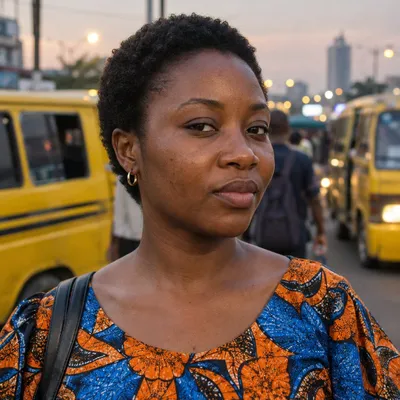
The bus was yellow once. Now it was the colour of old teeth, with NO KING AS GOD on the back window in red letters coming off. The radio didn’t work but Baba Ijebu had a small speaker hanging from the mirror on a string, playing old juju, very low.
Sunday counted. He always counted. Front seat, two. Row one, four. Row two, three, plus a woman with a basket. Back row, two, sleeping. Eleven.
“Owo da? Fare, fare, fare. Two hundred, two hundred.”
They paid, crumpled notes passed forward hand to hand. A boy in a security guard’s uniform. Two market women with empty trays. A man in a suit with his tie in his pocket. A girl with her braids half done.
They came up onto the bridge.
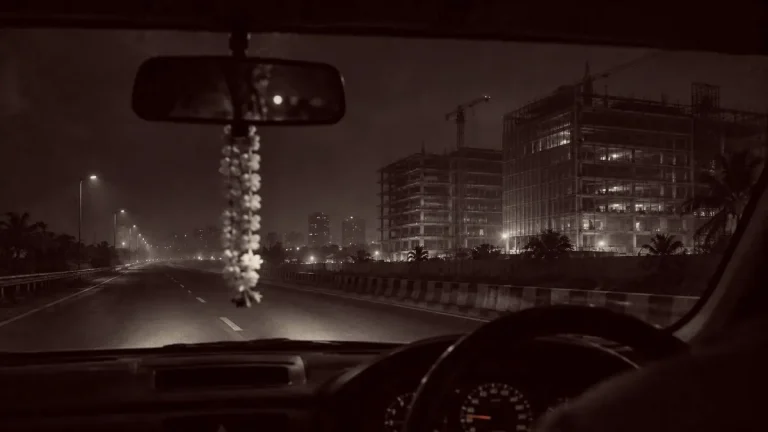
Third Mainland at night is the longest dark you will see in Lagos. Eleven kilometres of road on legs, over the lagoon, and the streetlights half working, so you go from light to dark to light. On the right, far away, the sawmills at Ebute Metta with their fires, and the stilt houses of Makoko, little lanterns over the water. On the left, nothing. Black water, and the wind coming in through the open door smelling of salt and diesel and something rotten, like fish left in a bucket.
Sunday counted again, because that’s what you do on the bridge. Nobody gets on or off on the bridge.
Front seat, two. Row one, four. Row two, four, the woman with the basket. Back row, four.
Fourteen.
He looked at the back row. The two sleepers were still asleep, heads together. Beside them, by the window, sat a man in a white agbada so wet it was see-through, and a boy of about ten in a school uniform, khaki shorts, his socks pulled up, sitting very straight with his hands on his knees. Water was running off the boy’s hair onto his collar. Running off the man’s sleeves onto the floor. There was a dark patch on the floor of the bus under the back row, spreading.
“Oga,” said Sunday. “Una never pay.”
The man in the agbada put his hand in his pocket and held out a note. Sunday reached over the row and took it. It was wet. A one-naira note, the old paper one, red-brown, with the man on it whose name Sunday had learned in primary school and forgotten. The boy held out coins. Kobo, with holes in some of them.
Sunday took them. He didn’t know what else to do.
* * *
“Driver, I dey drop,” said a voice from row two.
It was a woman. He hadn’t counted her. He’d have remembered. She was sitting where the market women were, except the market women had shifted along without seeming to notice, and she was dressed for a party, an iro and buba in old green lace, a gele tied high, gold earrings big as bottle tops. She was young. Her face was very calm. Her lace was soaked.
“Madam, where you dey drop? Na bridge we dey. No bus stop for here.”
“Under,” she said.
“Under where?”
She smiled at him as if he had made a small joke. “Under,” she said again. “I don tell am since. Under.”
Baba Ijebu was looking at Sunday in the mirror. His eyes were big.
“Sunday. The brake.”
“Wetin happen to the brake?”
“E no dey hold.” Baba Ijebu had both hands on the wheel and his foot flat to the floor. The bus was slowing. Not like a brake. Like a canoe coming in to land, drifting, the engine still going, the speedometer needle going down by itself, forty, thirty, twenty. The juju kept playing softly from the string. Behind them and in front, the bridge was empty. At twelve-fifty there should have been trailers, private cars, police. There was nobody.
The bus stopped exactly in the middle of the bridge, where there is no light at all, beside the railing.
The man in the white agbada stood up. He said, “Thank you, conductor,” in very good English, and stepped past the sleeping couple and down the aisle, ducking his head under the roof, and out of the open door, and over the railing. Sunday heard no splash.
The boy in khaki went next. He gave Sunday a kobo coin on his way, as an extra, and Sunday’s hand closed on it.
Then the others. They were all getting off. Not the ones Sunday had counted. Others. More than there had been seats for. People he hadn’t seen until they stood up, from beside the market women, from behind the security boy, from the floor. A man in a soldier’s uniform from some old war. Two fishermen with nets on their shoulders. A girl in a white church gown, barefoot. A tall old man in a wrapper with a brass bracelet on his ankle and a brass bracelet in his hand, a heavy horseshoe-shaped thing, which he pressed into Sunday’s palm as he passed. All of them wet. All of them calm. Each of them paid as they went out of the door into the dark over the water, and none of them made a sound going in.
The living passengers did not move. The suit man looked at his phone. The market women talked about the price of pepper.
Sunday stood by the door with his hands full. Wet notes. Pound notes with a palm tree on them. Shillings. Manillas. A naira note in a colour he didn’t remember. Notes so old they came apart between his fingers and ran down his wrists like mud.
He counted anyway. That’s the job.
* * *
Only the woman in the green lace was left. She came to the door. She smelled of camwood and lagoon. She opened her hand.
There was nothing in it. Then there was a two-hundred naira note, new, crisp, dry, the kind he’d been collecting all night. And a key on a ring, with a small plastic tag: a seat number, the way they number the planks in some danfos. Back row, by the window.
“I don dey this bus since nineteen ninety,” she said. “Since the bridge open. Every night. I no fit get down till person take my seat.” She folded his fingers over the money and the key, gently, like a mother. “Na your fare be this. Na your seat be that.”
Behind him, the engine was still running. In the mirror, Baba Ijebu’s eyes were closed.
“Sunday,” the woman said, kindly, already turning to the railing. “You don pay for all of us. Siddon. Rest your leg.”
The back seat by the window was empty and dry, and the foam was warm, as if someone had just got up.