I was hired to tell Amir Hamza at a hotel's opening night. Somewhere in the second hour the haveli decided it had a story of its own.
“Two hours, Nusratji. Not one minute more. The galouti is coming at nine-thirty and galouti does not wait for anybody, not even for Amir Hamza.”
This was Mr. Kapil Seth, who had bought Haveli Mirza Jafar Ali from fourteen quarrelling heirs and spent three years and, he told me twice, eleven crore rupees turning it into a hotel. He said it standing in the deorhi, the covered entrance where once a doorkeeper would have sat to stop men like him from going any further. He wore a bandhgala the colour of pistachio ice cream and a phone in each hand.
I said two hours was fine. I did not say that a dastan does not finish in two hours, or in two nights, or in two years. My grandfather told the Tilism-e-Hoshruba for most of his life and died, as far as any of us could tell, somewhere in the middle of the forty-sixth volume, with Amar Ayyar still disguised as a sweetmeat seller and nobody ever to know whether he was caught. That is the nature of the thing. You do not end a dastan. You stop for the night. You say baqi dastan kal, the rest of the story tomorrow, and you drink your water and you go home.
So I told Mr. Seth two hours, and he was pleased, and he showed me the house.
I will say this for him. He had done it carefully. The lime plaster was real lime plaster, not the cement they use now and paint to look old. The jaali screens had been taken down, cleaned piece by piece with toothbrushes by boys from Chowk, and put back. The courtyard of the mardana, where the men once received guests, had a fountain again, and the fountain worked, which in Lucknow is a kind of miracle. On the upper floor the zenana rooms, where the women of the family had lived and grown old and died without the street ever seeing their faces, had become what the brochure called the Begum Suites. Each had a brass plate on its door: Noor, Mehtab, Gulshan.
“And this one we are calling Qamar,” Mr. Seth said, at the end of the zenana gallery, where the corridor turned and stopped against a wall. The wall was freshly plastered, smooth as a boiled egg, and an artist had painted a peacock on it in blue and gold. “Qamar means moon. Very romantic. Except the room itself was bricked up, can you imagine. We found it on the old plans. Some nawab sealed it, God knows when. My engineer says it is not structural, we can open it in phase two, make a honeymoon suite.” He touched the peacock’s tail with one finger. “For now it is art.”
I asked him if anybody knew why it was sealed.
“Termites,” he said. “Or a death. In these old houses it is always termites or a death.” And he laughed, and his phone rang, and he went to argue with the caterer about the warqi parathas.
* * *
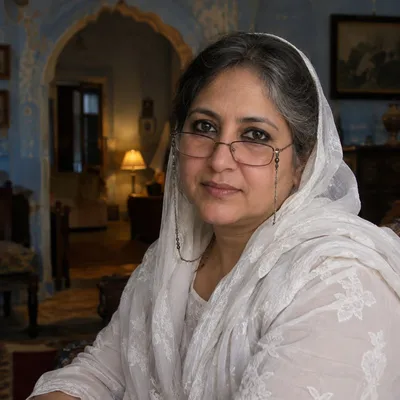
I should tell you something about myself, because you will need it to believe the rest.
I am not a superstitious woman. I taught English grammar at a girls’ school in Aminabad for many years before I put on the white angarkha and the white cap and climbed onto the takht. People laughed then, a woman doing dastangoi, as if the stories had been locked in some men’s room too. I did not care. My grandfather taught me the stories in the evenings after the meal because none of my brothers could sit still long enough, and I learned the rules he had learned: sit straight, keep the bowl of water by your knee, keep the lamp to your left, never look at the clock while you are speaking, and never, ever let the listener feel you are tired of him.
“The listener is the only king in the room,” he would say, cracking pistachios with his thumb. “Even if he is a sweeper. Even if he is asleep. You tell it for him.”
I have performed in drawing rooms in Defence Colony, in the lawn of a club in Bombay, in a school assembly hall where three hundred girls had been told to keep quiet and very nearly did. I have had people walk out. I have had people fall asleep with their mouths open. I have never had a story take my mouth away from me. Until that night, I had not known it was possible.
* * *
Shabbir had set the takht at one end of the mardana courtyard, under the arches, with a white sheet over it and two bolsters. He was a thin, patient man with a ladder he carried as if it were a relative, and he had made the lighting himself: little brass diyas with electric flames inside them, all down the arches, and a dimmer board on a stool behind a pillar.
“When you raise your hand like this, Baji, I bring it down slowly. For the scary parts. You tell me with your eyes.” He showed me. The fake flames sank and swelled like something breathing.
“There are no scary parts,” I said. “It is Amar Ayyar. It is a comedy, mostly.”
“Then I will just sit,” Shabbir said, with the face of a man who would very much like to bring the lights down at least once.
By eight o’clock the chairs were full. Ninety guests, perhaps a hundred: travel writers, a man from a hotel website with a camera on a stick, two foreign couples, Mr. Seth’s in-laws, some old Lucknow families who had come out of curiosity to see what had been done to a house where their own grandparents had once eaten. There was one empty chair in the front row, gilt and red velvet, with a card on it that said Reserved. Mr. Seth told me in a whisper that it was for the wife of an important man who had promised and not come. “Leave it,” he said. “It looks good in photos. Like a throne.”
I sat. I arranged the bowl of water. I put my hands in my lap and waited for the room to understand that I was not going to begin until it was quiet, which is the first trick of the craft, and then I began.
* * *
Ae sahibo, listen.
I gave them the opening I always give, the praise of God and then the praise of the listener, and then I took them into the tilism, the enchanted country of Hoshruba, where Afrasiyab the sorcerer-king rules from a garden that changes its shape every time you look away from it. I gave them Amar Ayyar, the trickster, with his bottomless bag and his forty disguises and his famous greed. They laughed where they should laugh. The foreign couples laughed a little after everybody else, which is what happens when people are reading a translation on their phones. The man with the camera on a stick stopped filming and simply listened, and I was pleased with that.
About forty minutes in, I noticed the smell.
You must understand that I know attars the way some women know saris. My grandmother wore ruh-e-gulab in summer and shamama in winter. My mother wore khus. What came across the courtyard to me, over the frying-onion smell from the kitchen and the jasmine in the women’s hair, was hina. Real hina attar, the old kind, baked in copper over a fire for days, dark and earthy and sweet as a wet wall. Nobody wears hina any more. Even the old men in the attar shops of Chowk will tell you that, sadly, as they bottle it for foreigners.
And at the same time, in the front row, the empty red chair creaked.
It is a particular sound, a chair taking weight. It is not a sound a chair makes on its own. The woman sitting next to it, Mr. Seth’s sister-in-law I think, turned her head and looked at the chair and then looked back at me with the polite face of somebody who has decided she imagined it.
I did not stop. My grandfather would have been ashamed of me if I had stopped. But I noticed that I was now telling it to the chair. I could not help it. When you have done this long enough, you can feel where the listening is coming from in a room, the way you can feel which side of your face the sun is on. Everyone else in that courtyard was enjoying themselves. Only the chair was listening.
* * *
At nine-fifteen, with the galouti on its way, I brought Amar Ayyar to a good resting place. He had stolen the sorcerer’s crown and was hiding in a well. I let him sit in the well for a moment so the audience could enjoy it, and then I lifted my hand, palm out, which is how you show the listener that you are about to stop.
“Baqi dastan…“
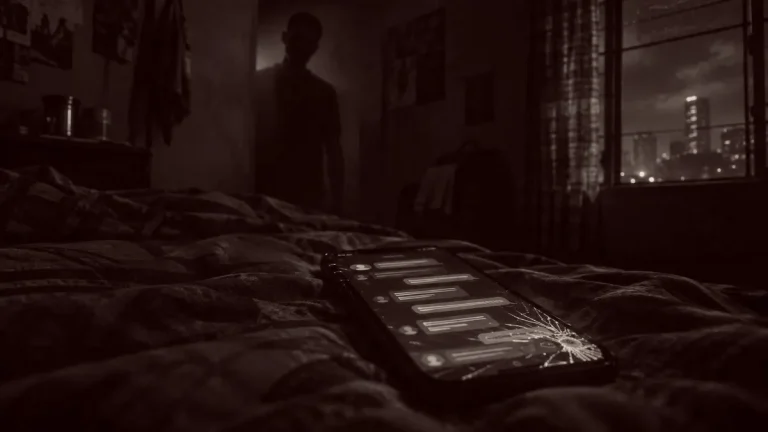
The lights went out.
Not slowly, not breathing down like Shabbir had shown me. Out, all at once, the fake diyas and the lamps in the arches and the strings of bulbs in the trees beyond the courtyard. There was a gasp, and then a laugh, and then the clapping started, because of course they thought it was meant. Somebody said “Wah!” in the dark. I heard Shabbir behind the pillar swearing very softly at his board.
And I heard my own voice go on.
I want to be exact about this. I did not decide to speak. My mouth was open because I had been about to say kal, tomorrow, and instead of that word, other words came out of it, in my voice, in my rhythm, with my grandfather’s small pauses in the places he used to put them.
“But tonight, huzoor, I will not tell you of a sorcerer’s garden. I will tell you of a house in Lucknow, a house of three courtyards, where there lived a begum who was not permitted to sleep.“
The applause died away to listen. They loved it. They thought this was the trick of the evening, the turn.
“She was not permitted to sleep because the women of the zenana would not let her. Every night after the last prayer they came to her room, the old aunts and the young wives and the maids with their hair loose, and they sat on her carpet and said, Qamar Ara, tell. And she told. She told them of jinns and of ships and of Amir Hamza, and of other things that are not in any book, and the women of that house laughed so loudly that the men in the mardana could hear them across two courtyards. And the Nawab, her husband, lay awake, and listened to his women laughing at something he could not hear.“
The lights came back.
Everyone clapped. Mr. Seth, I saw, was clapping hardest of all, half standing, looking around at his guests to make sure they were clapping too. Shabbir’s face behind the pillar was the colour of wet newspaper. He shook his head at me: not me, Baji. Not me.
I drank from my bowl. The water tasted of lime. Not lemon. Lime, the stone, the stuff of plaster, chalky and bitter at the back of the tongue, and I swallowed it because a hundred people were watching me drink.
* * *
The second time, I was cleverer, or thought I was.
I went back to Amar Ayyar in his well, the way you take a child back to the safe part of a story when it has had a bad dream. I made him climb out and steal a donkey, a whole long business with the donkey that has nothing to do with anything and has always made audiences laugh. I kept my eyes off the red chair. The hina smell had grown so strong that the woman next to it had taken out a handkerchief and was holding it to her nose, apologetically, as if she were the one doing something rude.
Then I tried to end it without saying the word. I simply stopped. I put my hands together and bowed my head, which is enough, people know what it means.
The lights went.
“The masons came at maghrib,” said my mouth, “when the women were at their prayers, because the Nawab knew the women would not leave the prayer mat to stop them. Qamar Ara was in her room with the door open, as always, waiting for them to come back to her. She was in the middle of a story. She heard the first brick go down on the threshold and she thought it was a maid dropping a tray. She did not stop telling. She heard the second brick and the third and she raised her voice a little, the way you do over noise, and she went on, because a teller does not stop for a little noise, and her women would want to know how it ended.“
In the dark, somebody’s bangles clinked. Somebody else, one of the old Lucknow men by his voice, said “Ya Allah” under his breath, and not in the way you say it about a performance.
“She went on for a long time,” said my mouth. “The mortar was wet, so for a while she could still be heard through it. The women heard her on the other side of the new wall when they came up from prayers. They sat in the corridor, where the wall was, and they listened, because the Nawab had said no one was to speak her name again but he had not said anything about listening. They listened for three nights. On the fourth night they could no longer hear the words, only the shape of the words. On the sixth night the Nawab had the corridor whitewashed and a carpet laid there and a table put against the wall with a vase on it. And the story was not finished.“
The lights came back. The clapping was louder now. People were filming. The man with the camera on a stick was standing on his chair.
Shabbir had come out from behind his pillar, with his hands open and empty to show me. He had pulled the plug of his board out of the wall. I could see the end of it hanging from his fingers like a dead thing.
* * *
I am a teacher, by training if not by trade, so I will give you the lesson I learned in the courtyard between the second time and the third.
A story is not owned by the teller. Every dastango knows this and none of us says it, because it is bad for business. The story is owned by the one who is waiting for the end of it. My grandfather, who was not a sentimental man, used to say that the reason we never finish the dastan is that a finished story releases its listener. He goes home, he eats, he forgets you. An unfinished story keeps him. You come back tomorrow because he will be there.
Qamar Ara had been kept. Not by her husband, though he thought so. By her own last sentence. Somewhere behind the boiled-egg wall with the blue peacock on it, there was a story with no end, and a woman who could not leave until it had one, and a house that had waited a hundred and sixty years or so for somebody to come and sit on a takht in its courtyard and open her mouth.
It was not going to let me say kal. There was no tomorrow on offer. The house wanted tonight.
I understood all this, I think, quite calmly. I was not calm in my hands. My hands were shaking so badly in my lap that I hid them in my sleeves. But my mind was quite clear, the way it goes clear when you are teaching a difficult class and you have just understood which girl started the trouble. And I thought: well, then. If I am to be made to tell it, I will tell it properly. I will not let it be dragged out of me in pieces between the light bulbs like a confession. I am a dastango. Let me do my job.
I did not wait for the lights. I lifted my hand to Shabbir, palm down, the signal we had arranged for the scary parts, though the board was unplugged and he could do nothing. He understood anyway. He stood very still.
The lights went out by themselves, gently this time, breathing down the way he had shown me. As if it had been watching him.
“Ae sahibo,” I said, in my own voice, by my own choice. “Listen to how it ends.“
* * *
I will not write down all of what I told. Some of it was not mine to tell and some of it I do not entirely remember, the way you do not entirely remember a fever. I will tell you the end, because that was the part the house had been waiting for, and that part I chose every word of.
I told how Qamar Ara, in the dark behind the bricks, ran out of the story she had been telling her women, and so began another, and another, and told every story she had, to the walls, until there were none left. I told how she then began to tell stories she did not know, stories of the house itself as it went on without her: of the Nawab growing old and deaf in the mardana, of his sons, of his sons’ sons selling the silver and then the carpets and then the doors, of the zenana emptying, of rain coming through the roof, of bats, of fourteen heirs who could not agree, of a man in a pistachio-coloured coat with a phone in each hand.
And I told how one night, a long time after, there came into the courtyard a woman in white, who sat on a takht with a bowl of water by her knee and began to tell a dastan. And how Qamar Ara heard her through two courtyards and a wall and a hundred and sixty years. And how she got up, then, for the first time in all that time. Because there was a teller in the house again. And a teller must have a listener, and the listener is the only king in the room.
“And she came down,” I said, “and she sat in the front, in the best chair, and she listened. And when the teller tried to stop, she would not allow it, because she had been stopped once in the middle and did not care to be stopped again. And the teller understood. And the teller said to her: Begum Sahiba, the end of your story is this. The wall is plaster. It was always only plaster. You are listening down here. You are not in there. You have not been in there for a very long time.“
There was a sound from the upper floor.
It was not loud. In that courtyard, with a hundred people holding their breath, it was enough. It was the sound you hear when a mango is pressed too hard and the skin splits. It came from somewhere along the zenana gallery, where the corridor turned and stopped.
The hina smell went out of the courtyard all at once, like a window had been opened.
The red chair creaked as the weight left it.
“Baqi dastan kal,” I said, and the lights came on.
* * *
They stood up for me. All of them, even the foreign couples, even the old Lucknow man who had said Ya Allah, though he did not clap, only stood with his hand over his heart and looked at me for a long time. The man with the camera on a stick said it was the most immersive heritage experience he had had in India and asked me how we had done the sound from upstairs. Mr. Seth kissed both my hands, which no man outside my family has done, and I let him because my hands were cold and his were warm.
“Every night,” he said. “Every night, Nusratji. This is the product. The hidden begum, the wall. We put it on the website. I will pay double. Shabbir, you genius, you are getting a raise.” Shabbir, standing behind him with the dead plug still in his hand, said nothing at all.
I went upstairs before I left. I told Mr. Seth I wanted to see the Qamar wall once more, for inspiration, and he was delighted by that too and sent a boy with me to switch on the gallery lights.
The peacock was gone.
Not entirely. Its feet were still there, blue and gold, near the floor. But in the middle of the wall, at about the height of a seated woman’s shoulder, the new plaster had split and burst and come away in a shape a little wider than a person, and lay in pieces on the corridor carpet. The old bricks behind it had come down with it. Every piece of plaster, every brick, every scrap of gold paint lay out here, in the corridor, on our side, on the brand-new carpet. Nothing had fallen in.
Through the hole I could see only darkness and a little floor, and on the floor a carpet that had once been red. And there was no smell in there at all. Rooms that have been closed for a hundred and sixty years smell of something, I am sure of it, of dust and bats and old cloth. This one smelled of nothing. It had already been aired.
The boy with the light switch said, “Sir is going to be very angry.”
But Mr. Seth was not angry. He came up while I was still standing there, and looked at the hole for a long moment, and then he laughed and laughed and said it was the best thing that could have happened, guests would pay to see it, he would put a rope in front of it and a little brass plate. He said the engineer had warned him the plaster on the old brick might not hold. He said, “You see, Nusratji? Termites.”
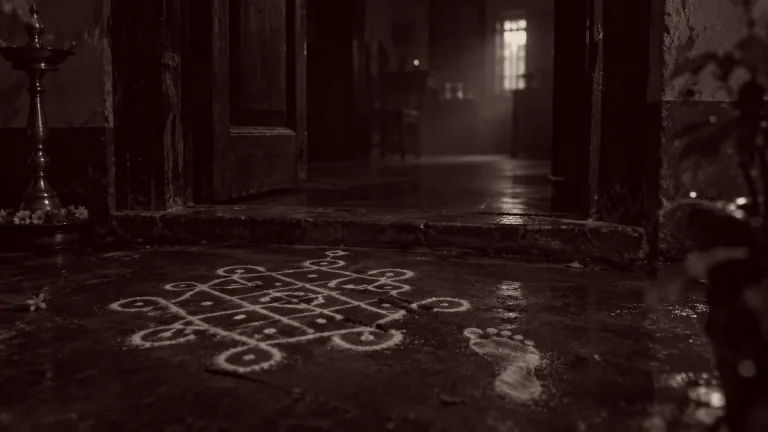
There was white dust on the gallery floor, beyond the bricks. You could see it clearly against the new carpet, which was the dark green they use in hotels so that the dirt does not show. Small prints, made by bare feet, going away from the hole. Not toward the stairs. Along the gallery, past Gulshan, past Mehtab, past Noor, toward the head of the stairs that look down into the mardana courtyard, where the takht was. And where they stopped at the top of the stairs, there was a smudge of dust on the railing, as if someone had leaned there to look down.
* * *
I signed Mr. Seth’s contract the next morning. Every night, eight o’clock, for as long as the hotel stands.
My nieces think I am mad. A woman of my age, they say, sitting on a takht every night of the year for tourists, telling the same Amir Hamza until her voice goes. I tell them the money is very good, which it is, and that I enjoy it, which in a way I do.
What I do not tell them is that I have begun the Tilism-e-Hoshruba again, from the first page of the first volume, and I am going slowly. Much more slowly than my grandfather went. There are forty-six volumes, and I give each evening only a little of each, and I always stop in the middle of something. Tonight Amar Ayyar is halfway up a wall. He will be there a long while.
The front row chair is no longer marked Reserved. Mr. Seth thought it looked lonely, and now he sells it, at a very good price, to honeymoon couples who want the best seat. But no one stays in it more than a few minutes. They say it is cold, or that there is a smell, a kind of earthy perfume, not unpleasant, only old. Then they move, laughing, to the second row. And I begin.
Ae sahibo, listen.