Content note Describes panic attacks and anxiety.
The plan was one station. Just one. From Platform Nine to the next stop, four minutes, and then he could get off, cross the bridge, and take a taxi home if he needed to. Dr. Mori had written it down for him on a card: One station. Four minutes. You can always get off.
Hiroshi had been carrying the card in his breast pocket for three weeks.
He stood now at the top of the escalator, holding the handrail, watching the evening crowd stream past him into the station. Office workers with their ties loosened. Students in uniforms, laughing. An old woman with a shopping trolley. Every single one of them moved with the casual confidence of people who did not think about trains at all, who did not lie awake rehearsing escape routes, who did not know that the body could betray you in the middle of an ordinary Tuesday.
Two years ago he had been one of them. Fourteen years of the same commute, the same carriage, the same corner by the door where he liked to stand and read. Then one morning, between two stations, with the carriage packed so tight he couldn’t lift his arm, his heart had begun to race for no reason at all. His chest had tightened. His hands had gone numb. The walls of the train seemed to press closer, and a voice in his head, perfectly clear and perfectly calm, had said: You are dying. You are going to die here, and no one will even be able to fall down beside you.
He hadn’t died. The train had pulled into the next station and he’d pushed out onto the platform and sat on a bench, shaking, while the doctors at the hospital later told him there was nothing wrong with his heart. Nothing at all.
But the next morning he couldn’t get on the train. Or the morning after that. Within a month he couldn’t take the bus. Within three, he couldn’t go to the supermarket during busy hours. He had worked from home since then, his world shrinking slowly, like a sweater washed too hot, until it fitted only his flat, the corner shop, and the park at dawn when no one was there.
“Panic disorder,” Dr. Mori had said, as if naming it would make it smaller. It hadn’t, at first. But it had helped to know it was a thing with a name, a thing other people had, a thing that could be treated. They had worked together for a year. Breathing. Small exposures. The bus stop. Then the bus, one stop. Then the supermarket at noon.
Now the train.
He stepped onto the escalator. His heart did something fluttery and alarming. Fine, he told it. I know you. He breathed out slowly, longer than he breathed in, the way Dr. Mori had taught him.
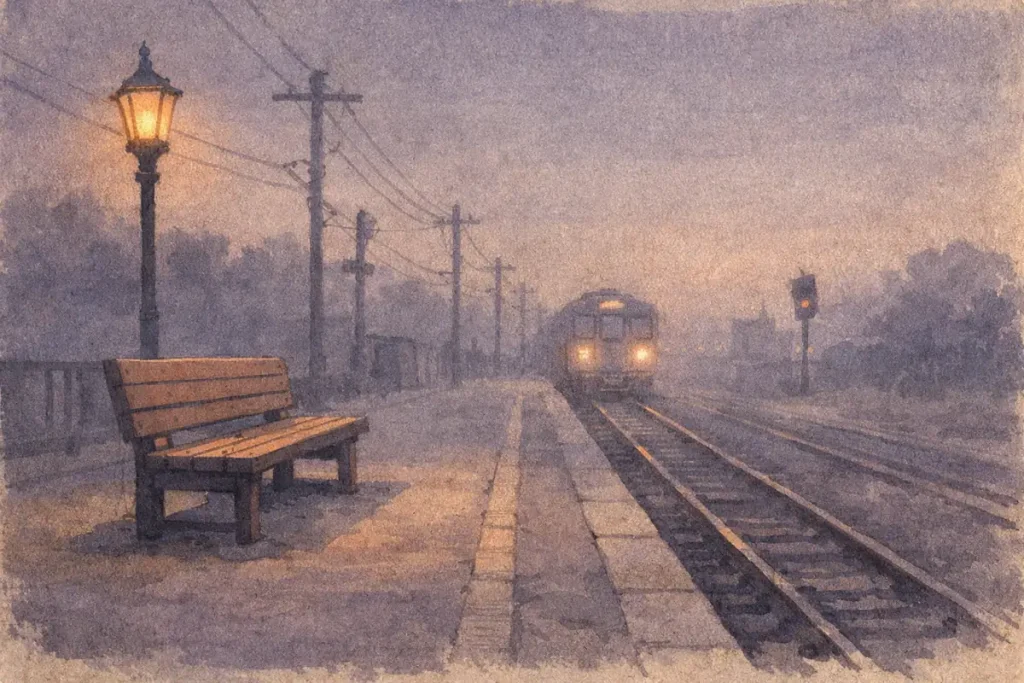
Platform Nine was busy. The display said the next train was in three minutes. Hiroshi went and stood near the back, by a pillar, his hand resting against its cold tiles. He counted things. Five things he could see: the yellow line, a pigeon, an advertisement for canned coffee, a girl’s red backpack, the clock. Four things he could hear. Three things he could touch.
The train came in with a rush of warm air and a squeal of brakes. The doors opened. People poured off. People poured on.
He didn’t move.
The doors closed. The train left.
He stood by the pillar and felt the familiar shame wash over him — hot, sour, total. Two years. Two years of practice, and he could not step through a door.
“First time in a while?”
He turned. An old man stood beside him, small and neat in a grey coat, holding a newspaper. He had very kind, very tired eyes.
Hiroshi wanted to say no, I’m fine. Instead, for some reason, he said, “Two years.”
The old man nodded as if this were the most normal thing in the world. “For me it was lifts,” he said. “After my wife died. Every time the doors closed, I was certain I would never get out. I took the stairs for six years. Fourteen floors to my daughter’s apartment.” He smiled. “I had very strong legs.”
Hiroshi laughed despite himself. It came out shaky.
“What happened?”
“My grandson,” the old man said. “He was four. He wanted to press the buttons. I couldn’t tell him no.” He shrugged. “So I got in. I was terrified. I held his hand. He thought I was holding it for him.” He folded his newspaper under his arm. “Where are you going?”
“One station.”
“Ah. I’m going two. I’ll ride with you for one, if you like.”
The display flickered. Next train: one minute.
Hiroshi looked at the old man, and the old man looked back, patient, unhurried, as if he had all the time in the world, as if there were nothing unusual about a stranger offering to accompany a grown man four minutes down the line.
The train came in. The doors opened.
“After you,” said the old man.
Hiroshi stepped on.
The carriage was crowded but not packed. He found a place by the door, his old corner, and put his hand on the rail. The doors closed with a soft hiss. His heart leapt. The floor moved. For a moment the walls seemed to lean, and the familiar voice cleared its throat to speak —
“My wife used to say,” said the old man beside him, conversationally, “that the worst fear is always the one just before you do the thing. After that, it’s only weather.”
Hiroshi breathed out. Long, slow, like blowing on soup. He looked out the window at the city sliding past, lit up and golden in the evening, the rooftops, the neon, a man on a balcony watering plants. He had forgotten how beautiful it was from here.
Four minutes.
The train slowed. The doors opened. Hiroshi stepped out onto the platform, and his legs were shaking, and his face was wet, and he didn’t care.
He turned to thank the old man. The old man was still on the train, holding the rail, smiling, raising his newspaper in a small salute as the doors slid shut between them.
Hiroshi watched the train go. Then he took the card out of his pocket, the one Dr. Mori had written. One station. Four minutes. You can always get off.
He turned it over, took out a pen, and wrote on the back: Next time, two.