Content note Mentions the aftermath of abuse and trauma (non-graphic).
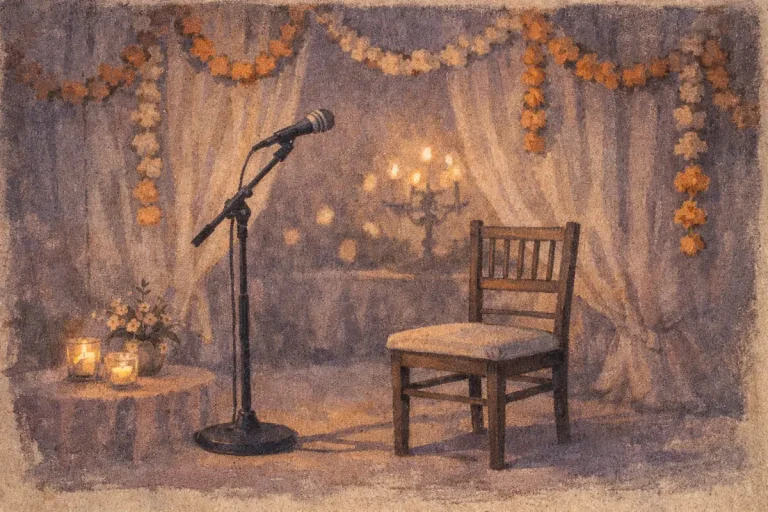
Room B was not designed for healing. It was designed, as far as Sunita could tell, for the community centre’s Tuesday yoga class and its Saturday chess club, and on Thursdays at seven it was borrowed by eight adults who sat in a circle of orange plastic chairs and tried to say true things out loud.
The first time Sunita came, she sat closest to the door.
She had planned her exit in advance. She’d checked the bus times. She’d told herself she would stay for exactly twenty minutes, long enough to tell her counsellor she had gone, and then leave. She kept her coat on and her bag on her lap, both hands holding the strap, as if someone might try to take it.
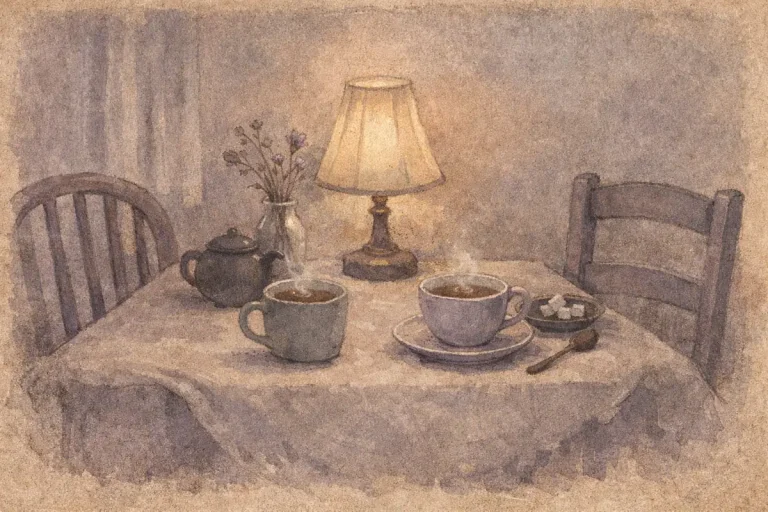
The facilitator was a woman in her sixties called Mrs. D’Souza, with grey hair in a loose plait and reading glasses on a beaded chain. She made the tea herself, in a dented urn that hissed like an angry cat, and she made it badly — too much milk, not enough sugar — and nobody ever said so.
“There are no rules here,” she said at the start of every meeting, “except three. What is said here stays here. Nobody has to speak. And nobody gets advice unless they ask for it.” Then she would smile. “Also, the biscuits are for everyone, Mr. Thomas.”
Mr. Thomas, a retired bank manager with a magnificent moustache, would put back the second packet he had been quietly sliding towards himself.
Sunita did not speak that first night. Or the next. Or for the first two months. She sat by the door with her coat on and listened.
She listened to Mr. Thomas talk about the boarding school he’d been sent to at eight, and the things that had happened there, which he did not describe and did not need to, and how he had not told his wife for forty years. She listened to Farah, a nurse in her thirties, talk about the ex-husband who had controlled every coin and every phone call, and how she still checked the locks four times before bed. She listened to a young man called Joel, who barely looked up from his shoes, say in a voice so quiet everyone leaned in that he hadn’t slept in a dark room since he was eleven. She listened to Mrs. D’Souza herself, once, talk about her own childhood, very briefly and very calmly, and then pour everyone more of the terrible tea.
What struck Sunita was not the stories. It was the room after the stories. The way nobody gasped, or said how awful, or told anyone what they should have done. They just nodded. Sometimes someone would pass the tissues along the circle, hand to hand, without a word. Sometimes Mr. Thomas would say, gruffly, “I know,” and that was all, and it seemed to be enough.
She had told her story twice before in her life. Once to a friend, who had cried so much that Sunita ended up comforting her. Once to a relative, who had gone very still and then said, “Why are you bringing up the past? Just move on.” After that, she had decided never to tell it again. She had built her whole life on top of it like a house on a sealed well. A good job at an insurance office. A small, tidy flat. Friends who knew her as funny, competent, a little private. She was very good at being fine.
But the well was still there. It showed itself in strange ways. In the panic that rose in her throat when a man stood too close in a lift. In the nightmares that came twice a month, regular as rent. In the way she flinched when someone raised their hand to wave. In the fact that, at thirty-eight, she had never let anyone stay the night.
In the third month, on a rainy Thursday in July, Sunita took her coat off.
Nobody remarked on it. But she saw Mrs. D’Souza notice, over the top of her glasses, and say nothing, and pour the tea.
In the fourth month, she moved one chair closer to the circle.
In the fifth month, Joel — the young man who looked at his shoes — spoke for nearly ten minutes, his voice shaking, about a dream he’d had in which he was a boy again but this time he ran, and he got away, and he woke up crying with relief. When he finished, the room was silent. Then Farah reached across and put her hand on his arm, and Joel looked up — actually looked up, at all of them — and Sunita felt something in her chest crack open like an egg.
“I’d like to say something,” she heard herself say.
Every face in the circle turned towards her. She had imagined this moment for months. She had imagined it going terribly. Her voice failing. Her mind going blank. Someone reacting the way her relative had. Getting up and running for the bus.
Instead, Mrs. D’Souza just nodded, and said, “Take your time.”
So she did.
She did not tell all of it. She told the outline. A family member. Years of it, when she was young. A silence afterwards that the whole family helped to keep. The relative who told her to move on. The well. The house on top. The lift, the nightmares, the raised hands. She did not cry. Her voice went strange and flat in places, as if it were reading from someone else’s report. Her hands shook on the strap of her bag.
When she finished, nobody gasped. Nobody said how awful. Nobody told her what she should have done.
Mr. Thomas cleared his throat. “I know,” he said.
Farah passed the tissues along the circle, hand to hand, until they reached her. Joel, of all people, gave her a small, shy nod.
Sunita sat there, holding the tissues she didn’t need yet, and realised that the sealed well had a door in it now. It was not open. It might never be fully open. But it had a door, and there were seven people in an orange plastic circle who knew where it was, and who would not be afraid of it.
On the bus home, she cried for the first time in years. Not the frightened crying of the nightmares. Something else. Something that felt like rain after a long, hot summer, the kind that makes the whole street smell of earth.
She still goes to Room B on Thursdays. She sits in the circle now, not by the door. She has learned to make the tea, and she makes it properly — less milk, more sugar — and nobody says anything about that either, though Mr. Thomas has twice asked for seconds.
When new people come, frightened, coats on, bags on their laps, sitting closest to the door, Sunita does not try to talk to them. She remembers how that felt.
She just makes sure the chair next to theirs is empty, in case they ever want to move one closer.