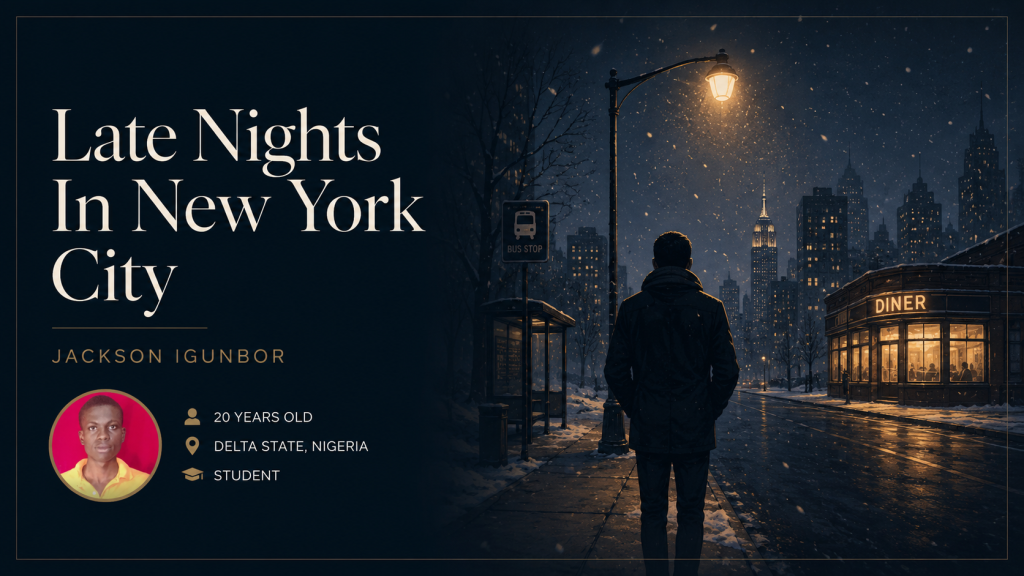
THE HOOK: Late Nights In New York City follows Ebuka, a Nigerian immigrant adjusting to New York’s freezing nights and unfamiliar silence. As memories of home, family, and culture accompany his journey, ordinary moments reveal the emotional weight of displacement. Through humor, nostalgia, and heartfelt conversations, the story explores identity, belonging, and the enduring warmth of home despite the distance.
O boy, see cold! Even harmattan no wicked reach this one,” Ebuka said, shivering as he came out of the hotel he had rented, only to be greeted by the raging cold. The winds sliced sharper than the harmattan mornings in the north, the kind that cracked lips till they bled. He shivered as the late-night breeze grazed his skin. He was wearing a thick black jacket and a scarf around his neck, but the chilling breeze still cut through, stabbing his bare skin with a rageful force that left him shaky for a while. The feeling brought his mind back to his school days, in the late months of the year, when they would run through the cold freezing morning with their wool sweater that layered over their uniform. Despite the cold, the principal of the school often stood at the gate with a long fat cane in her hand, waiting for the victims of the morning cold to vent her frustrations on. But although there was no principal here and the cold here was off the charts, the memories and the wave of nostalgia it brought welcomed a warm smile on Ebuka’s cold, shivering lips.
“Omo, e con be like say Niger harmattan no cold reach oo. Which kind cold b dis na!” he muttered, shaking nonstop as he lifted his head in front of the hotel. Underneath his jacket, Ebuka was getting goosebumps, his skin hairs poking through his jacket’s lining. Ebuka pulled his jacket tighter, though this New York weather still bit through layers like hot pepper soup that burns the tongue of its impatient attacker. Back home in Enugu, “cold” meant harmattan dust and cracked lips—nothing like this sharp wind that seemed to laugh at his trembling skin, frozen hair, and stiff bones.
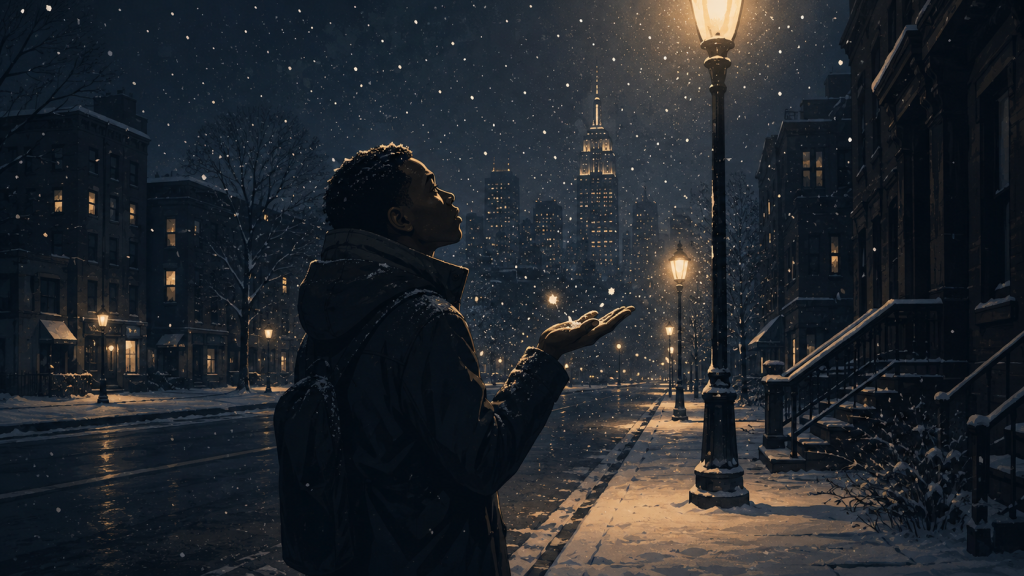
He decided to head to the bus stop, his legs shaking the moment he finally lifted them off the ground. On his way, small balls of white began raining from the sky. “Na the snow b dis? See as e b like garri. E soft but e con still cold somehow, like say God pour ground cassava from heaven without fire,” Ebuka said, his eyes fixated on the sky as snow slowly rained down.
His excitement of witnessing snowfall away from home for the first time, coupled with the curiosity of how the snow would actually feel on his skin, Ebuka found himself lifting his hands. The snow dropped softly on his palms, sending a minor jolt through his hand, “Assuming we had this kind of snow back at home…” He said, pausing as a short chuckle left his lips, and his head swung back up, “…They for pack am go fry say na Akara wey don cold” his eyes taking a moment to appreciate the scenery before he closed it and painted a mental image with a satisfied smile.
He took a deep breath, flinching as the cold air stabbed the inside of his nostrils. “Chai! Hope say my nose never block oo,” he said, feeling his nose for any tear. He exhaled after he found none, a puff of white air escaping his mouth.
At the bus stop, people stood like trees: stiff, silent, not even so much as a greeting to their neighbor. Some stood with their phones on one hand and their bags on the other. Others just held their phones in their hands. In Nigeria, waiting this long, someone would have started a conversation, cracked a joke, or maybe even made an argument. Here, only the sound of rain and taxis whose horns blasted like Lagos danfo drivers arguing for road space filled the air—but nobody shouted back.
‘If Amaka and chinedu were here, even if you’re not the talkative type, you’ll be prompted to say a word or two’ Ebuka said, laughing silently at the silence in the air, as it’s density could kill a mosquito and eliminate malaria in Nigeria. The thought broke Ebuka’s laughter out of its confinement, turning a few heads his way and earning a couple of looks that made him keep his laughter back to himself.
Ebuka checked the time. The bus was late, and in America, even lateness felt lonely, a fact the falling snow and empty late-night sky would agree with.
The bus finally arrived, and everyone expressed their complaints about the lateness of its arrival. Its doors opened, and just like that they all shuffled in like a bunch of market women entering transport to Onitsha—but this time it was all done in silence except for the drumming of their feet against the floor. Ebuka waited for them all to enter before he boarded, taking a seat at the back, close to the window.
The doors closed, and the bus began moving, missing out one more person who had just arrived at the bus stop, hailing and waving at the bus, hoping the driver would see him. He stood there with his hands on his knees as he caught his breath. Ebuka couldn’t hear the breaths but he could clearly tell that the man was exhausted. He tried to call out and get the driver’s attention to let him know that there was one more passenger outside, but then the bus came to a sudden halt, causing a few of the passengers to jerk forward abruptly. It turned out that they had just run into a red sign on the traffic.
Ebuka looked back, hoping the man picked up on that. The man was already at the door, knocking repeatedly like someone lining up at the community’s public toilet, waiting for the person inside to finish his ‘download’. The driver noticed the man and swiftly hit a button next to him, resulting in the doors opening and giving way for the man to make his way in.
The man took a seat at the other end of the row, leaving a huge gap between them. Ebuka continued gazing outside the window, watching as people walked and had all sorts of conversations, and it reminded him of the celebrations they usually held back at home. Sure, it wasn’t this quiet, but the crowd felt about the same.
The bus came to a stop and as he came down, Ebuka’s gaze landed on a diner with simple furnishings, like the mixture of fried rice, chicken, and salad that his mother usually prepared for him at times like this. The thought of his mother brought a smile to his face, “Mummy for like this place oo.”
“I dey sure say that woman go don wake the whole neighborhood,” he said, a small chuckle leaving his lips as he took a step forward, snow crunching under his feet before entering the diner.
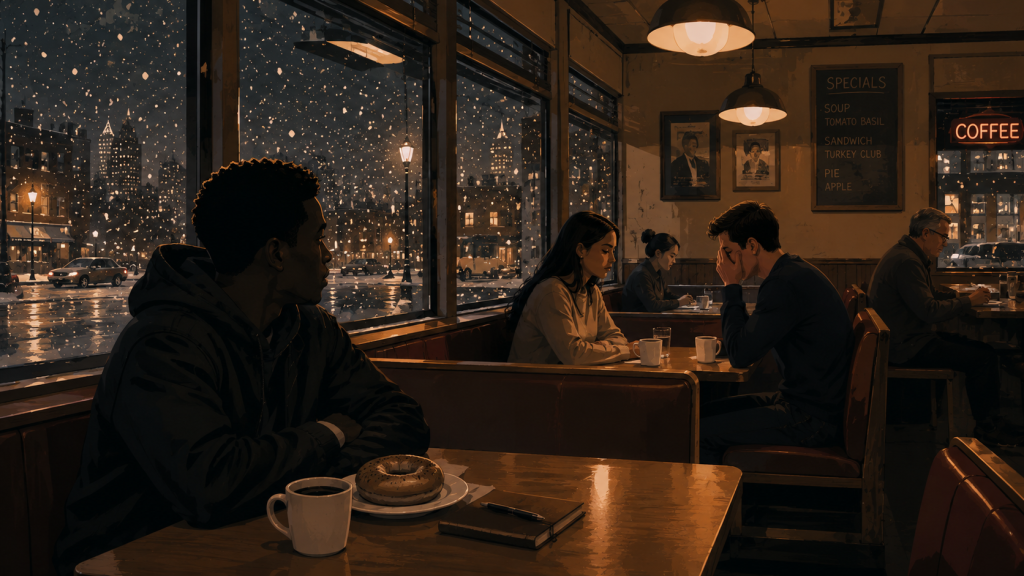
The bell rang as Ebuka opened the door and walked inside, the smell of bagel hitting his nose and reminding him of akara frying back home. The silence of strangers eating alone felt strange compared to a bustling buka. The counter was a ceramic-tiled table with a glass shelf under it. The shelf had all sorts of pastries that were just out for exhibition.
Ebuka took a seat and picked up the menu, the rustling sound of the paper ringing loudly in his ears as his eyes furiously went through the contents. When he was done, he hit a button at the center of his table, and in a flash, a male waiter came out to take his order.
“Two bagels and a cappuccino,” he said, waiting patiently as the waiter penned it down.
“Would you like to take a free order with that?” the waiter asked, smiling softly.
“You give free orders?” Ebuka asked, surprised.
“Yes, we want to express gratitude to all our customers for their patronage.”
Ebuka dropped his bag to the table and nodded. “Then I’ll take two of your best combinations to go.”
“Got it,” the waiter said, before walking away.
Ebuka sighed and tapped his fingers repeatedly on the table, his eyes scanning the diner. Even though he frequently comes here for his breaks and lunch snacks, he still hasn’t gotten used to the homey air in there.
He saw a few men in black suits with their laptops laid out in front of them and a couple of files right beside the laptop. Some people just took pictures of the things they bought and some pictures with the people they came with– all smiles and no secrets, sending Ebuka back to his country, where everyone is a suspect, and there is literally no trust among the citizens, even coming down to family members and close friends.
Late Nights In New York City—Jackson Igunbor
The sight of a couple sitting across from him arrested his attention.
“Make I do small aproko again,” he muttered, leaning in and bringing out one of his legs out of the confines of the table.
Ebuka watched the couple across the diner… he could almost hear their conversation.
Ada sat across from James in the diner. The coffee on the table seemed to have gone cold—not that she cared. In Lagos, she would have chased him out with words sharp enough to peel yam, but here in New York she kept her mouth shut, learning the American way of swallowing bitterness like vitamins.
James cleared his throat. “I don’t think this is working.”
Ada almost laughed, but held it in. Nigerians say if the soup is salty, the tongue will confess—and his tongue had finally done its duty. She nodded, not because she agreed, but the way market women nod at customers who price pepper without money. Outside, snow splattered the glass, soft and endless, nothing like the bold, angry rainstorms of home.
“Okay,” Ada said, the word falling from her mouth like spoilt rice thrown to street dogs.
Ebuka nearly chuckled into his cup, the smell of the bagel scraping against the walls of his nostrils and the taste of the cappuccino soaking into his tongue, making him recall the taste of the tea and brown bread his mum gives him every morning before he goes out.
He could see James was expecting a scene or a little drama, but Ada’s calm dismissal was sharper than insult.
“Aswr, you no go fit do Naija girls dis kind thing, con go scot free. Dem no born you well,” he muttered, impressed.
After a few more minutes, Ada stood and walked over to the door, pulling it open and walking out. Ebuka shook his head with a grin before turning back to his meal.
Later, trudging home from the diner, his shoes biting against the snow that covered the streets like garri poured raw from the bowl—cold, useless without fire—he smiled ear to ear, proud of himself for ending his night smoothly.
Midnight in New York felt like standing inside a coffin: no voices, no suya smoke curling from a roadside stand, no okada men hailing passengers with reckless laughter. Back in Aba, even at this hour, someone would be selling puff-puff or calling out gossip, but here the silence was loud enough to bruise him.
His jacket was heavy, but the weight in his chest was heavier. He missed the heat of his mother’s kitchen, the way she scolded him for coming home late yet always left a plate of jollof covered with foil.
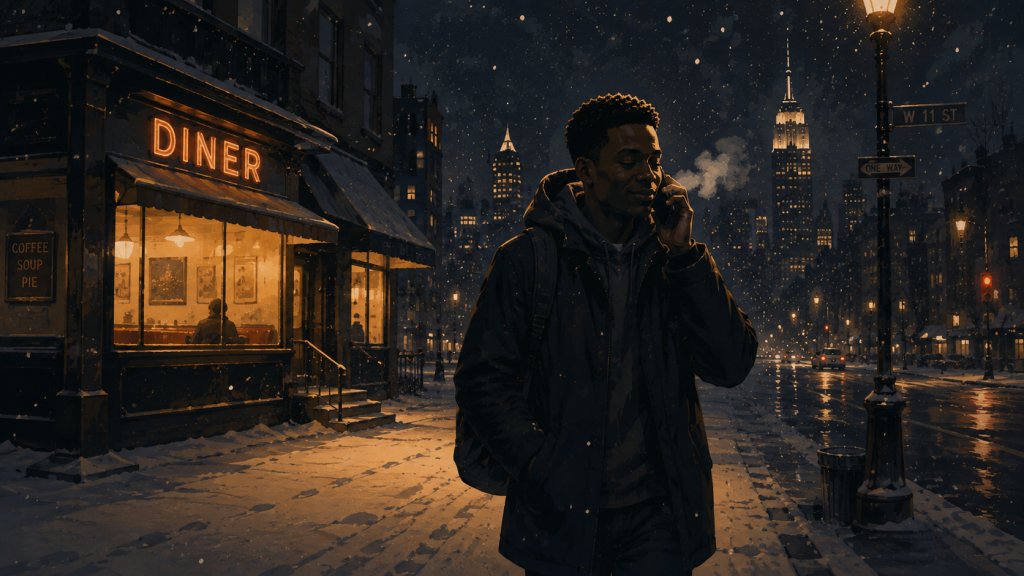
His phone rang in his jacket pocket, and he pulled it out. The name flashing on the screen brought a smile wider than the cold could freeze.
My Sunrise It read.
“Ndi nne mama!” were the first words that escaped his lips.
“Shut up there, yeye pikin,” a calm, soothing voice replied.
Ebuka laughed, all the chill melting away as he spoke to his mother.
“You just go there finish, con forget us for here, abi Ebuka?” she teased.
“Mummy, why you dey talk like dat? You know say I never even settle down well for here.” His voice dragged like okro stretching in hot eba. “How Daddy dem na?”
“That man? Mtcheww. I no know where e throw-way himself put,” she said, her sarcasm soft like butter.
Ebuka chuckled, warmth filling his chest.
They spoke of Chinedu, Amaka, and then, with a spark in his voice, Ebuka said, “Mummy, I get gist for you oo. I meet one fine girl from our side…”
Her laughter lit up his ears. “Eeh? And hope say you collect e number?”
“You no trust your pikin?” he boasted. “As she dey comot, na im I jam am collect am sharp sharp.”
“Gbam! Na my pikin you be!”
They laughed together until it was time to hang up.
As the line went dead, Ebuka exhaled into the frozen night, his breath turning white in the streetlight. The proverb his father loved came to him again: the bird that forgets its nest will be lost in the storm.
Standing at the bus stop, he wondered if he had left his nest, or if the nest had left him.
About the Author
Jackson Igunbor is a Nigerian storyteller whose heartfelt narratives explore migration, identity, and belonging, transforming everyday experiences into emotionally resonant stories with honesty, warmth, and depth.
📍 Nigeria
Love this story?
Facebook
X
LinkedIn
WhatsApp
Threads
One Response
Nice. Got the contrasting flavour of Nigeria and America. Enjoyed reading it
One Response
Nice. Got the contrasting flavour of Nigeria and America. Enjoyed reading it