They say the Luit is a mother.
They say it in songs at Bihu,
with the dhol going and the girls in a line —
but I have lived on its bank, and I tell you
the river is not a mother.
The river is a lover. And it is jealous.
Malati was the boatman's wife at Bogibeel,
married at nineteen to Dhan Gogoi,
who was kind, and slow, and old before his time,
and who smelled of wet rope and tobacco
and slept the moment his head touched the pillow
as if sleep were a ferry he had paid for.
Every evening she went down to the water
with a brass pot on her hip
and her gamosa over her shoulder,
and the river, watching her come down the bank,
went quiet, the way a man goes quiet
when the one he wants walks into the room.
It knew her. It had known her since she was small,
paddling in the shallows in her frock,
throwing marigolds in at Magh Bihu.
It had held her up the first time she swam.
It had watched her hair grow long.
It had waited. A river is good at waiting.
* * *
Then came Rupam from across the water,
from the tea gardens on the other side,
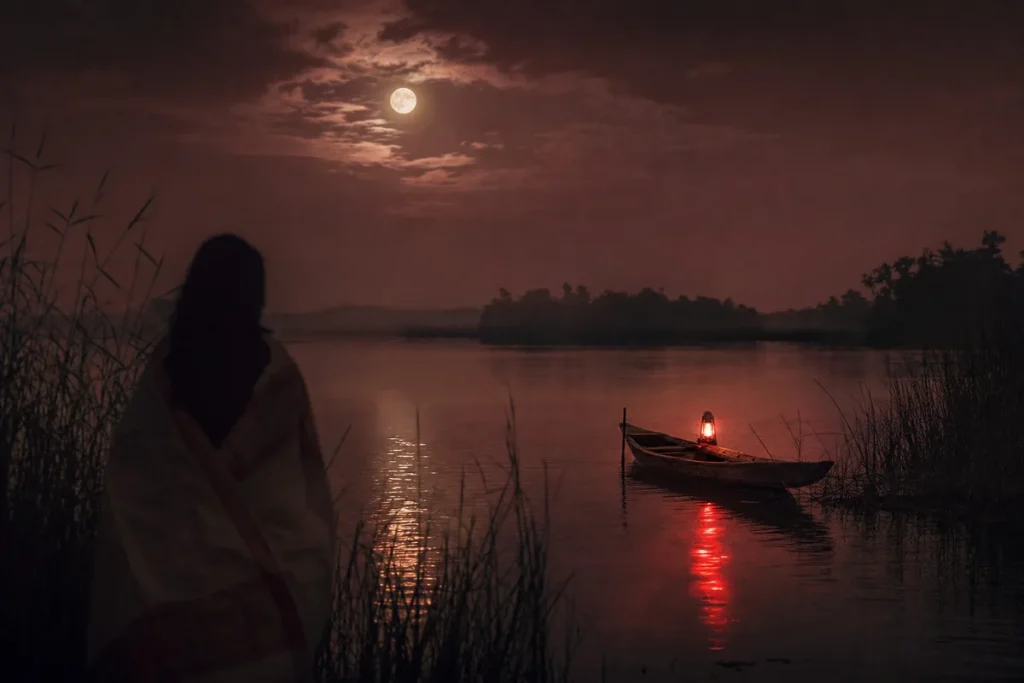
with a lantern on the bow of his little naao
and a voice that carried on the evening air
like smoke from a field being burned —
low, and warm, and everywhere at once.
He sang the old songs, the ones about
the girl who waits by the river for her love.
He sang them slowly, rowing past at dusk.
Malati, at the ghat with her brass pot,
did not look up. Did not look up.
The second evening, she looked up.
You know the rest. Everyone knows the rest.
A lantern in the reeds below the bamboo.
A gamosa left folded on a stone.
Two shadows on the sand of the char
where the river had laid down, that year,
a long pale bed of silt, as if to help.
The river saw. Of course the river saw.
It sees everything that happens on its edges.
It felt the little boat rock where it was tied,
felt the lantern's red light lie across it
like a hand across a sleeping face,
and it said nothing. That spring, nothing.
* * *
But the river remembers how she used to come
with only her brass pot and her bare feet
and nobody's name in her mouth.
It remembers how she sang to it, once,
before she had anyone else to sing to.
And in Ahar the water started rising.
First it took the char where they had lain,
rolled up the pale silt bed like a mat
and carried it off downstream to Majuli.
Then it took the bamboo, then the stone.
Then it came up to the steps of the ghat
and stood there, brown and wide and patient.
Dhan Gogoi said, It's only the monsoon.
He tied his boat with a double knot.
He mended the roof. He did not see
how his wife stood at the window every night
looking out over the black water
for a red light that was no longer there.
Because Rupam's naao did not come that week.
Nor the next. The ferry was not running.
The river had swallowed the far bank to the trees,
and the songs that used to carry on the dusk
were drowned under the roar of the current,
and all she heard at night was the river, breathing.
* * *
On the night of the full moon in Saon
she went down to the water anyway.
No brass pot. No gamosa. Only her feet,
and her hair loose the way a married woman
does not wear her hair outside the house,
and her lips moving without a sound.
And the river rose to meet her at the ghat.
It came up gently, the way it used to
when she was a child and it held her up.
It wound around her ankles, cool as silk.
It whispered, Did you think I would share you?
It whispered, I was here first.
They found the lantern three days later
caught in the water hyacinth below Dibrugarh,
the glass still whole, the wick still dry,
as though somebody had put it out with care.
They did not find Rupam. They did not find Malati.
Dhan Gogoi untied his boat, and rowed, and rowed.
* * *
So when they tell you at Bihu the river is a mother,
nod, and dance, and eat your pitha.
But on a full-moon night in Saon
if you go down to the ghat at Bogibeel
you will hear it, under the noise of the water:
a woman's voice, low, and somebody answering —
not Rupam's, not Dhan's — a deeper voice,
a brown and patient voice as wide as Assam,
singing the old song about the girl who waits,
singing it very slowly, over and over,
the way a lover sings when he finally has
what he wanted, and is afraid to stop.