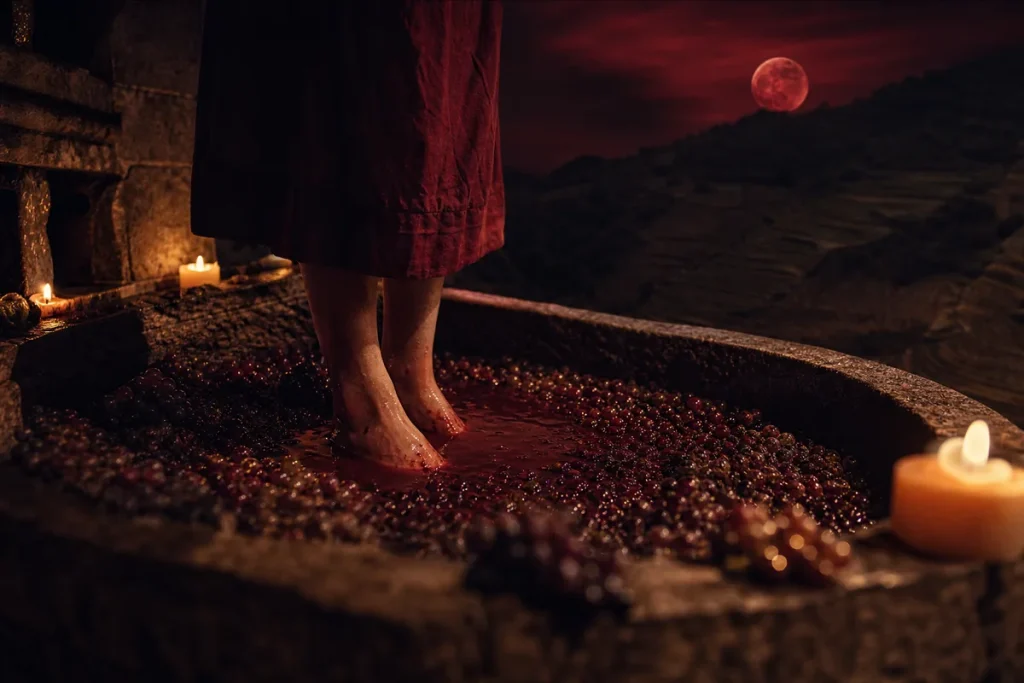
In the Douro they still tread the grapes by foot. Not for the tourists — for the wine. The old families say machines bruise the seeds and the wine comes out bitter, so at night, after the picking, a line of people climbs into the granite lagar, arms linked, and marches back and forth for hours through the crushed fruit, up to the thigh in it, singing.
That’s how I first touched Duarte Lapa de Vasconcelos. Arm in arm, in the dark, in two feet of warm grape must, his elbow locked through mine and his bare leg moving against my bare leg, purple to the hip.
I had been at the quinta for three days. I’d answered an advert on a café noticeboard in Lisbon: harvest work, two weeks, bed and food. I didn’t tell them I was running from a man, a flat, a whole life. Nobody at a harvest asks.
* * *
The house stood above the terraces like an old woman watching her grandchildren from a balcony. Grey granite, a chapel, a long veranda with tiled walls the blue of a bruise. Every window faced the river. The river in that valley is slow and green and very deep, and in the evenings it turns gold and then black.
Duarte’s mother never came down to the vineyard. I saw her once, the second evening, a small woman in black at a high window, and she looked straight at me — not at the other pickers, at me — and put her hand over her mouth and stepped back into the dark.
“Don’t mind Dona Amélia,” the foreman’s wife told me, filling my bucket with soup. “Since the boy drowned, she’s not right. She covers all the mirrors in that house. Twenty-five years.”
“Which boy?”
The woman looked at me strangely. “Tomás. The older brother.” She crossed herself. “You don’t know? He went into the river the night of the harvest party, ninety-nine. They never found him.”
* * *
In the lagar, Duarte didn’t sing. He marched beside me with his jaw set and his dark eyes fixed on the far wall, and every time the line turned, his hand on my forearm tightened.
He was thirty-eight or so. Broad shoulders, the arms of a man who still worked his own land, a white shirt stained to the elbow with wine. The candles stuck along the granite walls threw his shadow huge and moving, and the must was warm as bathwater, thick and sweet and alive, and the smell of it — fermenting fruit, sugar, something almost like blood — went to my head faster than any glass.
After two hours, when the others climbed out yawning, he stayed. So did I.
We stood in the middle of the lagar up to our thighs in dark red, the two of us, in the candlelight. He looked at me then, finally, the way his mother had from the window — as if I were someone come back.
“You look like someone,” he said.
“Who?”
He didn’t answer. He put his stained hand on my face, along my jaw, very gently, and his thumb left a purple mark on my cheek that I could feel drying. Then he kissed me. His mouth was sweet with grape and his body, through the soaked white shirt, was burning. I wound my arms round his neck and the must swirled round our legs, warm, thick, and I lost my footing and he caught me, and we went down, both of us, into the crushed grapes, laughing and then not laughing at all.
I’ll leave us there, in the lagar, by candlelight, purple to the neck. In the morning the foreman said it was the best must in ten years.
* * *
He took me up to the big house after that. Every night, after the treading, through the kitchen door, up the back stairs where the mirrors on the landings were draped in old black cloth like mourners.
His room had a long window over the river and an iron bed. He’d wash me first, every night, in the big enamel basin, warm water and a cloth, rubbing the purple off my legs inch by inch in silence while I stood on the cold tiles shivering, and the water in the basin went pink, then red, then dark. It was the most erotic thing anyone had ever done to me and also, I began to feel, the strangest. He did it so carefully. As if he’d done it before. As if he were restoring something.
* * *
On the ninth night I couldn’t sleep. He was breathing deep beside me, one heavy arm across my hips. I slid out from under it and went down through the dark house with my bare feet on the cold stone.
The cellar door was open. Barrels in long rows, the smell of oak and old wine and damp. And at the back, a small barrel by itself, on a stand, with a date chalked on the head: 1999. Beside it, carved into the granite wall with something sharp, two sets of initials. T. and I. A heart, roughly cut. And below, smaller, newer, scratched over and over until the stone was white: D. D. D.
“Inês,” said a voice behind me.
Dona Amélia was in the doorway in a black nightdress, holding a candle. In that light, for the first time, she wasn’t frightened of my face. She just looked tired.
“She was a picker too,” she said. “From Lisbon. Dark hair, like you. Your mouth. Tomás was going to marry her. They were going to announce it at the harvest party.” The candle shook. “Duarte loved her more. He always loved what his brother had.”
“What happened to her?”
“They said she went back to Lisbon.” The old woman looked at the little barrel. “That night Tomás went down to the river to look for her. He never came back up. And Duarte—” she stopped. “Duarte never let anyone touch that wine. Twenty-five years. He won’t sell it. He won’t drink it. He comes down here some nights and puts his hand on it, like a man touching a woman’s hip.”
* * *
I went back up the stairs past the black-draped mirrors. I didn’t run. I don’t know why I didn’t run.
He was awake, sitting on the edge of the bed in the moonlight from the river window. He’d heard me come in. He held out his hand.
“My mother talks at night,” he said quietly. “She’s been talking for twenty-five years. Nobody listens anymore.”
“Is it true?”
He pulled me down onto his knee. He put his face against my stomach and stayed like that for a long time, and his shoulders shook once, and his arms round my waist were so strong I couldn’t have got loose if I’d tried. I didn’t try.
“I’ve waited a long time,” he said into my skin, “for the harvest to bring something back.”
* * *
The pickers left yesterday. The foreman’s wife pressed my wages into my hand and said, low, “There’s a bus at seven from Pinhão. Be on it.”
I’m writing this in Duarte’s room. The river is going black under the window. He’s downstairs in the cellar; I can hear him moving barrels. He told me that tonight, for the first time in twenty-five years, he’s going to open the 1999. Just for the two of us. He said it should be drunk by someone who loves this house.
The bus from Pinhão left eleven hours ago.
I’ve washed my own legs in the enamel basin. I’ve put on the dark red dress he left on the bed. It fits me perfectly. It’s old, a little musty, hand-sewn. Somebody took it in at the waist once, by hand, very carefully.
I can hear him coming up the stairs. Two glasses clinking.
I’ve pulled the black cloth off the mirror. I want to see what he sees.