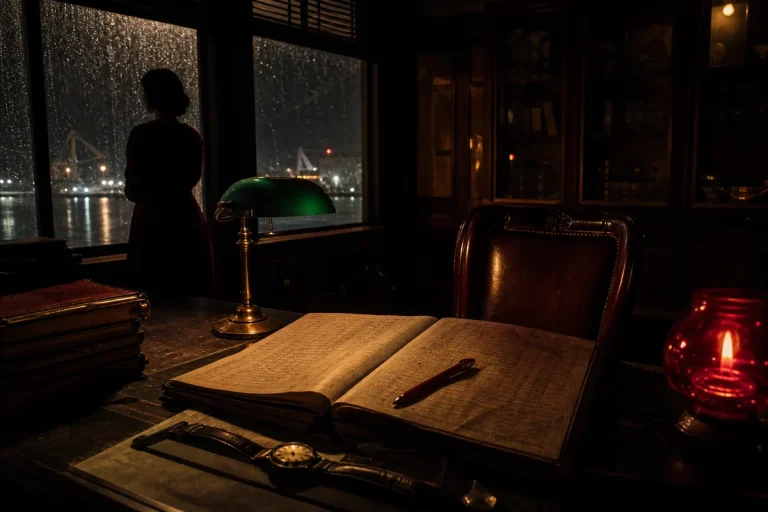
The first thing she said to me, before her name, before good afternoon, was: “Don’t tune it properly.”
I was standing in the hall of a house on Calle Posadas with my case in my hand and rain dripping off my hat onto a floor of black and white marble, and the maid who had let me in had already disappeared, and this woman in a grey dress was standing at the foot of the stairs looking at me as though I were a delivery she had not ordered.
“I’m sorry, señora?”
“The piano. My husband kept it flat. A little. He said four-forty was for orchestras and dentists.” She almost smiled. “He liked it at four-thirty-five. You can do that?”
“I can do anything to a piano, señora. Whether I should is another question.”
That, I think, is where it started. Not with her face, which was beautiful in the way of old photographs, all bones and patience. Not with the house. With the way she looked at me when I said that, as though I had spoken out of turn and she had decided, after consideration, to allow it.
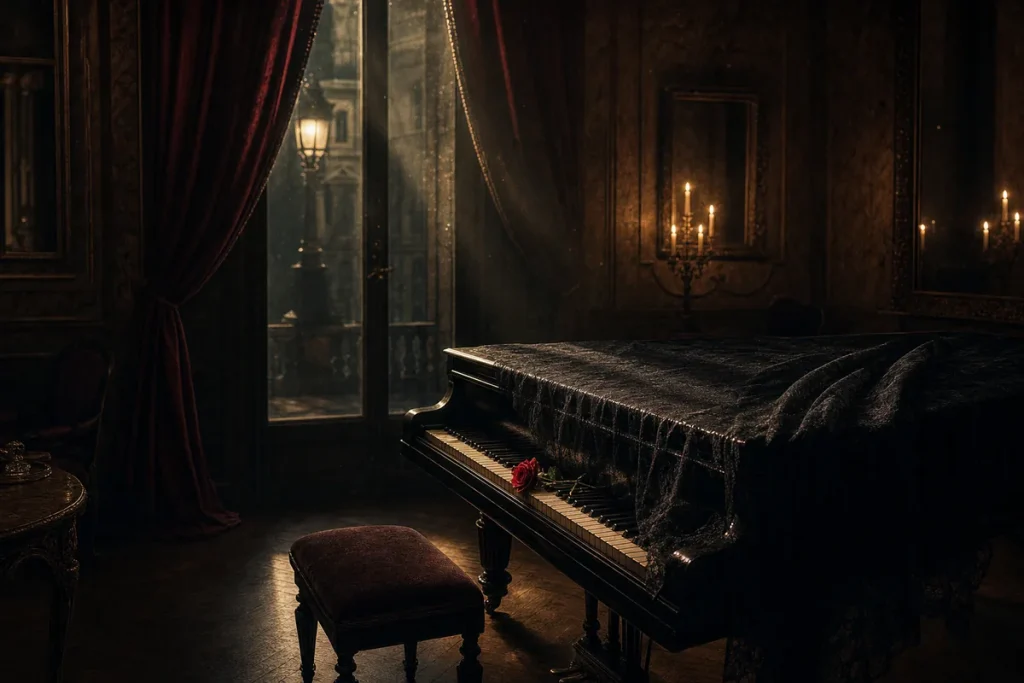
Her name was Inés Varela. Her husband had been dead eleven months. The piano was a Pleyel, French, 1911, rosewood, standing in a parlour with tall windows and crimson velvet curtains that had not been opened, I would have sworn, since the funeral. There was a black lace mantilla laid across the closed lid like a cloth on an altar. On the wall above it, in a silver frame, a man in his sixties with a white moustache looked down at me with the expression of someone who has caught a stranger in his bedroom.
I took the mantilla off the lid. She made a small sound. I folded it and gave it to her, and she held it against her chest while I worked.
* * *
A piano goes out of tune slowly, the way a marriage does: a little every day, nothing you could point to, until one evening you sit down to play the old song and it sounds like somebody else’s.
I told her it would need attention every month. She said every week. I said that was not necessary. She said, “Thursday. Four o’clock. Is that a problem?”
It was not a problem.
So every Thursday at four I climbed the steps on Calle Posadas and the maid let me in and I went to the parlour, where the curtains were closed and a single lamp was lit, and I opened the Pleyel and checked my fork against its A and found, every week, that it had hardly moved. Pianos don’t drift in a week. I knew it and she knew I knew it. I loosened a string here and there, a hair, so that I would have something to put right. I played the scales slowly. I took my time.
And she sat on a straight-backed chair by the window, with her hands in her lap, and listened. Not to the piano. To me working on it. I could feel her listening the way you feel the sun on the back of your neck.
On the fourth Thursday she said, “He used to play Fauré. The nocturnes. Do you know them?”
“A little.”
“Play one.”
I am not a pianist. A tuner plays well enough to know if the instrument is lying. But I played the fourth nocturne, badly, in the dim parlour, on a dead man’s piano tuned to a dead man’s ear, and when I finished she was standing behind me. I had not heard her get up. She was close enough that I could smell her: lavender water, and under it the dust of the closed room, and under that something warm and bitter like orange peel.
“He played it faster,” she said. “He always rushed the middle. I used to tell him.” She put one finger on the key I had just released, a B flat, and pressed it, very gently, so that it did not sound. “You don’t rush.”
“No, señora.”
“Inés,” she said, and went back to her chair.
* * *
I began to hate him. The man in the silver frame. I’m not proud of it.
I hated his moustache and his Fauré and his four-thirty-five. I hated that his reading glasses were still on the side table, folded, as though he would be back for them. I hated that every Thursday I spent an hour carefully keeping his piano wrong, so that it would sound the way it sounded when his hands were on it, so that she could close her eyes in her chair by the window and pretend.
Because that was what she did. I was sure of it. I was a ghost’s assistant, a man paid to hold the door open for someone who was never coming through it.
In the eighth week I brought a different fork. Four-forty. Orchestras and dentists.
She was late coming down. The maid said the señora had a headache. I sat alone in the parlour with the lamp and the curtains and the man on the wall, and I tuned the Pleyel properly. All eighty-eight. It took nearly two hours. When I finished it was dark outside, and the rain had started again, and I played the fourth nocturne at true pitch, bright and clean and a little cruel, and I did not rush the middle.
I heard the door. She stood in it in a dressing gown the colour of wine, her hair down, her face very white.
“What have you done,” she said.
“I’ve tuned your piano, Inés.”
She crossed the room. I thought she would strike me. I think she thought so too. Instead she sat down beside me on the bench — the bench is not wide; her hip was against mine — and she put her hands on the keys and played the first bars of the nocturne. She played well. Much better than me. And it sounded like another instrument, like another house, like the windows had been opened.
She stopped in the middle of a phrase.
“It doesn’t sound like him,” she said.
“No.”
She was crying, but not in the way I had seen before, quietly, into the lamp. She was crying the way you cry when a fever breaks.
I took her hand off the keys. I don’t remember deciding to. Her fingers were cold and they closed around mine as if they had been waiting, and outside the rain came down on Calle Posadas, and the man in the silver frame watched us, and for once I let him.
* * *
I would like to tell you that the curtains were opened after that. That she gave the mantilla to the church and the reading glasses to the maid and that she and I — well. I would like to tell you a lot of things.
What I can tell you is this. I went back the next Thursday at four. The maid let me in. The parlour was as it had always been: closed curtains, single lamp, the lace across the lid. Inés was in her chair by the window in her grey dress.
I opened the Pleyel and struck my fork, and the piano answered it, and the A was flat. Four-thirty-five. All of them. Someone had come in the week and put it back.
I looked at her. She looked at me for a long moment, and there was nothing in her face that I could read, and then she said, in her ordinary voice:
“Leave it like that, please. Just a little flat.” And after a pause, more quietly: “So he can still find his way in. And you can come every Thursday to let him out.”
I have been going for three years now. Thursday, four o’clock. I keep the piano as she likes it. I play the nocturne slowly, not rushing the middle. And afterwards, when the lamp is out, she shows me the other things in that house that a man must learn to keep exactly as they were — and some that she lets me change.