When Kenji ended it, he did it kindly, in a family restaurant in Shinjuku with a laminated menu between us, and he asked for his key back in the same voice he used to ask the waitress for more water. I took it off my ring and slid it across the table. It was a small brass key with a red silk cord through the head, because I had tied the cord there myself in the first month, so I would always find it in my bag.
He put it in his shirt pocket. He paid. He said, “Take care of yourself, Mi-chan,” and I said I would.
I did not tell him about the copy. I had it made in the second month at a key shop in the basement of the station, in case I lost the first. That is what I told myself at the counter, watching the machine whine and spit brass dust. In case.
* * *
For six weeks I did nothing. I want that to count for something.
I went to work. I translated the safety instructions for a commercial rice cooker and an industrial floor polisher. I watered my plants. In the evenings I walked home the long way, which went past the end of his street in Nakano, and I did not turn down it.
The seventh week it rained for four days, and on the fourth day I turned down it.
His building was the same. Four floors, cream tile, a row of bicycles under a plastic roof. His window on the third floor was dark. It was a Thursday; on Thursdays he had volleyball with the people from his office until ten. I knew that the way I knew my own phone number.
I stood under my umbrella across the street for a long time. Then I crossed it.
The key turned as if it had been waiting.
* * *
You must understand that I didn’t do anything. I didn’t take anything. I didn’t move anything, or not much.
I took off my shoes in the genkan, next to his. I went in. The apartment smelled the way it always had: tatami, and the cedar soap he bought in bulk, and faintly the sesame oil from the frying pan he never washed properly. The rain was loud on the window. I didn’t turn on the light. I didn’t need to; the streetlamp came in orange through the curtains, the same as it used to come in on the mornings I woke there and watched him sleep.
I sat on the floor at the low table where we used to eat. I put my hands flat on the wood. That was all. For about twenty minutes, I sat in the place where I had been happy, with the rain, and nobody knew I was there, and I was not happy, but I was close to where it had been, the way you sit close to a stove that has been turned off.
Then I put on my shoes and locked the door and went home.
It is very easy, the second time.
* * *
The second time I lay down on his futon. It was folded in the cupboard the way he always left it, and I took it out and unfolded it and lay on my side, facing the window, on the side that had been mine. The pillow smelled of him. I put my face into it and breathed until I was dizzy.
And under him — this is how I found out — something else. A shampoo. Peach, or something like peach, sweet and synthetic, the kind they sell to schoolgirls in pink bottles. I have never used a shampoo like that in my life.
I lay very still. I could hear my heart in the pillow.
The third time, I looked in the bathroom. A second toothbrush, green. A hair tie on the edge of the sink, the cheap elastic kind with a little plastic bead. Long hair. Lighter than mine, dyed. I held it up to the window and the streetlamp came through it like copper wire.
I put it back exactly where it had been. I am careful. I translate warnings for a living.
* * *
I went every Thursday after that, through the rest of the rainy season and into the heat. I learned her. That is the only way I can say it. I learned her the way you learn a city by walking it at night when nobody is there.
She drank green tea from a convenience store, the bottled kind, and left the empty bottles in a row on the windowsill like small soldiers. She read magazines about hiking. She slept on my side. I knew because the pillow on my side smelled of peach now, and the pillow on his side smelled only of him, and when I lay down I had to choose which one to put my face into, and I always chose his, and I hated myself, and I chose his.
Once I found a note on the table in his handwriting: Back late — there’s curry in the fridge — don’t wait up. No name. Just the little drawing he used to put at the end of notes to me, a cat with a round face. My cat. The cat he used to draw for me.
I sat with it for a long time. I didn’t cry. I folded it in half and then I unfolded it and smoothed it flat and put it back.
That was the night I took my shoes off in the genkan and didn’t put them side by side with his. I put them in a corner. As if I were a guest. As if I were the one who didn’t belong.
* * *
I know how this sounds. I know what you are thinking, and you are right, and I knew it too, every Thursday, standing in the corridor with the key in my hand and my heart going like the industrial floor polisher, model FP-40, Warning: Do not operate if the cord or plug is damaged. I was damaged. I operated.
What stopped me was not guilt. I wish it had been.
It was a Thursday in August, very hot. I let myself in. I took off my shoes. And on the low table, in the orange light, there was a small paper bag from the key shop in the basement of the station — I knew the bag; I had held one exactly like it — and next to it, lying on the wood, a brand-new brass key on a ring with a little plastic peach.
He had had one made for her.
Not a copy of my copy. Hers. Her own. She was going to have her own key, and walk in on her own, and take off her shoes in her own way, and nobody would ever have to sit in the dark and touch the table to remember.
I stood there for a long time.
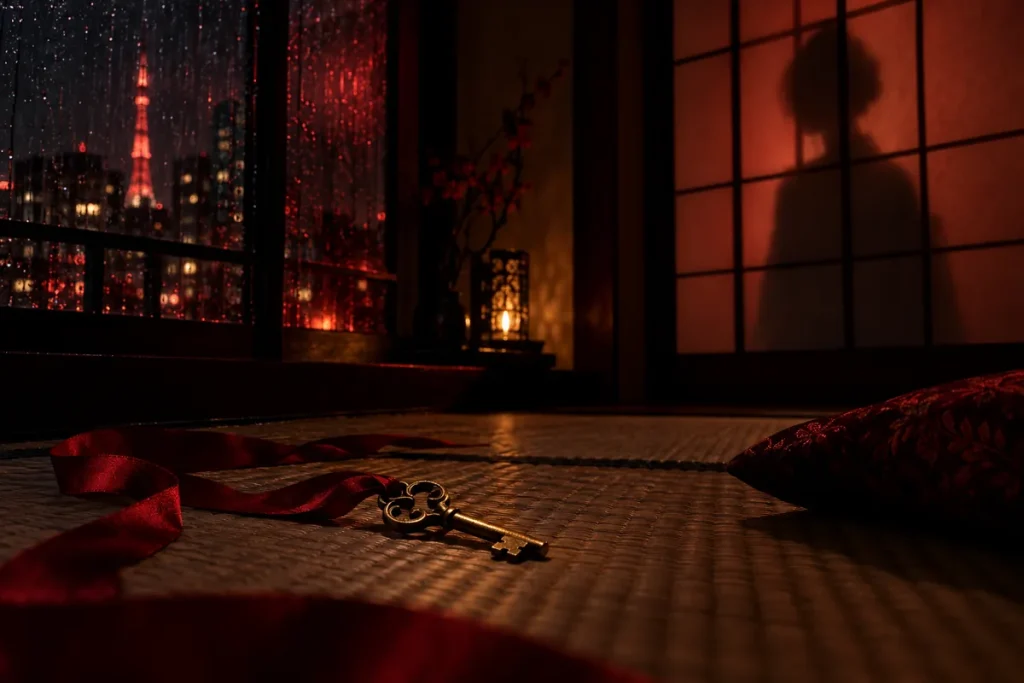
Then I took my key out of my bag. The small brass one, with the red silk cord through the head that I had tied myself, a long time ago, so that I would always find it. I put it on the tatami beside the door. Not on the table, next to hers. On the floor. Where you put things you are leaving behind.
I didn’t lock the door when I went out. I couldn’t. I didn’t have a key.
* * *
I don’t know if he found it, or if she did. I don’t know if they talked about it, or what they said, or whether he understood immediately or lay awake for weeks putting it together.
I moved to Kanazawa that winter. I have a new apartment, very small, and only one key, and I keep it on a plain steel ring with nothing tied to it at all.
But sometimes, on Thursdays, when it rains, I catch the smell of peach shampoo on a stranger in the bus, and my hand goes to my bag before I can stop it, feeling for something red.