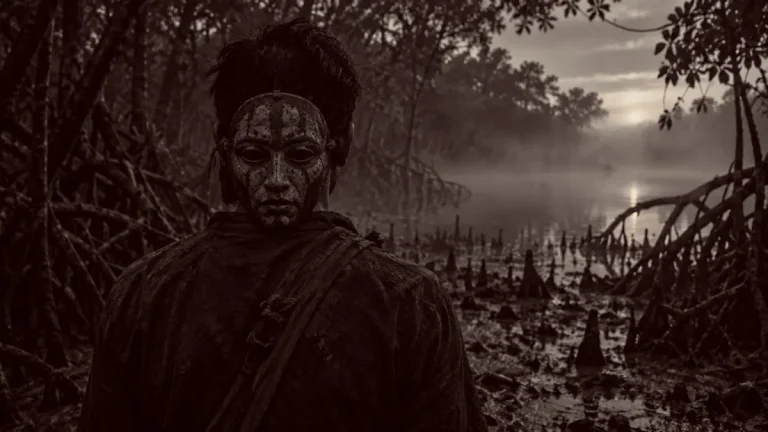
The last bhutbhuti out of Nimati ghat runs aground on a sandbank in the fog, and the old boatman says somebody on board still owes the river.
The peanut man got on at Nimati ghat with a tin trunk on his head and a bundle of newspaper cones under his arm, and Haren Das let him on without a ticket, which Junali noticed because Haren Das had just argued with a schoolteacher for five minutes over ten rupees.
“Bhaben Kaka doesn’t pay,” Haren said, when he saw her looking. “Bhaben Kaka has never paid.”
It was ten past four. The ferry should have left at half past two. A truck carrying cement for some government building in Kamalabari had got its back wheels into the soft mud of the loading ramp, and for two hours the whole ghat had watched four men and a tractor try to pull it out, and then watched them give up and unload the cement bag by bag onto the boat instead. So now the bhutbhuti sat low in the water with eighty bags of cement in the middle, three motorcycles tied along the side, a cycle with a basket of ducks, and fifteen passengers who all had somewhere they should have been by now.
Junali had a seat on the plank near the front, beside a woman with a baby wrapped up to its eyebrows in a pink woollen cap. Junali had come off a twelve-hour shift in the medicine ward at Jorhat Medical College and her feet hurt in a way that went up into her knees. Her mother had called twice already. Have you got on. Is it the big boat or the small boat. Don’t sit at the edge. She had answered yes, the big one, no.
The engine started on the third pull. The smell of diesel and wet jute came over everything. Somebody’s phone was playing a Zubeen song very softly, and somebody else said turn that off, and it was not turned off.
* * *
For the first half hour it was an ordinary crossing. The Brahmaputra in November is low and brown and wide, and the channels between the chars change every year, so the boatmen read the water the way Junali’s grandmother used to read the sky over the paddy. Haren Das stood at the back with the tiller under his arm and his helper, a thin boy called Monti, stood at the front with a long bamboo pole, putting it down into the water every few minutes and calling out numbers.
The light went early. Then the fog came up off the water, not down from the sky, the way it does on the river: first a low white skin over the surface, then knee high, then you could see the people on the boat but not the water beside it, and then you could not see the back of the boat from the front.
Haren Das cut the engine down to a mutter.
“Monti!”
“Six haat.”
“Again.”
“Five. Four and a half.”
“Left. Left, I said.”
The pole went down. The pole came up. Junali heard the boy say, “Two,” in a different voice, and then the bottom of the boat made a long soft sound, like a hand being drawn down a wall, and the whole thing tilted a little to the right and stopped.
Nobody said anything for a moment. Then the man with the cement, a contractor’s supervisor in a leather jacket, said, “What is this? Why have we stopped?” and everyone began talking at once.
* * *
They were on a char. That much was clear when Monti jumped down with the pole and stood on sand that came only up to his ankles. Not a big char. Haren Das walked its edge with a torch and came back in four minutes, which meant it was perhaps a hundred steps around. No grass on it, no reeds, no cattle prints. A new one, then, thrown up by this year’s flood and not yet found by anybody.
“Push,” said the cement supervisor. “We’ll all push. Come on, boys.”
The two college boys and Dipankar, who taught physics at a coaching centre near the Jorhat bus stand and had told Junali this twice already, got down with their trousers rolled up. The contractor’s man got down without rolling his up. The retired forest guard, Lakheswar, who was seventy if he was a day, got down too and nobody could stop him. They pushed. The boat did not move. They pushed with the engine going. The propeller dug a hole in the sand and threw water over everybody and the boat settled deeper into the hole it had made.
“Leave it,” said Haren Das. “Leave it, leave it. Get back in. You’ll break my shaft.”
“We can’t just sit here.”
“We’ll sit here.”
“Till when?”
Haren Das looked at the fog, and then at the water, and then, Junali thought, at Bhaben Kaka, who had not got down to push and had not said anything. He was sitting on his tin trunk with his cones in his lap, and he was eating his own peanuts, cracking them one by one with his thumb.
“Till it lets us go,” Haren said.
* * *
The first phone died at about six.
It was Dipankar’s. He had been trying to get a signal by holding it over his head, walking up and down the length of the boat between the cement bags, and he looked at it and said, “Arre,” and pressed the button on the side, and pressed it again. “It was sixty percent,” he said. “Sixty-one.”
“Cold,” said the contractor’s man. “Batteries go in the cold.”
It was not very cold. It was November cold, gamosa-around-your-neck cold. Junali had worked night duty in December in a ward where the windows didn’t shut and her phone had never done that.
The second one went ten minutes later. One of the college boys. Then the woman with the baby, Ranu, who had been sending voice messages to her husband’s mother, saying we are stuck, we are fine, we are stuck, don’t worry, and in the middle of saying don’t worry her screen went black. Her husband, Bitu, gave her his phone, and that went at about seven.
After that people stopped using them and just held them, as though holding them would keep them alive. Junali had fourteen percent. She turned on the torch for one minute, to look at the baby, who was asleep with a wet mouth, and when she turned it off it said nine.
* * *
Haren Das got the stove going in the back, a little kerosene stove he kept in a biscuit tin, and boiled water in a dented kettle for lal sah. He had six glasses. They passed them round. The ducks in the basket on the cycle made small complaining noises and the woman who owned them, a Mising lady who had said nothing at all so far, put her hand flat on the lid of the basket and they went quiet.
Bhaben Kaka got up then, for the first time, and went down the boat with his cones.
“Badam,” he said. “Badam, badam. Hot. Ten rupees. Badam.”
They were not hot. Junali could see that from her seat. But people bought them, because there was nothing else to do with their hands. He came down the boat slowly, the trunk left behind, the cones in the crook of his arm like a bundle of sticks, and as he went he counted. Junali remembered that later. At the time it was only the kind of thing old men do, the way her grandfather used to count the steps up to the namghar out loud, every single time, though there were always nineteen.
“One,” Bhaben Kaka said, giving a cone to the contractor’s man. “Two, three,” the college boys. “Four,” Dipankar, who said he didn’t want any and took it anyway. “Five,” the cloth trader from Garmur, who was going home with two sacks of eri chadar and had offered everybody one to keep warm. And so on down the boat. The duck lady. The schoolteacher who had argued over ten rupees. A Bihari man who sold plastic buckets. Lakheswar, the forest guard, “eleven”. Then Bitu, “twelve”, and Ranu, and he reached across Junali’s lap to put a cone into Ranu’s hand, and she said, “Kaka, I have no change,” and he said, “Later, later. Thirteen.”
He went back to his trunk and sat down.
“Kaka, you’re not counting yourself,” said one of the college boys, laughing.
“I don’t go across,” said Bhaben Kaka. “I only sell.”
* * *
It was Lakheswar the forest guard who said it first, though he said it as a joke.
“The river has stopped us,” he said. “Somebody hasn’t paid.”
“Haren, did you collect from everybody?” said the contractor’s man.
“Not that kind of paying,” said Lakheswar.
Nobody laughed, and then too many people laughed. The schoolteacher said this is exactly the problem with Assam, we are still in the middle ages, and the forest guard said, mildly, that he had worked thirty-one years in Kaziranga and the Burhapahar range and he had pulled more bodies out of the Brahmaputra than the schoolteacher had marked exam papers, and the schoolteacher stopped talking.
Then Haren Das said, from the back, “He’s right.”
He was sitting on the gunwale with the empty kettle between his feet. He was a heavy man with a grey moustache and a woollen cap pulled down to his eyebrows, and his voice was the same voice he used for telling people where to put their motorcycles.
“My father used to say it. My grandfather. On this stretch, between the big char at Dhakuakhana and the Majuli bank, the river keeps an account. Most people pay with what they drop. A shoe. A phone. A bag of rice. Sometimes it wants more.” He shrugged. “When it wants more, it stops the boat.”
“And then?” said Bitu.
“And then one person stays on the char till morning. The rest go.”
“And the one who stays?”
Haren Das did not answer that. He bent down and started tightening the screw on the stove.
“This is madness,” said Dipankar. He said it loudly. “Haren-da, you’re frightening the lady with the baby. There’s a perfectly good explanation. It’s a sandbank. In the morning the fog will lift and the water will come up a little when they open the gates at the Subansiri dam, or whatever, and we’ll float off. There’s no account.”
“The water doesn’t come up in November,” said Lakheswar.
“Then we’ll wait for a boat.”
“No boat will come out in this,” said Haren Das. “No boat comes on this stretch after dark.”
“Then the morning ferry—”
“The morning ferry goes by the other channel.”
Somewhere out in the fog, not close, there was a sound. Junali would not have been able to describe it to anyone afterwards. It was a little like a cow lowing, except it went on too long, and a little like a long breath let out through the nose, and it came from upstream and then, a moment later, from downstream, as if it had gone round them.
The Mising lady took her hand off the duck basket and put her palms together and touched them to her forehead.
* * *
They did not decide it all at once. That is what Junali would think about later: that there was no moment when anyone stood up and said let’s do it. It came like water through a sack. By nine o’clock there was no more tea. By ten, the boat had tilted a little further, and the cement bags had shifted, and Monti said the water was coming in through a seam at the front and began bailing with a plastic mug. By half past ten Junali’s phone died at three percent with her mother’s name on the screen. The sound came again, and again, and each time from a little nearer, and once there was a smell after it, the green smell of river weed when it is pulled up and left in the sun.
At eleven, Ranu’s baby woke and would not stop crying, and Ranu was crying too, quietly, and Bitu said, to nobody in particular, “If it’s true. If it’s only true. What does it cost to try.”
The contractor’s man said, “Who?”
And the boat was very quiet.
“Not the lady,” said Lakheswar at once. “Not the baby. Not the boy.” He meant Monti.
“I’ll stay,” said Lakheswar, after a moment.
“Don’t be stupid, you’re seventy,” said Dipankar. “You’ll die of cold.”
“Then you stay.”
“I have a mother who—”
“We all have mothers.”
They were raising their voices now and the baby cried harder, and Junali, who had stood in a corridor at three in the morning while two doctors argued over which of two patients got the last ventilator, said, “Stop it. Stop. If we’re going to do it we do it properly.”
She heard herself say it and did not know where it had come from.
She tore pages out of her duty diary, the small red one the nursing superintendent gave everyone in January, and tore each page in half. She gave out the pieces and Dipankar’s pen, which had come from a coaching centre and said FUTURE TOPPERS on the side. Everyone over eighteen. Write one name. Fold it. Put it in Haren Das’s cap.
“I’m not writing,” said Haren Das. “It’s not mine to write.”
“Then you count.”
People wrote. The cloth trader asked how to spell Lakheswar. Nobody answered him. The duck lady could not write and whispered something to Bitu and Bitu wrote it for her and folded it. Junali wrote a name on her own slip and folded it twice and did not look at anyone while she put it in the cap.
Haren Das tipped the cap out onto a cement bag and opened the pieces one by one in the light of the last torch, which was the college boy’s, and read them out.
“Bhaben Kaka,” he read. “Bhaben Kaka. Bhaben Kaka.” Then one with the schoolteacher’s name, and one with Dipankar’s, and then “Bhaben Kaka” again, eight times, nine. He stopped reading out loud after a while and just put them in a pile.
Bhaben Kaka had not voted. He was sitting on his tin trunk eating peanuts.
“All right,” he said, before anybody could tell him. He stood up and brushed the shells off his lap. “All right. Somebody help me with the trunk.”
* * *
They helped him with the trunk. Junali would remember that too, that Dipankar and one of the college boys lifted the tin trunk down onto the sand as carefully as if it were a person, and set it down, and Bhaben Kaka sat on it, and Ranu gave him the pink blanket from the baby’s bag and he put it round his shoulders without a word.
The cloth trader gave him an eri chadar. The schoolteacher gave him ten rupees, and then, as if ashamed, fifty more.
“Kaka—” said Junali.
“Go and sit, baideu,” he said. “Your feet are tired.”
And the boat moved.
It did not move because anyone pushed. Monti was still bailing. Haren Das had not touched the engine. The boat simply lifted, the way your body lifts when you lie back in a pond, and turned a little on the water, and slid off the char backwards. The engine caught on the first pull. Haren Das swung the tiller over without a word and they went into the fog, and when Junali looked back, the shape of the old man on his trunk with the pink blanket round him was already grey, and then less than grey, and then there was only the fog and the sound of the engine.
Nobody spoke all the way across.
* * *
The fog lifted at about half past five, all at once, the way it does, and the sun came up red behind Dhakuakhana. They were not where Haren Das thought they were. They were far upstream of the Kamalabari ghat and he had to bring the boat down along the bank for forty minutes, past the dark low line of the island with its silk-cotton trees and smoke from kitchen fires and the white of a satra’s walls between them.
Junali looked back the way they had come. The river was wide and flat and shining. There was no char. There was nothing anywhere on the water at all, not a sandbank, not a stick, for as far as she could see in either direction, only a pair of river dolphins coming up and going down a long way off.
“It’s gone under,” said one of the college boys. “The water came up.”
“The water doesn’t come up in November,” said Lakheswar, not looking at anyone.
* * *
The tea stall at Kamalabari ghat opens at five for the first boat. It is a bamboo shed with a tin roof and two benches and a glass case with laru and Jeera biscuits, and a kerosene stove going under a black kettle, and a boy who washes the glasses in a bucket.
Bhaben Kaka was sitting on the bench, with his tin trunk beside him.
He was dry. That was what Junali saw first, as a nurse sees things, before she saw anything else. His shirt was dry and his dhoti was dry and the soles of his feet, bare on the mud floor, had no sand on them. The pink blanket was folded neatly beside him on the bench. He had a glass of red tea in his hand and he was blowing on it.
The passengers came up the ramp one by one with their bags, with the motorcycles being wheeled off behind them, and they saw him, and they stopped. Nobody screamed. Nobody ran. It was too early and too bright for that, and there were ordinary people at the ghat, a man unloading banana leaves, two schoolgirls in uniform, a policeman yawning, and in the middle of all of it was Bhaben Kaka with his tea, smiling, nodding to each of them as they came up, the way an old man nods to people from his own village.
“Dipankar,” he said. “Sir. Your mother is well? Good. The big one in the year after next, Sir, in Shraavan. I’ll see you there.”
Dipankar stood with his mouth open.
“Lakheswar. Old friend. You I’ll see soon. The first rains.”
The forest guard nodded slowly, as if that was only fair.
“Bitu. Ranu.” To Ranu he held out the pink blanket. “Take it, maina, the morning is cold for the small one. Bitu, the flood when your daughter is nine. The one that takes the embankment at Salmora. Ranu, the same day.”
He went on. He knew every name. He knew the cloth trader’s name and the name of the man who sold buckets, which nobody else on the boat had known. He told each one a flood, a year, a month, sometimes a place, and he said it pleasantly, as a man tells you when the next bus is, and each of them stood there and took it and then went past him, down the road towards the shared autos, without speaking.
Junali was last.
She stood in front of him. Her feet still hurt. Her bag strap was cutting into her shoulder. She waited for him to tell her.
“Sit, baideu,” Bhaben Kaka said. “Have tea. Jiten, a glass for baideu. Without sugar, she likes it without sugar.”
She did. She had never told him that.
The boy brought the glass and she took it and held it, and Bhaben Kaka was already looking past her down the ramp at the river, which was quiet and enormous in the sun, and he did not say anything else to her at all.
She sat on the bench with the hot glass between her palms. A motorcycle went past. Somewhere in the village a namghar bell was going, very faint.
And it came to her then, sitting there, not all at once but the way you notice that a drip has stopped: the cones going down the boat in the dark. The contractor’s man, one. The college boys. Lakheswar, eleven. Bitu, twelve. The old brown arm reaching over her lap to Ranu, over her, the way a ward boy reaches over a bed that has already been stripped. Thirteen.
There had been fourteen of them.