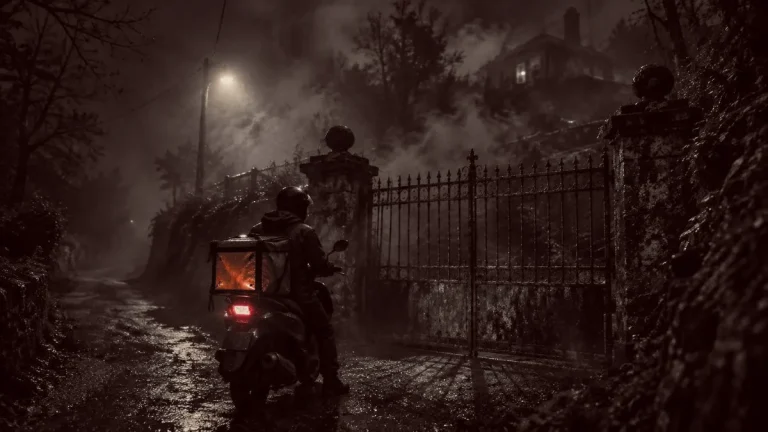
In the mangroves the honey collectors wear their masks on the backs of their heads. Every morning Ratan wakes to find his has been turned around.
The mask is clay, painted, with big white eyes and a red mouth, and it goes on the back of the head. Every mouali in the boat wears one. Mama comes from behind, always from behind, so you give him a face to look at where he expects a neck. That is the whole idea. A child could understand it. Ratan’s father wore one, and his father’s brother, who was taken anyway, in a creek off the Matla, in a year when the masks were plastic and the old men said that was the trouble.
On the first morning Ratan wakes in the bottom of the boat with the tide going out under him and a crab ticking along the plank near his ear, and the mask is on his face.
Not on the back of his head, where he tied it. On his face. The painted eyes are over his own eyes and he is looking out through the two holes at the grey sky.
He sits up. He pulls it off. Nitai, at the stern, is lighting the stove with his back turned.
“Ke ghurieche?” Ratan says. Who turned it.
Nobody answers. Haru is still asleep with his mouth open. Gopal-da is sitting on the prow with his legs crossed, wrapped in his shawl, looking at the mask in Ratan’s hands, and it is a long look, and then he looks at the forest instead.
“Ghumer moddhe ghure jay,” Nitai says, without turning. It turns in the sleep. “Tui ultopalta ghumos.”
Ratan does not sleep upside down. He sleeps on his back like a dead man. His mother used to say so.
* * *
They are seven in the boat. Gopal-da, the gunin, who knows the mantras that close the forest’s mouth. Nitai, who owns the boat and holds the permit from Sajnekhali. Haru and his brother. Two cousins from Kultali. And Ratan, who is twenty-four and has done three seasons and has the best eyes for a hive of anyone on the island, everyone says it, he can see the bees going in and out of the khalsi bushes from fifty hands away.
It is April. The khalsi is in flower and the honey is coming thin and pale and the bees are fat with it. The tide goes in and out of the creeks twice a day like the forest breathing. When it goes out, the mud shines and the pneumatophores stick up out of it in their thousands, sharp as nails, and every footprint in the mud is a word you have to read.
On the first afternoon they go in. Gopal-da walks in front, saying the mantra under his breath and tying a thread on a goran branch, and the rest follow, single file, with the daos and the bundles of hental leaf for the smoke. Ratan walks last. His mask is on the back of his head, tied twice. He can feel its weight there, a second skull.
They take two hives that afternoon. Good ones. The comb drips in the light.
* * *
On the second morning the mask is on his face again.
This time he tied it with a strip of lungi cloth, a knot his father taught him, a fisherman’s knot. The knot is still tied. The mask is still tied to his head. It has simply gone around, the cloth twisted, like someone turned his whole head in the night and left his body lying where it was.
Haru laughs at first, then sees Gopal-da’s face and stops.
Gopal-da takes the mask from Ratan and holds it in both hands. He turns it over. He smells it, actually puts his nose to the clay and smells it. Then he gives it back.
“Jongol kauke beche niyeche,” he says. The forest has chosen someone.
“Ke?” Ratan says.
Gopal-da does not answer. That is the way with gunins. He goes and sits on the prow and begins his morning prayer to Bonbibi, the long one, the one about Dukhe the poor boy left on the island by his rich uncle for Dakshin Rai to eat, and how Ma Bonbibi came across the water on her tiger and saved him. Every gunin sings it. Ratan has heard it a hundred times. Today he listens to it.
Nitai cooks rice and dal and nobody talks while they eat.
* * *
That afternoon there is a fresh print in the mud at the edge of the Pirkhali creek, bigger than Ratan’s two hands spread. The mud has not yet filled it with water. Gopal-da squats by it and says a long mantra with his eyes shut and ties a red thread on a sundari root. They go in further than yesterday. Gopal-da says the honey is better deeper.
Ratan walks last again. Nobody tells him to. He finds he is at the back of the line each time they set off, the way water finds the low place.
He takes the biggest hive of the season that day. Haru holds the smoke. Ratan climbs. When he comes down with the comb in the basket, all six of them are standing at the bottom of the tree looking up at him, and for a moment, before they smile, it is not his face they are looking at. It is something just behind his shoulder.
* * *
On the third night he sews the mask to the back of his gamchha with fishing line and wraps the gamchha round his head and ties it under his chin like a woman going to market.
He does not sleep. He lies on his back in the bottom of the boat and watches the stars over the mangroves, and listens to the tide sucking at the hull, and Haru snoring, and a night bird far off going tuk, tuk, tuk. He holds the edge of the gamchha in his fist.
Some time after the moon goes down, his eyes close.
When he wakes, he is looking out through two painted holes, and the fishing line is lying in the bottom of the boat cut into short neat pieces, the way you would cut it with a blade.
* * *
On the fourth day he stops asking.
He watches instead. He watches Nitai measure out the rice in the morning from the sack, one bowl, two bowls, and he watches him put aside a smaller bag for the journey home. He watches Gopal-da tie the threads in the forest. Red. Red. Red. And once, on a tree near where they take the last hive of the day, not red. Black. Gopal-da tying it quickly and moving on.
He watches them sit together at the stern after dark, the six of them, talking low, and stop when he comes near. Not like men who are hiding something. Like men at a bedside.
Haru’s brother gives Ratan his own bidi, which he has never done.
The cousins from Kultali ask about his mother. Whether she still has the cow. Whether his sister is married.
Nitai, scraping the rice pot, says without looking up: “Tor kopal bhalo, Ratan. Ei bochhor modhu bhalo hoyeche.” You’re lucky this year. The honey is good this year.
The honey is very good this year. The boat sits low in the water with it. Eight hives in four days. In his three seasons Ratan has never seen that. He has never heard of it.
Dhona, in the song. The rich uncle. Who went into the forest and could not find any honey, not a drop, until he made his promise to Dakshin Rai. And after the promise, the bees came to him from every tree. And the boat sat low in the water with it. And Dhona went home with the honey and left Dukhe on the shore.
Ratan sits with the bidi going out between his fingers and does the sum in his head. Seven men came. The small bag of rice for the journey home is for six.
* * *
On the fifth morning the mask is on his face, and he does not take it off.
He sits up wearing it. They all see him. Nobody says anything. Gopal-da, on the prow, has his shawl over his head and his lips are moving.
Ratan looks at them through the two holes, one by one. Nitai. Haru. Haru’s brother. The two cousins. Gopal-da. They look back. Their own masks are on the backs of their heads, all of them, painted eyes turned to the forest, the way masks are supposed to be.
And he understands what the mask was doing. It was never turned so that he could see Mama coming. A man cannot see behind himself. It was turned so that Mama, coming up behind him through the golpata, would find no face there. Only the bare back of a neck. And so that the men in the boat, looking at him, would see a face that was not his. Clay, and white eyes, and a red mouth. A face that was easy to leave.
Gopal-da had not been reading the mask, those mornings. He had been checking that it was still facing the right way.
“Choll,” says Nitai. Let’s go. “Last hive. Gopal-da says it’s a big one. Deep in. You’ve got the best eyes, Ratan.”
They go in, single file, Gopal-da first. Ratan last. The tide is going out and the mud is shining and the pneumatophores are sticking up out of it like the spikes on a fence. A long way in, past where the black thread is tied, Gopal-da stops and points up into a keora tree, and there is the hive, enormous, the bees pouring in and out of it like gold smoke.
“Tui ja,” says Gopal-da. You go.
The others step back. Not far. Just enough. Haru will not look at him. Nitai is already looking at the path back to the boat.
Behind Ratan, in the golpata, something heavy shifts its weight from one foot to another and the leaves stop moving.
Ratan stands very still in the mud with the mask over his face. Then, slowly, so as not to hurry anything, he reaches up and unties it, and turns it round to the back of his head, and ties it there again with his father’s knot. And he picks up the hental bundle, and lights it from Haru’s matches, which Haru gives him without a word, and walks forward to the tree, singing the part of the song where Dukhe calls out across the water, Ma, Ma, kothay achho, because Bonbibi only comes for the one who calls her by name, and he is not going to be quiet about it.
He does not look back to see who is following. He knows who is following.