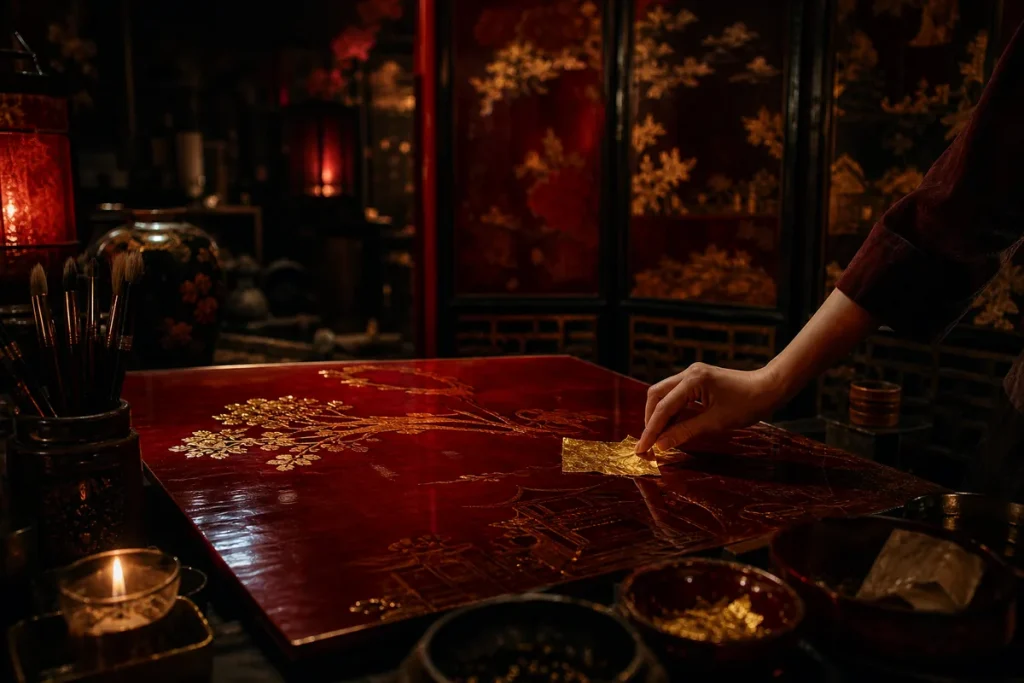
Raw lacquer burns. Nobody tells you that when you admire a finished panel in a hotel lobby, all that deep, wet, shining red. The sap of the sơn tree, before it cures, raises welts on any skin that touches it. My father’s hands were scarred to the wrist from forty years of it. He used to say lacquer is like a woman from Huế: it takes its time, and it remembers everything.
I remember everything.
* * *
Mr. Lưu Quang Đạt came to my studio in a white car that could not fit down the lane, so he walked the last hundred metres through the puddles in Italian shoes, and I watched him from the upstairs window and thought: so this is your face.
I had only ever seen him in documents. The signature on the papers that took my father’s house on Hàng Bạc Street — the narrow tube house where I was born, where three generations of us had painted and sanded and polished in the long back room. A loan my father never took. A seal that was not his seal. Lawyers. Then a hotel. Then, eighteen months later, my father in a hospital bed with his scarred hands folded, saying the house is gone, Khuê, the house is gone, as if he were reporting the weather.
And now the man wanted a panel for the lobby of that hotel. Three metres wide. Red and gold. “Something traditional,” he said, standing in my studio with rain on his shoulders. “Something with soul.” He was handsome. I hadn’t expected that. Fifty, silver at the temples, a mouth that smiled first on one side, warm brown eyes that looked at my unbuttoned work shirt and then, politely, didn’t.
“It will take three months,” I said. “Lacquer can’t be hurried.”
“Then I’ll come and watch it not being hurried,” he said.
* * *
He came every Thursday evening. I don’t know what he told his wife.
At first he sat on the bench by the door with a glass of rice wine and watched me lay the coats. Each layer of red on the board, then into the damp cupboard to cure, then sanding under water, then the next. He liked to watch me sand. I knew he did. It’s a slow, wet, rhythmic work, the stone moving in circles under my palm, my sleeves pushed up, water running down my wrists, my whole body rocking with it. I could feel his eyes on the back of my neck like a hand.
On the third Thursday he took off his jacket and asked if he could try.
I stood behind him at the bench and put my hands over his on the sanding stone. His back was against my breasts. His hair smelled of expensive soap and cigarettes. I moved his hands in slow circles over the wet red surface, and I felt him breathing, and I felt him harden all along the length of his body, every muscle going tight against me, and I kept the circles slow. Slow. Lacquer can’t be hurried.
“You’re very patient,” he said hoarsely.
“Yes,” I said, into his ear. “I am.”
* * *
The first night I let him stay, I made him take his shoes off at the door the way my father always did. He laughed. He did it.
I’m not going to pretend I felt nothing. That is the ugly part of this story, the part I tell you only because otherwise none of it is true. His hands were good. Gentle, unhurried, attentive, as if he had decided to learn me the way I was learning him. When he unbuttoned my work shirt he kissed the old burn on my collarbone, a lacquer burn from when I was nineteen, and asked how I got it, and when I told him he kissed it again, longer. Rain on the tin roof. The smell of the damp cupboard and the red. I pulled him down onto the mat in the long room and for an hour I forgot whose son he was, whose signature, whose house.
For an hour. Then he fell asleep with his arm across my stomach, and I lay awake and listened to his breathing deepen, and when it was deep enough I slid out from under the arm, took his phone from his jacket, and pressed his sleeping thumb to it as gently as a kiss.
* * *
It went on for eleven weeks. Eighteen coats of lacquer.
He talked, in bed. Men do, when they think a woman is soft. About the hotel, the partners, the officials who needed envelopes, the old houses on the old streets that were “only standing there being sad, wasting the land”. He talked about the seals. He laughed about the seals. “Old people never read what they sign,” he said, his mouth against my shoulder, “and when they don’t sign, well, there’s a man in Hà Đông who makes very good seals.”
I photographed everything while he slept. Contracts. Messages. A ledger in a hotel safe whose number he typed in front of me because by then I was furniture, I was the lacquer girl, I was the warm body that smelled of tree sap. I sent it all to a woman I went to school with, who now writes for a newspaper that does not take envelopes.
And on the panel, under the red, I painted my father’s house.
That is how sơn mài works. You build the picture in layers, gold leaf and eggshell and colour, and then you bury it under coat after coat of lacquer until the whole surface is one deep, blind red. Then you sand. Patiently, under water, for days, and the picture comes up through the red slowly like a face surfacing in a river. Only the painter knows exactly what is under there. Only the painter knows when to stop.
* * *
The panel went up in the lobby on a Thursday. He threw a party. Ministers’ wives, foreign investors, a quartet. He stood with his hand at the small of my back, introducing me as “the artist, a true artist, from a real Hanoi family,” and his thumb moved there in small slow circles the way I had taught him, and I let it.
The panel was all red. Deep, shining, perfect. People said it was like looking into a glass of wine.
At midnight, when they had gone, he took me up to the suite on the top floor. He was a little drunk and very happy. He undid my áo dài slowly, button by button down the side, kissing each place the silk opened, and I closed my eyes and let myself have it, one last time, all of it — the warmth of him, the weight, the mouth — because I am my father’s daughter and I believe a thing should be finished properly.
In the morning the newspaper came out.
* * *
I wasn’t there when they took him from the hotel. I was downstairs in the empty lobby at six a.m. with a bucket of water and a sanding stone, and I was working on the panel.
Circles. Slow. The red thinning under my palm. Gold coming up through it, then the pale broken eggshell of old walls, then the shape of a narrow door, a hanging lantern, a long back room full of boards.
By the time the police cars had gone and the guests came down to breakfast, my father’s house was there on the wall of the hotel that ate it, shining, three metres wide, under a last clear coat of lacquer that will never come off.
My hands are still burning. Not from the lacquer. From him, I think. From how much I wanted him. That’s the part that doesn’t wash out.
Lacquer remembers everything. So do I. Some nights I wish I didn’t.