The first thing you should know about the Minister is that he never read his speeches before he gave them.
“If I read it first, I’ll start performing it,” he told me in my first week, tapping the pages on his desk to square them. “I want to meet the words at the same time as the audience does. I want to be surprised by you, Lindiwe.”
I was twenty-nine. I’d been writing press releases about road maintenance in a provincial office with a broken air conditioner. And this man — tall, grey at the temples, a voice like dark honey poured slowly — wanted to be surprised by me.
So I surprised him. For two years.
* * *
You have to understand what it is, to write for a voice like that. You sit at your laptop at one in the morning in a flat in Arcadia, and you write a sentence, and you hear it in his mouth. You learn his breath. Where he pauses. Which words he leans on, which consonants he loves — he loved a hard “k”, the way it clicked — and you start to write for his tongue the way a composer writes for one singer.
Then you stand at the back of a hall in Polokwane or Durban, and he lifts his chin and says your sentence, and four thousand people go silent, and some of them cry. And he looks up, just once, over all of them, and finds you at the back. Every time. He always found me.
It’s the most intimate thing I have ever done with anyone. Including what came after.
* * *
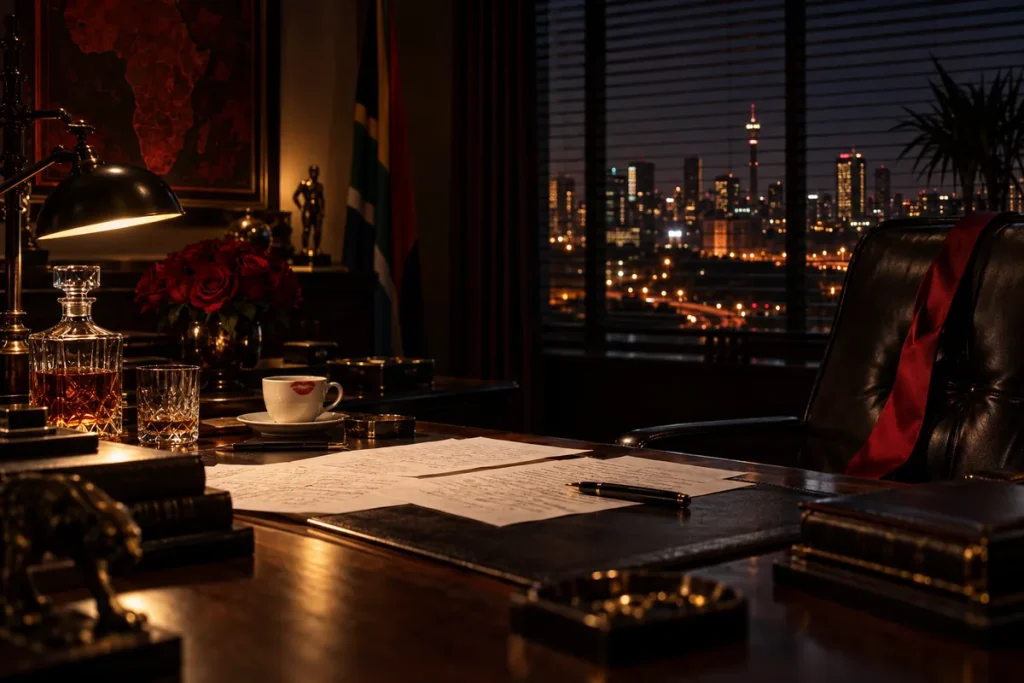
What came after started in his office in the Union Buildings, nearly midnight, after a budget vote. Everyone else had gone home. He had his jacket off and his tie pulled loose and his shirtsleeves rolled to the elbows, and he was reading my draft aloud, pacing, trying the lines.
He stopped beside my chair. He read a sentence slowly, very low, and then he said, “No. You read it. I want to hear how you hear it.”
So I read it. My own words. And while I read he stood behind me and put his hands on my shoulders, and then his thumbs moved, slowly, up the sides of my neck into my hair, and my voice went to pieces in the middle of a sentence about water infrastructure.
“Keep going,” he said.
I couldn’t. I put the pages down. I tilted my head back against his stomach and looked up at him upside down, and he bent and kissed me like that, upside down, his mouth on my mouth the wrong way round, and it was the strangest, hottest kiss of my life. Then he turned my chair around.
He locked the door. He turned off the big light and left the desk lamp on, and its yellow circle fell across the pages on the floor, my words, scattered, while he unbuttoned my blouse with the same unhurried care he gave a podium. He said things to me in that low honey voice. I recognised some of them. Some of them were mine.
I’ll leave us there, under the portrait of the President, with the door locked. Some files stay closed.
* * *
It went on for fourteen months. His office, after the late sessions. Hotel rooms in Bloemfontein, in Gqeberha, connecting doors left unlocked. Once in the back of the ministerial car with the partition up and the Highveld storm hammering on the roof, his hand inside my skirt and his mouth at my ear, whispering the opening of his conference speech so I could hear how he’d say it tomorrow. I wrote better than I had ever written. Every speech was a love letter in code. Four thousand people heard them. Only one person knew who they were for.
He had a wife. A good one, a judge, sharp and elegant, who shook my hand at functions and said “You’re the one who makes him sound clever.” I hated how much I liked her. I hated it less than I wanted him.
* * *
I found the tender documents by accident. I was looking for an old speech on the shared drive and opened the wrong folder.
A water project in the Eastern Cape. Six hundred million rand. Pipes that existed only on paper. Villages that were told every year that next year the taps would run. The company that got the tender belonged to his nephew. And the speeches — my speeches — the ones where he stood in dusty school halls and promised clean water with that dark voice breaking, the ones where people cried — every one had been given in a village on that list.
I had written the cover. Beautifully. In his voice. For his mouth.
I sat in my car in the basement of the Union Buildings for two hours and couldn’t stop shaking.
* * *
He was giving a big speech the following Tuesday, live on national television. Water Week. He wanted it to be “the best one you’ve ever written, my love.” He kissed the inside of my wrist when he said it. He never read his speeches before he gave them.
I wrote it in one night.
It begins the way they always begin — the river, the grandmother carrying water on her head, the promise of the nation. His favourite consonants. His favourite pauses. And then, in the middle, a sentence about pipes. And then the names of seven villages. And then the name of a company. And then a sentence about a nephew. In his voice. In his rhythm. So beautifully built that by the time his mouth understood what it was saying, it would already be said.
On Tuesday I stood at the back of the hall in Pretoria with the cameras in front of me and my heart going like a fist against a door.
He lifted his chin. He began. The river. The grandmother. Four thousand people going silent.
He reached the sentence about the pipes.
And he stopped. He looked down at the page, really looked, for the first time in two years. The silence went on too long. People started to shift. A camera operator glanced up from his viewfinder.
Then he lifted his head and looked over all of them, the way he always did, and found me at the back.
I’ll never know what he saw on my face. I know what I saw on his. Not anger. Something worse. Something like pride.
He smiled, first on one side. And he read the next line. And the next. All seven villages. The company. The nephew. Every word, in that voice like dark honey, without a single stumble, and four thousand people went from silence to a sound I’d never heard a crowd make.
* * *
He resigned on Friday. The judge has filed for divorce. The nephew’s in court in Bhisho.
Last night my phone rang at one in the morning. Unknown number. I knew the breath before he said anything.
“That was the best one you’ve ever written,” he said. “I want you to know that.”
I didn’t answer.
“I’m writing a book,” he said. “My side. Off the record, of course.” A pause, the exact length of the pauses I used to write for him. “I’ll need a voice, Lindiwe. Nobody knows my voice like you.”
I’m still holding the phone. I haven’t said yes.
I haven’t hung up, either.