An interpreter is a glass wall. That’s what they taught us at the graduate school in Seoul. You are clear. You are clean. Words pass through you without a fingerprint. If anyone in the room remembers your face afterwards, you have failed.
For eleven years nobody remembered my face. I was proud of that.
Then Mathieu Delorme looked at me across a table on the forty-first floor of a glass tower in Yeouido and said, in French, before the session had even begun, “You have a beautiful voice. I’m going to enjoy listening to you lie for me.”
I translated it for the chairman as “Good morning, thank you for having us.”
* * *
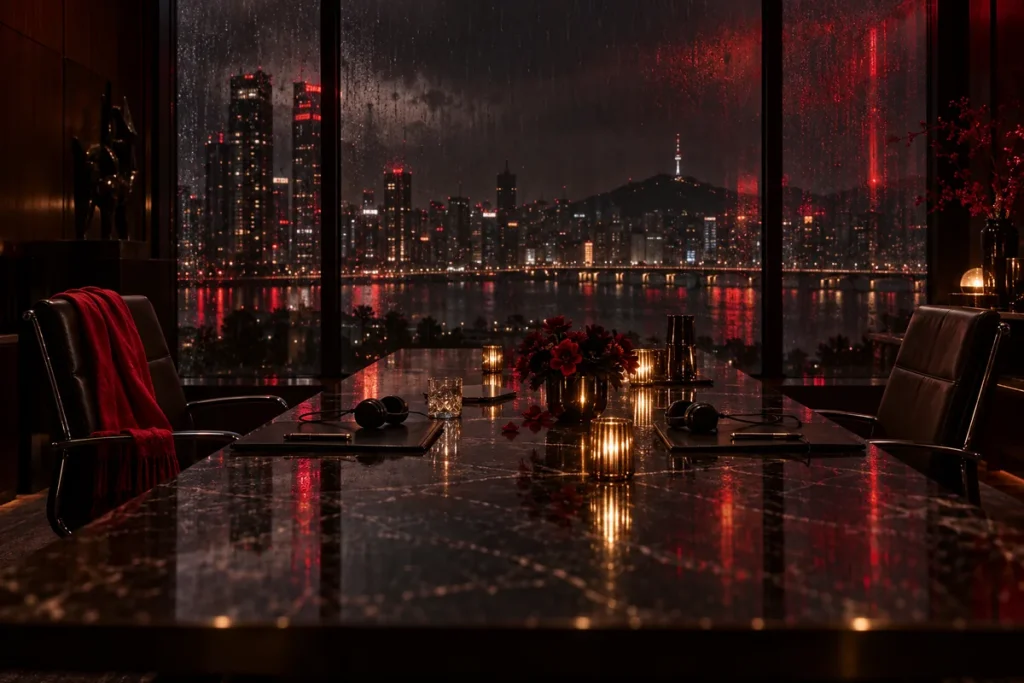
The deal was ships. Twelve LNG carriers, a shipyard in Ulsan, a French energy company, a number with so many zeroes I stopped seeing it. Four days of negotiation. Two teams of men in dark suits across a long table, the Han River grey below the windows. And me, at the end of the table in my black interpreter’s suit with my notebook and my headset, the only woman in the room, the only person who understood everything.
That’s power, if you want to know. Not the money. The understanding. I heard the French lawyers whisper “they’re desperate” to each other behind their hands. I heard our vice-chairman mutter “the Frenchman’s bluffing” in Gyeongsang dialect that he thought nobody from Paris would ever decode. I carried each side’s words across the table with my face perfectly smooth, and kept all the whispers in my body like stones in a pocket.
And Mathieu watched me do it. Grey eyes, a lazy smile, a voice like warm milk with whisky in it. He spoke slowly, more slowly than necessary, and he looked at my mouth while I rendered him into Korean. As if he was waiting to hear how his words sounded in my body.
* * *
The first night, he sent a note to my hotel room. In French, on the hotel’s cream notepaper. Room 3104. I want a private lesson. How do you say “I couldn’t stop looking at you” in Korean?
I should have thrown it away. Interpreters don’t go to negotiators’ rooms. It’s the first rule. It’s the only rule.
I wrote back, under his line, in Hangeul: 당신에게서 눈을 뗄 수가 없었어요. And underneath, in French: Come and hear me say it.
He came to mine. I don’t know why that mattered, but it did.
He stood in the doorway in his shirtsleeves with his tie in his pocket and said, “Say it.” And I said it, in Korean, very quietly, and his face did something I’d never seen a man’s face do across a negotiating table. He closed the door behind him and put his hand flat on my stomach, through the silk of my blouse, and said, “Again.” I said it again. His hand moved. “Again.” Lower. “Again.”
By the fifth time I wasn’t saying it in any language at all.
The window was enormous. The whole of Seoul burned below us, the bridges strung over the black river like necklaces of light, the towers of Gangnam far off and shining. He undressed me against that glass, slowly, button by button, saying the French word for each part of me as he uncovered it, and making me say the Korean. Épaule. 어깨. Nuque. 목덜미. Hanche — I’ll stop the lesson there. Some vocabulary is not for the public.
* * *
Four days. Four nights.
By day I was glass. I sat at the end of the table and turned his words into Korean, flat and perfect, and he never looked at me once, not once, and it was the most erotic thing in the world. I would feel his voice in my headset, in my ears, warm, a breath away, saying “our position on the delivery schedule is firm”, and I would remember the same voice at three in the morning against the back of my neck, saying things that had nothing to do with delivery schedules. And I’d render it into Korean without a single tremor while my thighs pressed together under the table.
By night I was not glass. In his arms in the dark of room 3104 I was the most visible woman in Seoul. He learned me. He learned that I liked to be held from behind at the window, his chin on my shoulder, both of us looking out at the city. He learned the scar on my knee from a bicycle in Daegu when I was nine. He learned that I talk in my sleep, in Korean, and he lay awake and listened, and in the morning he told me what I’d said, in his terrible accent, and I laughed until I cried.
I knew it was dangerous. I didn’t know how dangerous until the fourth night.
* * *
He was lying with his head on my stomach. The city lights on the ceiling. His fingers tracing slow circles on my hip.
“Tomorrow,” he said, “I’m going to say a sentence. Near the end. Notre offre finale.”
“Our final offer.”
“Yes.” He turned his head and kissed my hip. “I’d like you to translate it as something softer. Our current position. That’s all. One sentence. Nobody will ever know. They’ll think there’s still room. They’ll come up. It’s worth — oh, a great deal.” His mouth moved lower. “To me.”
I lay very still and looked at the ceiling.
“You’re asking me to be a fingerprint on the glass,” I said.
“I’m asking you to be mine,” he said, against my skin. “Just for one sentence.”
He didn’t wait for me to answer. He didn’t need to. He was very good at reading a room.
* * *
The last session. The forty-first floor. The Han grey and shining. Twelve men in dark suits and me at the end of the table.
Near the end Mathieu leaned forward. He laid his hands flat on the table and looked, for the first time in four days, straight at me.
“Notre offre finale,” he said, in that voice.
I turned to our chairman. I took a breath, low, from the stomach, the way they teach you.
“Our final offer,” I said, in perfect Korean. Flat. Clean. Glass.
And then — I’d never done it before in eleven years — I leaned close to the chairman’s ear and added, in a low murmur, in the Gyeongsang dialect his own vice-chairman used: “And he asked me last night to tell you it wasn’t. Which means it isn’t. Hold.”
The chairman didn’t move a muscle. He was a very good negotiator. He folded his hands, looked across at Mathieu, and said, “We’ll need to think about that.” I translated it. Perfectly.
Mathieu’s face across the table. I’ll keep that face. It’s the only thing from that week that I took for myself.
They signed two days later. On our terms. Eighty million dollars better than notre offre finale. The chairman sent a bottle of very old whisky to my apartment with no note. He doesn’t remember my face either. That’s fine.
* * *
Here’s the part I’m not proud of.
That last night, after the session, after everything, I went to room 3104.
He opened the door. He didn’t say anything. He looked at me for a long time in the doorway — furious, humiliated, and something else, something that looked, God help us both, like respect. Like hunger.
“You lied,” he said finally.
“I translated,” I said. “Perfectly. Every word you said. I just added a few of my own.”
He laughed then, a short, rough sound, and pulled me in by the front of my black interpreter’s suit and kicked the door shut.
At the window, later, with the city burning below us and his chin on my shoulder, he whispered something in French that I’ve never told anyone. I could translate it. I’m the best there is.
I’ve decided not to. Some words should stay on the other side of the glass.