Bríd from the next house brought the turf herself, in a wheelbarrow, the evening I arrived. Dark, dense sods cut from the bog behind the hill, stacked against the gable like loaves of black bread.
“There’s enough there for a month,” she said. “If you’re staying a month.”
“I don’t know how long I’m staying.”
She looked at me for a long time, the way women out here look at the weather. Then she said, “Don’t let it go out at night, so. And don’t keep it going, either. There’s a balance.” And she wheeled the empty barrow away up the boreen before I could ask her what on earth that meant.
* * *
Cathal’s cottage hadn’t been opened in two years. Not since the October the sea came up over the rocks at Carna and took him and his lobster pots and gave back only the pots.
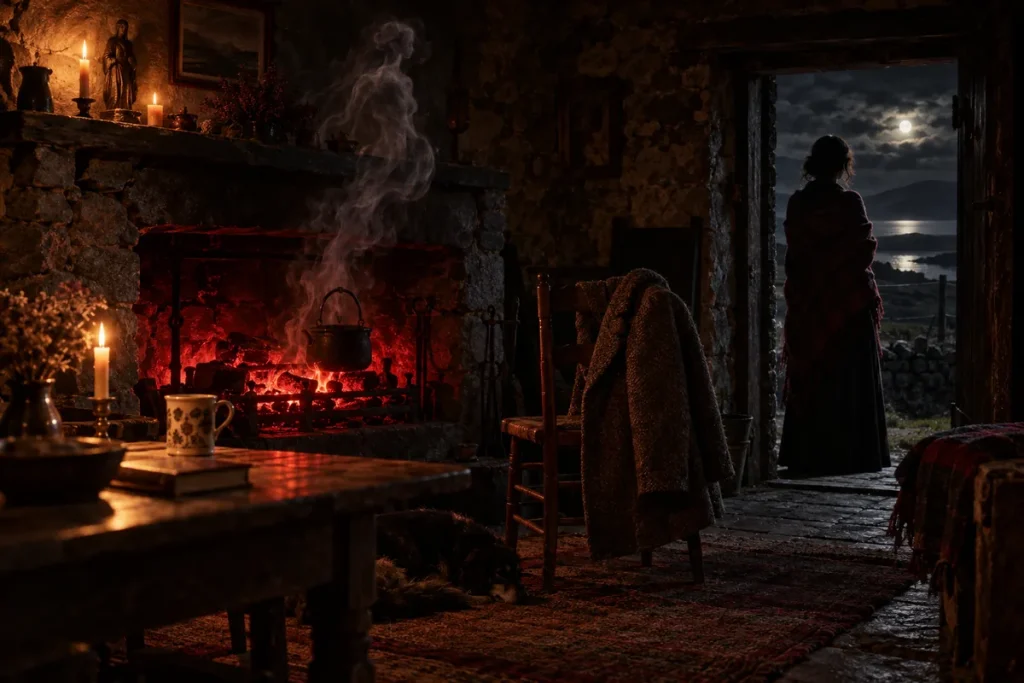
Everything was where he had left it. His big wool jumper on the hook by the door. His boots. A mug with a ring of dried tea at the bottom. His smell, faint, still in the walls — salt and smoke and the oil he used on the boat. I stood in the middle of the kitchen with my bag still on my shoulder and I put my face into the jumper and made a noise I didn’t know I could make.
That night I lit the fire the way he taught me. A twist of newspaper, a few sticks of bog deal, then the sods leaned together like people at a bus stop. It caught slowly. Turf always does. The smoke crept out sweet and heavy and filled the low room, and the light went red and gold on the whitewashed walls, and I sat in his chair with his jumper on, the sleeves down over my hands, and fell asleep.
I woke because the room was warm. Not fire-warm. Body-warm. The kind of warm that comes from someone lying close behind you.
* * *
The second night I felt the chair take his weight. I was sitting on the floor in front of the fire, my back against the seat of the chair, the way I used to sit between his knees while he read. And the wood behind my spine creaked, and the cushion sank, and two knees — I swear to you, two knees — pressed gently on either side of my shoulders.
I didn’t turn round. I knew if I turned round there would be nothing there.
Something touched my hair. Slow, the way he used to, his fingers raking from my forehead back to my neck, over and over, until my scalp tingled and my eyes closed by themselves. The fire hissed. The smoke smelled of the bog and of him. I tilted my head back against the cushion and felt the ghost of his thigh against my cheek, rough wool, warm.
“You came back,” I said.
The fire flared. That was all the answer.
* * *
By the end of the first week I was lighting the fire at four in the afternoon, as soon as the light began to go.
He was more every night. On the fifth night I felt his breath, a warm draught on the side of my neck that smelled of salt. On the sixth night his mouth was on my shoulder, just where the jumper had slipped, and his teeth grazed me the way they used to, gently, a question. My whole body answered before I did. I had not been touched in two years. I had not wanted to be. And now I was arching back in the red light like a cat in front of the fire, pulling the jumper off over my head, and the heat on my bare skin was the fire and it was him and I could not tell where one ended.
On the seventh night he took me to bed. I mean that exactly. I felt him lift me — the old strength in the arms, the boat-hauling arms — and the cold sheets warmed under us as if we had been lying there for hours. His weight came down on me, solid, real, and the whole small room smelled of turf smoke and sea. I said his name into the dark. Then I stopped saying anything at all.
* * *
In the morning I couldn’t get warm.
I stood under the shower until the tank ran cold and I was still cold, a deep cold, the bone kind. My lips in the bathroom mirror were faintly blue. My fingertips had gone white and wrinkled, like hands too long in seawater.
Bríd came with more turf. She stopped in the doorway and looked at me, and then at the fire, still smouldering from the night, and then at the second mug I’d put out on the table without thinking, beside mine.
“Ah, girl,” she said softly.
“I’m fine.”
“You’re not, and you know you’re not.” She put her rough hand on my cheek. It felt like a hot stone. “My mother used to say the drowned are always cold. They’re always looking for a fire. And the warmest fire there is, is a living woman who loves them.” She took her hand away. “He’s not doing it to hurt you. That’s the worst of it. He’s only cold.”
* * *
I am writing this on the twenty-third night.
The turf stack is down to the last few sods. My hands are shaking with cold even here, an arm’s length from the fire. I sleep most of the day now. Outside the window the Atlantic is grey and white and endless, and I watch it the way you’d watch a rival.
And yet. When the light goes and I build the fire, the room fills with him. He is almost solid now. Some nights I see him — not his face, never his face, but the shape of his shoulders against the red glow, the dark curl of hair at the back of his neck, his hands. His hands are warm. His hands are the warmest thing in the world. When he holds me, I stop shivering, and I would give anything, anything at all, to stop shivering.
There’s a balance, Bríd said. Don’t let it go out. Don’t keep it going.
I have three sods left. I could let the fire die tonight, go up the boreen to Bríd’s in the dark, and get the morning bus to Galway and the rest of my life. Or I could put all three on at once and sit in his chair and wait for those hands.
The newspaper’s twisted. The matches are on the hearth.
He’s already here. I can feel his breath on my neck, warm, salt, patient.
I strike the match.