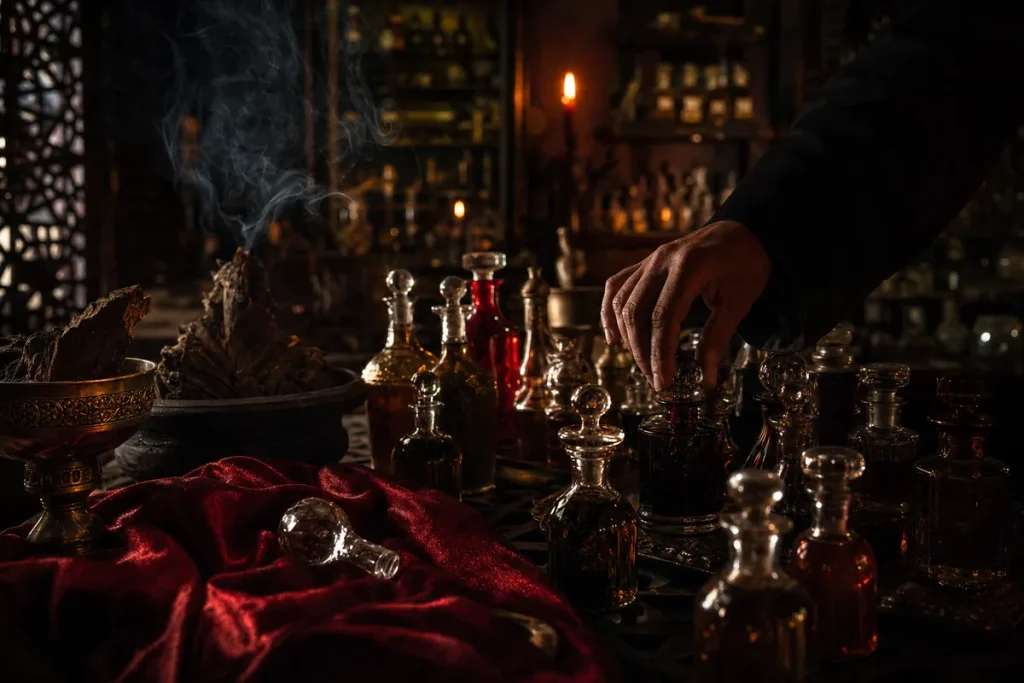
She came into the shop on a Tuesday in February with rain on the shoulders of her coat, and she did not look at the bottles. Everyone looks at the bottles. My father built those shelves in 1974 and lined them with the little ruby and amber flasks he bought from a glassblower in Sarafand, and for fifty years every customer who has come up the steps from Rue Gouraud has stopped in the doorway and looked at them the way you look at a cathedral window.
She looked at me.
“You make things to order,” she said. Not a question.
“Sometimes.”
“I want a man,” she said. “I want the smell of a man. He died in September. I have his shirts but they are going. Every week a little more. I want you to make it so I can keep it.”
Her name was Yasmina. She was perhaps forty. She had a wedding ring she turned with her thumb while she talked, round and round, as though she were winding something.
I should have said no. My father would have said no; he used to say a perfumer who takes the dead as clients ends up working for them. But it was a slow winter, and her voice was low and a little hoarse, and when she took off her wet coat there was a smell under the rain — her own, not his — of iris root and warm skin and something faintly burnt, like a match after it is blown out. I wanted to know what it was. That was my first mistake. I wanted to know.
* * *
She came every Thursday at six. I sat her in my father’s chair by the window and I asked her questions, and I wrote her answers on index cards, and I lined the cards up on the workbench like a man laying out a body.
“Cigarettes?”
“Gitanes. But he’d stopped. Only one, at night, on the balcony.”
“Soap?”
“The green olive soap from Tripoli. Always the same.”
“His work?”
“He restored furniture. Old wood. Varnish, I suppose. Sawdust. Cedar, when he could get it.”
“What did he smell of,” I asked, “when he came close?”
She was quiet for a long time. The rain ran down the window. Across the street the man who sells manakish was pulling down his shutter.
“Warm,” she said finally. “Like bread. Like the inside of his elbow.” And she put two fingers to her own elbow, in the soft crook of it, and I looked away because I could not stop looking.
I built it the way you build anything: a heart of cedar and a little tobacco absolute, the olive soap as a clean green opening, a ghost of benzoin underneath for the varnish. Week by week she smelled the blotters and shook her head or nodded, and week by week I came closer, and I want to tell you honestly that by the fifth Thursday I had it. I had him. It was there on the paper strip, a dead carpenter in a glass tube, and when she breathed it in her eyes closed and her mouth opened very slightly as though she were about to say his name.
And I put the strip down and said, “Not yet. It’s not right yet.”
* * *
I don’t know how to explain what I did next except to say that I am a perfumer and it is the only language I have.
I began to change it.
Not much. A drop at a time. The Gitanes became less Gitanes — I softened the tobacco with a little hay, which is what I smell of in summer, when I walk up to my aunt’s in the mountains. The cedar I kept, but I let a thread of cardamom into it, because I cannot work without a cup of coffee and my hands always smell of it. The olive soap I replaced, so slowly she never noticed, with the Aleppo laurel soap I have used since I was a boy. And the warmth, the inside of the elbow — that I did not have to invent. That I only had to remember to breathe out while she was breathing in.
Every Thursday she said, “Closer.” Every Thursday I said, “Not yet.”
By April she was coming twice a week. By May she had stopped turning the ring. One evening she arrived without an umbrella in a sudden downpour, and I gave her a towel from the back room, and she dried her hair in my father’s chair and laughed at herself, and the towel smelled of me, and she held it against her face for a moment longer than she needed to and then put it down very carefully, as though it had said something rude.
I was jealous of a dead man. I want that written down. I was jealous of a man who restored furniture and smoked one cigarette at night on a balcony I had never seen, and I was taking him apart, molecule by molecule, in front of the woman who loved him, and I could not stop.
* * *
In June I gave her the bottle.
I chose the smallest ruby flask from my father’s shelf and I filled it myself, and I wrapped it in tissue, and when she unwrapped it in the chair by the window I stood behind the workbench with my hands flat on the wood so she would not see them shake.
She put a drop on her wrist. She waited, the way I had taught her to wait, for the alcohol to lift. Then she brought her wrist to her face and breathed in.
For a long time she didn’t say anything. Outside, the street was full of evening: scooters, someone’s radio, the call to prayer from somewhere toward the port mixing with the bells of Saint Nicolas, the way it does here, like two people talking at once and both being right.
“This isn’t him,” she said.
“No.”
“This is —” She stopped. She looked up at me. I had never seen anyone’s face do what hers did then, which was to become frightened and relieved in the same moment, as though she had been falling for a long time and had just seen the ground.
“You did this on purpose,” she said.
“Yes.”
“Every week.”
“Yes.”
She stood. She came round the end of the workbench, slowly, with her wrist still raised, and she held it under my nose the way I had held a hundred blotters under hers, and I breathed in my own skin, my own coffee, my own mountains, on her.
“Then tell me,” she said, very quietly, “what it smells like when it comes close.”
I turned the sign on the door to fermé. I want to be honest about that, too. My hand did not shake at all.
* * *
She still has his shirts. I know because I have seen them, folded in a drawer in her flat in Mar Mikhael, in a cedar box I did not make. Sometimes, late, when she thinks I am asleep, she opens the drawer and puts her face into them, and I lie very still in the dark and breathe as warmly as I can, and wait for her to come back to bed and tell me which of us she smelled.