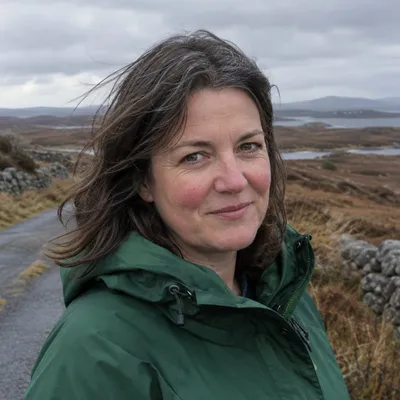
A postwoman steps off the bog road to let a tractor pass. That evening she eats a full dinner, then another, and she is still hungry.
Two breakfast rolls from the Centra in Bangor before half nine. That was the Wednesday. I’m telling you that first so you’ll know I’m not exaggerating about the rest of it, because I’ve never eaten two breakfast rolls in my life. I’m forty-six. I had my gallbladder out in 2019. I eat porridge.
I was on the Cloonagh loop, which is the back end of my route, forty-odd drops spread over eleven miles of bog road where you’d see more hares than people. I know every gate on it. I know which dogs will go for the tyres and which ones only pretend. I know Mrs. Barrett gets her Ireland’s Own on a Thursday and if it’s not there by twelve she rings the depot.
The day before, on the long straight past the old Gallagher house, I came round the bend and there was a tractor coming the other way with a bale trailer on, wide as the road, and nowhere for either of us to go. So I pulled the van in hard onto the verge, and I got out to wave him by, because Mikey Joe Durkan can’t judge a gap to save his life and I wasn’t having him take the mirror off a second time. I stepped back off the road to give him room. Two steps, three. Onto the grass.
It was the green that I remember. This was the middle of November. Everything on that bog is the colour of a wet teabag from October to April. And here was this patch, maybe the size of a kitchen floor, bright as a golf course. Soft too. My boot went into it like it was a mattress. I remember thinking, that’s a spring, that’s a wet spot, and I remember stepping off it quick before it went over the top of my boot.
Mikey Joe went by and lifted one finger off the wheel. I got back in the van. I didn’t give it another thought.
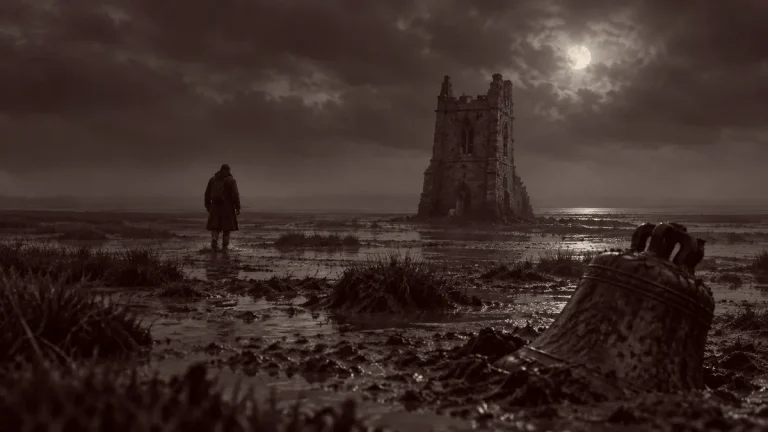
There’s a stone above that patch, by the way, on a bit of a rise. A heritage group from Belmullet put it up in the nineties. It says, in Irish and English, that this is a burial place of the Famine dead, 1847, and that their names are not known. I’d passed it two thousand times. I’m only saying.
* * *
The hunger came that evening.
I’d had my dinner, a proper dinner, the chicken and the spuds and the bit of veg, and I was sitting with the telly on, and I was hungry. Not peckish. Hungry like when you’ve been out all day on a hill with nothing. Hungry so that it hurt in the middle of me. I got up and made toast. Four slices. Ate them standing at the counter. Sat down again. Hungry.
Darragh came in from training at half nine and found me eating cold rice out of the pot with a spoon.
“Mam.”
“I’m starving.”
“You ate,” he said, the way he says things at sixteen, flat, like a referee. “I saw you eat.”
By the Friday I had a bag of food on the passenger seat of the van and I was eating at every gate. Bananas, a sliced pan, those cheese strings that he likes, a whole box of the cheap fig rolls. I’d stop to drop an ESB bill in at the Kilbanes’ and eat a sandwich before I’d put the handbrake on. I went into Mrs. Barrett’s with her magazine and she gave me a slice of brack the way she always does, and I took it, and then I asked her for another one, and she looked at me with her mouth a bit open and gave me the rest of the loaf in a bag.
I’m not proud of the Monday. The Monday I was on the doorstep at the McHales’ with a registered letter that needed signing, and nobody answered, and the back door was open the way it always is out there, and I could see the fridge through the scullery window. I’ll leave it at that. I put a twenty-euro note under the butter dish and I’ve never said a word to them. If Teresa McHale is reading this, it was me.
And the weight fell off me. That’s the part I can’t make you understand unless you’ve seen it. I was eating, I’d say, three times what a grown man would eat, and every morning there was less of me. Half a stone the first week. My uniform trousers were held up with a hair bobbin through the belt loops. My face went. My rings went loose and then they went off altogether and I put them in the egg cup on the windowsill. I looked in the bathroom mirror one morning and I saw my grandmother, who was a tiny bent woman I only knew at the end, and I had to sit down on the side of the bath.
The doctor in Belmullet did bloods. Thyroid, sugar, everything. All clear. She said, “Are you under stress, Mairéad?” and I said I was a single mother with a teenager and a Berlingo with two hundred thousand on the clock and of course I was under stress, and she gave me a leaflet.
* * *
Tommy Gill is the last drop on the Cloonagh loop. A cottage at the end of a boreen so bad I leave the van at the road and walk it. He’s eighty-eight, or ninety, it depends who you ask. Never married. A daughter in Boston, and I don’t know how that works either. He gets a letter from her every month with a Dunkin’ Donuts gift card in it, which he gives to me for my Darragh, because what would he do with it.
He was at the half-door when I came up. He looked at me coming, the whole way, and when I got to him he didn’t take the letter. He took my wrist instead, and turned it over, and looked at how the bone stood out.
“Where were you walking?” he said.
“Nowhere. My route.”
“You were off the road somewhere. Below at the Gallaghers’, was it? Under the stone?”
I told him about the tractor. He let go of my wrist and nodded, slowly, the way you’d nod at a forecast.
“That’s the hungry grass, girl,” he said. “Féar gortach. You walked on it.”
I laughed. I did. I’d heard of it the way you hear of the banshee, from my own Nana, sitting at the range. The grass that grows over the Famine dead that were put in the ground with no priest and no prayer, and if you walk on it you get their hunger. You’ll eat and you’ll eat and you’ll never be full, because it’s not your hunger you’re feeding.
He didn’t laugh.
“They went into that ground in their hundreds and nobody fed them going,” he said. “And it’s not fed yet.”
“What do I do?”
“You carry bread. A crust in your pocket, always, my mother said, going across any bog. And you go back and you leave bread on it. Give it what it wants.”
“And that’s it? It goes?”
He looked at me a long time, and then past me, down the boreen to where the van was.
“It goes,” he said.
* * *
I went back that evening with a full sliced pan and a pound of Kerrygold, because I didn’t know what it would want and it seemed mean to leave the bread dry. I parked where I’d parked for Mikey Joe. It was dark by half five. I stood on the road with my phone torch and I could see the patch, even in the dark, that same unholy green. I didn’t step on it. I threw the bread onto it from the road, slice by slice, like you’d feed ducks, and I unwrapped the butter and put it on the grass at the edge, and I said a Hail Mary because I didn’t know what else to say. And then, God forgive me, I said, “Now, lads.” Like they were a crowd of young lads at the end of a party.
On the way home I realised I hadn’t eaten anything in the car.
I slept that night. Ten hours. I woke up and I wasn’t hungry, and I ate a slice of toast and left the crust. I could have cried. I did cry, a bit, in the shower.
Darragh was at the table when I came down. He’d the cereal box in front of him, the big one, the Aldi own-brand cornflakes that does us two weeks. It was empty. He was eating the dust out of the bottom of it with his fingers.
“Is there any more bread?” he said.
* * *
I’ll be quick about the next part.
It was eleven days. He ate everything. He ate what was in the fridge and the presses and the chest freezer in the shed, half of it still frozen. He got up in the night and I’d hear the microwave go at three and four in the morning. He ate the dog’s food. He stopped going to school, then he stopped going to training, which he’d never in his life missed, and he sat in the kitchen in his hoodie with his knees up eating, and the hoodie got bigger on him every day, and his face got sharp and old, and he cried, my big lad, because he couldn’t stop and he didn’t know why.
I didn’t tell him. What would I tell him? Your mam walked on a grave and then she gave it to you?
I went back up to Tommy Gill on the Saturday. Not on my route. In my own car.
“You knew,” I said.
He was at the range. He didn’t turn round.
“It doesn’t go,” he said. “Bread won’t put it out. Nothing will put it out. You can only move it on. It goes to the next one that’s hungry for you.”
I asked him how he knew that and he told me. He told me about his brother, Paddy, in 1951. Who’d walked across the same corner of bog after a sheep. And their mother, who’d carried bread out to the grass, God help her, to save Paddy. And about the next thing that happened, which was Tommy himself, nine years of age, eating the bark off the ash tree in the yard. And what their mother did then. Which was the thing he wouldn’t tell me, except that she went out to the stone in the snow with a basket and she didn’t come back, and the hunger was gone off him the next morning and they found her in the spring.
“She fed them,” he said. “She sat down with them and fed them.”
He gave me a Dunkin’ Donuts card for Darragh. I took it. I didn’t know what else to do with my hands.
* * *
So I’m in the car now. It’s a Sunday evening, and it’s lashing, and the wipers on this thing never did the passenger side right.
I went to the big Tesco in Castlebar. Two trolleys. I filled the boot and the back seat and the footwell. Bread, mostly. Every kind they had. Brown, white, soda, the fancy sourdough at four euro a go, a dozen packets of rolls. Ham. Tins of beans, which I’ll need the opener for, and I’ve the opener. Butter. A whole cooked chicken, still warm, the bag steaming up the back window. Apples. Porridge, God knows why, habit. Fig rolls for myself.
I left a note for Darragh on the table under the egg cup with my rings in it. It says I’m gone to his Auntie Bríd’s in Westport for a few days, there’s money in the drawer, and his dinner’s in the oven. A lasagne. A big one. He’ll have had it by now, all of it, and I’d like to think he’ll have pushed the plate away at the end. I’d like to think he’ll have left the corner.
The stone’s coming up now on the rise. I can see the green of the grass in my headlights through the rain, brighter than anything on God’s earth.
I’ve the flask and the good blanket and my Nana’s rosary. The engine’s off. I’ll carry it all down in a few trips, so as not to waste it.
There’s a lot of them. They’ve been waiting a long time. I’ll want to start with the chicken while it’s warm.