Content note Mentions grief and the death of a spouse.
The charity shop van was coming on Thursday, and on Wednesday night Ruth still had not opened the wardrobe.
She had promised her daughter. She had promised herself, too, in the way you promise yourself things at three in the morning, when the bed is too big and the house makes noises it never made before. Eight months, she’d said. Eight months is enough. People will start to think it’s strange.
“Nobody thinks it’s strange, Mum,” Clare had said on the phone. “Take as long as you need. But I think you should do it. I think it might help.”
So on Wednesday night, after the news and a cup of tea she didn’t want, Ruth went upstairs, stood in front of the old oak wardrobe Frank had carried up the stairs on his back in 1979, swearing the whole way, and opened the doors.
The smell hit her first. She had not been prepared for that. Wool and cedar and the faint soap he had used for forty years, and underneath, something that was simply him — something no shop could sell and no word could describe. She sat down on the edge of the bed very suddenly, because her knees had decided for her.
His shirts hung in a row, blue and white and that one dreadful mustard one he insisted was a classic. His good suit, worn to every wedding and every funeral, the elbows shiny. His gardening trousers, still with soil in the turn-ups. On the shelf above, his hats, stacked like a small tower of personalities: the tweed cap, the summer hat, the ridiculous bobble hat their grandson had knitted him in a terrible shade of orange, which Frank had worn to the shops every winter with enormous pride.
Ruth began slowly. She took down the shirts one by one, folded them, laid them in the cardboard boxes Clare had left. It was easier than she’d feared and harder than she’d hoped. Each shirt came with a moment attached, like a label. The blue one: a Sunday in Galway, rain, chips in the car. The white one: their daughter’s graduation. The mustard one she held up to the light and laughed out loud, alone in the bedroom, and then cried, and then laughed again, and then put it in the box with a firmness that surprised her.
The suit went in. The trousers went in, soil and all. She kept the bobble hat. That was not even a decision.
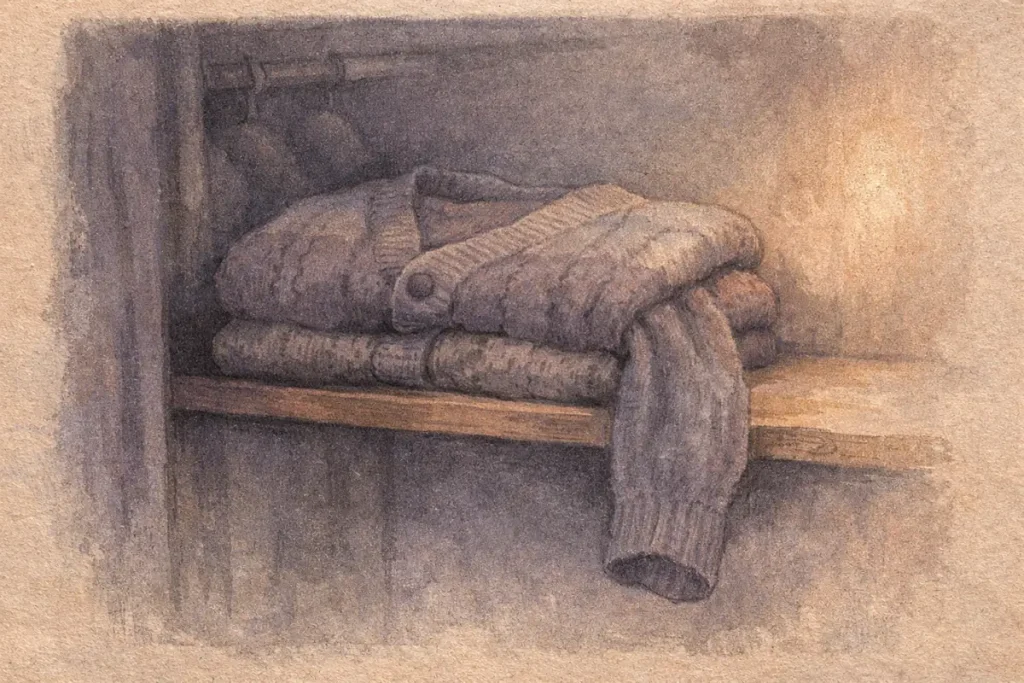
And then, at the bottom of the wardrobe, folded in the corner where he always threw it, she found the sweater.
It was grey. It was old. It was, frankly, a disgrace. She had bought it for him the first Christmas they were married, when they were living in a damp flat above a butcher’s shop and money was so tight they’d split one orange for dessert. It had been a good sweater then — thick, warm, a little too big. Over forty-odd years it had been worn to death and brought back again more times than she could count. There were holes at both elbows that she had darned, badly, in three different colours of wool. One cuff had unravelled and been tucked in. There was a paint stain on the front from when he’d done the kitchen in 1994 and a faint shadow on the shoulder where their grandson, as a baby, had been sick on him at a christening.
She had begged him for years to throw it out. “You look like a tramp,” she’d say. “People will think I don’t feed you.”
“It’s my thinking sweater,” he’d say, every time, and put it on anyway.
Ruth held it in her lap for a long time. Then, without quite deciding to, she lifted it to her face.
It still smelled of him. More than anything else in the wardrobe. More than the shirts, more than the pillow she’d stopped washing in March. It was as if the sweater had been keeping him, quietly, in the corner where nobody looked, waiting for her to be ready.
She did not put it in the box.
She sat on the bed with it in her lap until the streetlight came on outside. She thought about the flat above the butcher’s, the split orange, the way he’d unwrapped the sweater that first Christmas and put it on immediately, over his pyjamas, and danced around the tiny kitchen in it to impress her. She thought about the hospital, at the end, when he’d been so cold, and she’d brought the sweater from home and tucked it round his shoulders, and he’d opened his eyes and said, “There she is,” and she had never been sure whether he meant her or the sweater.
On Thursday morning the van came. Two young men carried the boxes down the stairs, cheerful, careful, calling her “love.” She stood at the door and watched them go — the shirts, the suit, the gardening trousers, the mustard disaster — and she was surprised to find that it felt less like losing him and more like letting parts of him go out into the world, to keep other people warm.
When Clare rang that evening, Ruth told her it was done.
“All of it?” Clare asked gently.
“Nearly,” said Ruth.
She was wearing the sweater as she said it. It came down almost to her knees. The elbows were scratchy where she had darned them. It was, without question, the ugliest thing she had ever owned.
That winter she wore it every evening, in the armchair by the window, doing the crossword he used to finish for her. She found she could think better in it. She could remember the answers.
It was, after all, his thinking sweater. Now it was hers.