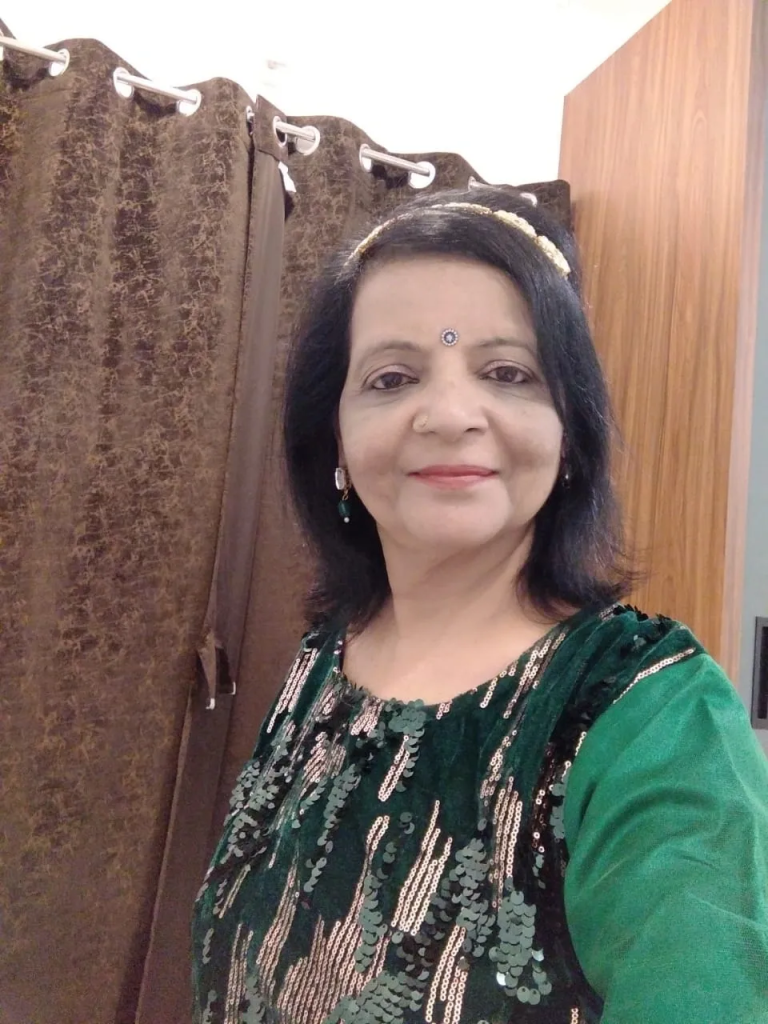
(Vadodara Gujarat)
The Poetic Land honours Bienu Varma Vaghela from Maharashtra as the Second Prize Winner of Season 2 for her powerful patriotic poem “संगम” (Sangam). Her poem is not only about the nation as land, but about the nation as a living harmony of cultures, faiths, arts, and voices.
The poet provides unity as the central theme of her poem:
“दो जिस्म मगर, इक जान हैं हम”
(Two bodies, but one soul). In this line, India represents many different bodies where each person is a body with a soul connected to the other bodies. The poet expresses that diversity is not to be viewed as division; it is to be seen as the air that all people share.
The poet paints India as a sacred meeting place of nature,
“उत्तर में ताज हिमालय का / और दक्षिण में साज़ समुन्दर का”
Although the North is represented by the mountains of the Himalayas and the South is represented by the rhythm of the ocean; the North represents strength, the South represents silence; both the North and the South are representative of the Earth, not necessarily of geographical features.
The description of religious harmony is perhaps the most beautiful part of the Book and highlights the importance of unity between different religions.
“मंदिर के मन्त्रों में, और मस्जिद की अज़ान में, गुरूद्वारे की गुरबाणी में…” Through these lines, the poem teaches that prayer changes its language, but not its human meaning. Faith becomes a bridge, not a wall.
Festivals, food, dialects, and regions differ, yet she writes:
“लेकिन जुड़े हैं सबके सुर और ताल यहाँ” This is the heart of the poem: many rhythms, one music.
Her celebration of Indian art and dance—
“भंगड़ा, गरबा, लावणी, कत्थक, कथकली” —shows culture as a shared inheritance, not a competition.
In the final movement, the poem rises toward global vision and responsibility, declaring:
“वसुधेव कुटुम्बकम शोभायमान यहाँ” The world as one family.
The Sangam , which is a work written by Bienu Varma Vaghela doesn’t scream nationalism, it sings it, quietly; far and dignified. It reminds the audience that a nation does not live on power alone, but through memory, through respect for and togetherness with, all humans.
“TLP recognize a second prize for the author, recognizing a unifying form of poetry without eliminating all differences between people or nations, and those who write poetry are those who listen to others before saying anything.”