Content note Mentions a parent's alcoholism and domestic abuse (non-graphic).
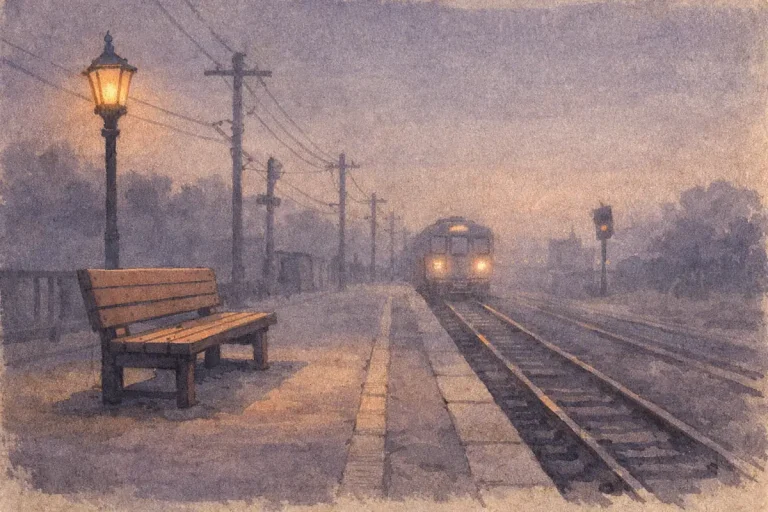
Every Sunday at four o’clock, Anirban takes the 12B bus across the river to his father’s flat, and every Sunday, for the first ten minutes, neither of them knows what to say.
It has been like this for eight months. Before that, they hadn’t spoken for eleven years.
His father lives on the second floor of an old building with a cracked courtyard and a mango tree that drops fruit on the parked scooters every summer. The flat is small: one room, a kitchen the size of a cupboard, a balcony with two plastic chairs. It is very clean. That is the first thing Anirban noticed, eight months ago, standing in the doorway with his heart hammering. The flat was clean. The bottles were gone. There was a calendar on the wall with small crosses on it, hundreds of them, one for every day.
“Three years, two months,” his father had said, following his gaze. And then, as if apologising: “They give you a coin at the meetings. I keep it in the drawer.”
Anirban grew up in a different flat, a bigger one, across the city. He grew up learning to read the sound of his father’s key in the door — whether it found the lock first time, or scraped around it, or dropped on the floor. He learned to read the silence at the dinner table, which kinds were safe and which kinds came before the shouting. He learned to do his homework in the bathroom with the door locked and the tap running. He learned to tell teachers that his mother’s bruised wrist was from a fall in the kitchen, and that his father missed the school concert because of work.
He learned, most of all, to be very quiet and very good, so that nothing would ever be his fault.
When he was nineteen, his mother finally left, and he went with her, and he did not look back. He did not answer the letters that came, every few months, in his father’s shaky handwriting. He did not go to the hospital the first time his father was admitted, or the second. He built a life — a degree, a job in software, a wife, Priya, who knew the outline of the story but not the details, because Anirban did not tell the details to anyone. He was good at not telling things. He had been trained by an expert.
Then, last year, his mother died. At the funeral, at the back of the hall, a thin grey man stood alone with his hands clasped in front of him, and did not come forward, and left before the end.
A week later, a letter arrived. It didn’t ask for anything. It said: I am sorry for everything. I don’t expect you to forgive me. I have been sober for three years. I would like to see you once, if you ever want to. If you don’t, I understand. At the bottom was an address across the river.
It was Priya who said, gently, “You don’t have to forgive him to go and look at him.”
So he went.
The first Sunday, they sat on the balcony in the plastic chairs and drank tea and talked about the mango tree for forty minutes. The second Sunday, they talked about cricket. The third Sunday, his father said, out of nowhere, staring at the courtyard, “I remember the concert. The one at your school. You were playing the harmonium. I was in a bar two streets away. I could hear it from there.” He did not look at Anirban. “I’ve thought about that every day for twenty years.”
Anirban had put down his tea and walked out, and caught the 12B home, and not gone back for three weeks.
But he did go back.
That is the thing he cannot fully explain, even to Priya, even to himself. He does not go out of love, exactly — or not the uncomplicated kind. He doesn’t go because he has forgiven his father. Most days he isn’t sure that he has, or that he will, or that he needs to. He goes because there is a boy inside him who did his homework in the bathroom with the tap running, and that boy has questions, and the only person who can answer them lives on the second floor of a building with a mango tree.
Some Sundays, the answers come. His father tells him about his own father, who drank too, and about the first drink he ever had, at fourteen, at a wedding, and how it felt like being let out of a cage. He tells him about the meetings — the community hall with bad coffee, the retired bus driver who is his sponsor, the people who stand up and say their names and the worst things they ever did, out loud, every week. “You’d be surprised,” his father says, “how much lighter you feel after you’ve said the worst thing out loud. Even when nothing changes.”
Some Sundays, the answers don’t come, and they just sit on the balcony, two men with the same nose and the same way of holding a teacup, and watch the mangoes fall.
Last Sunday, his father made fish curry. It was Anirban’s mother’s recipe, and it was not quite right — too much mustard, not enough salt — and Anirban told him so, and his father laughed, a real laugh, and said, “She always said I’d ruin it.”
Then, while they were washing the plates in the tiny kitchen, side by side, his father said, very quietly, “Do you think you’ll ever bring Priya?”
Anirban dried a plate. He took a long time over it.
“Maybe,” he said. “Not yet. Maybe.”
His father nodded and kept washing. “Maybe is good,” he said. “Maybe is more than I had.”
On the bus home, crossing the river in the late light, Anirban took out his phone and looked at a photograph Priya had sent him that morning: a scan, grey and grainy, a small curved shape in a dark sea. Their first. Due in the spring.
He thought about his father’s calendar, the hundreds of small crosses. He thought about the boy with the tap running. He thought about what kind of sound his own key would make, someday, in his own door, and how he already knew — had always known — exactly what kind of father he wanted to be.
Maybe, he thought, he would bring Priya at Christmas. Maybe, one day, the baby.
Maybe was more than he’d had, too.