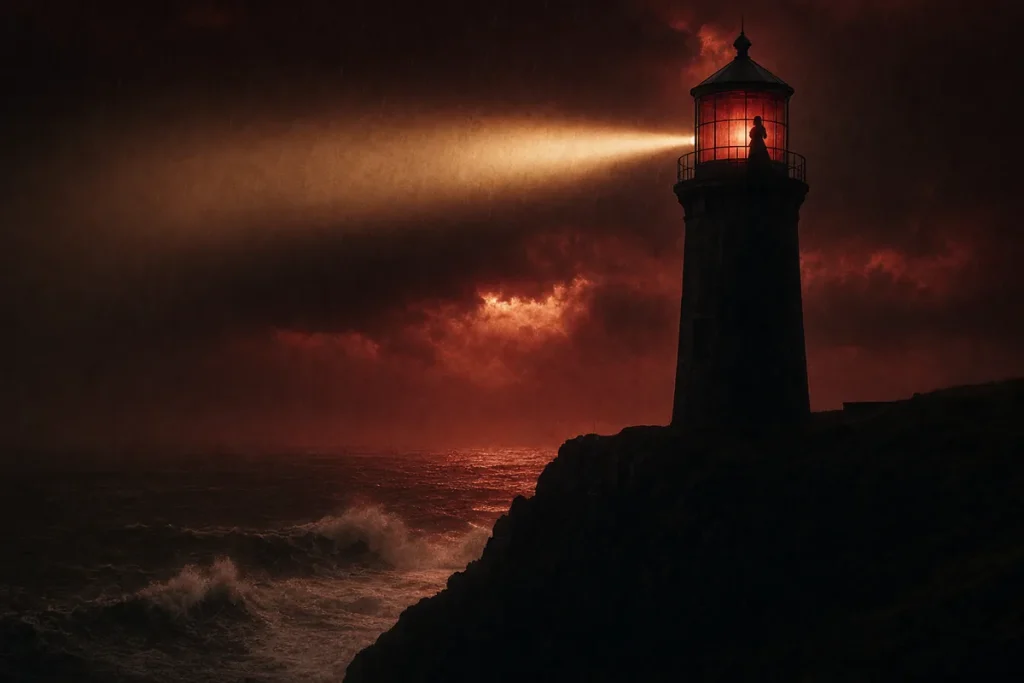
There are ninety-six steps from the kitchen of the keeper’s cottage on Ynys Garreg to the lantern room, and in my first winter on the rock I counted every one of them twice a night, up with the tea and down with the empty cup. Ifor liked his tea at ten and at two. He liked it black, and he liked it brought, and he liked to say diolch, cariad without looking round from the lens, as though I were the weather.
I was twenty-three. He was forty-one and had kept lights for the Trinity House for nineteen years, the last six of them on Ynys Garreg, which is a fist of black stone four miles off the Pembrokeshire coast with a white tower on top and nothing else at all. Not a tree. Not a cow. Gulls, and the wind, and the bell buoy on the reef saying the same word over and over like a woman at a graveside.
My mother said I had done well. A keeper’s wage, a house with no rent, a man who did not drink. All true. I want to be fair to Ifor, even now. He never raised his hand to me. He never raised his voice. He simply did not see me, the way you stop seeing a clock.
* * *
Daniel Marr came out with the supply boat at the end of March, 1897, to be assistant keeper. He was from Bristol, which on Ynys Garreg was like being from the moon, and he was twenty-six, and the first thing he did when he climbed up the landing steps with his sea chest on his shoulder was to stop, and look at me standing in the cottage door with flour on my hands, and take off his cap.
That was all. A cap. You would not think a thing like that could undo a person.
He took the middle watch, midnight to four, so Ifor could sleep. Which meant that the two o’clock tea became Daniel’s tea. Which meant that twice a night, then only once, then — because there was no one on the rock to say I must not — once and then again a little later, I climbed the ninety-six steps to a man who turned round from the lens when he heard my foot on the iron.
We talked. I want that understood: for months we only talked. He told me about the docks at Bristol and the music halls and his sister who had married a baker in Clifton. I told him the names of the birds. He did not know a single one. He said gull for everything with wings, and I laughed at him, and the light went round above our heads, white, white, white, every fifteen seconds, and threw our shadows out across the dark sea like two nets that never came back with anything.
In June he asked me what I had wanted to be, before. Nobody had ever asked me that. I didn’t have an answer and I cried, there on the gallery with the wind pulling at my hair, and he did not touch me. He stood beside me with his hands behind his back like a man in church and waited until I had finished.
I think that was the night. Not the night of the storm, though that was the night it happened. The night he kept his hands behind his back.
* * *
In the log book that Ifor kept, in his small careful hand, every night of that year has the same last line. Light exhibited sunset to sunrise. All well. I have read it since. I have read every page.
The storm came in October. A south-westerly that the glass had not warned of, and the sea came over the landing stage and took the boat-house door off its hinges and threw it up against the tower like a playing card. Ifor was below, with a fever he had been carrying for three days and would not admit to. I made him a poultice and he turned his face to the wall. At midnight I took the tea up.
Daniel was at the lens with a cloth, wiping the salt spray off the outer glass from inside where the mist kept forming. He did not turn round. I put the cup down. The tower shook — it did that in a big sea, a kind of shudder in the stone you felt in your teeth — and the light went round, and round, and in the glass of the lantern I saw his face and my face side by side, small and gold and far away, like people in a locket.
“Elin,” he said, to the glass.
That was the first time he had used my name.
I will not tell you the rest. It isn’t yours. I will tell you that the light did not go out. That I watched it go round above us all that night, every fifteen seconds, white, white, white, and that I let it count for me, because I could not have counted anything myself.
* * *
In the morning the wind had dropped and the sea was grey and flat and ashamed of itself. I went down the ninety-six steps and made the porridge. Ifor came to the table, pale, wrapped in his coat, and ate it without speaking, and when he had finished he wiped his mouth and said, “Supply boat will be late. Two weeks, perhaps three. They’ll not come out after a blow like that.”
Then he said, “I’ve written to the Board. Mr Marr is to have a transfer to the Smalls. They need a man there. It’s a good post for a young fellow.”
He said it to the porridge bowl. He said it in his ordinary voice. And then he got up and went to bed, and slept for fourteen hours, and the fever broke.
Three weeks. Have you ever lived three weeks on a rock with two men and a secret, and the secret is not a secret, and nobody says so? Daniel kept his watches. I took up the tea at ten and at two. Ifor said diolch, cariad without turning round. In the evenings the three of us ate together and talked about the weather, and once Ifor laughed at something Daniel said about a gull, a real laugh, and I had to go outside and stand in the wind until my face was mine again.
When the boat came, Daniel shook Ifor’s hand on the landing stage. He shook mine. He said, “Mrs Pryce.” He did not take off his cap.
I watched the boat until it was a speck, and then until it was not.
* * *
That was a long time ago. I am old now, and Ifor has been in the churchyard at St Davids for longer than I was married to him. They automated the light on Ynys Garreg years back; there’s no keeper there now, only the machine and the gulls.
When they cleared the cottage they sent me Ifor’s log books, because there was no one else to send them to. I read the night of the storm. Wind SW, whole gale, heavy sea. Boat-house door carried away. Keeper unwell. Light exhibited sunset to sunrise. All well.
But the ink is different on that last line. Darker. As if he wrote it later, in the morning, after he had sat for a long time with the pen in his hand deciding what was true.
All well. He gave me that. I have never known whether it was mercy or a sentence, and I have had fifty years to decide.
Some nights I still wake at two, and my feet are cold, and I could swear I am on the iron stairs with a cup in my hand, ninety-six steps, going up toward a man who will turn round.